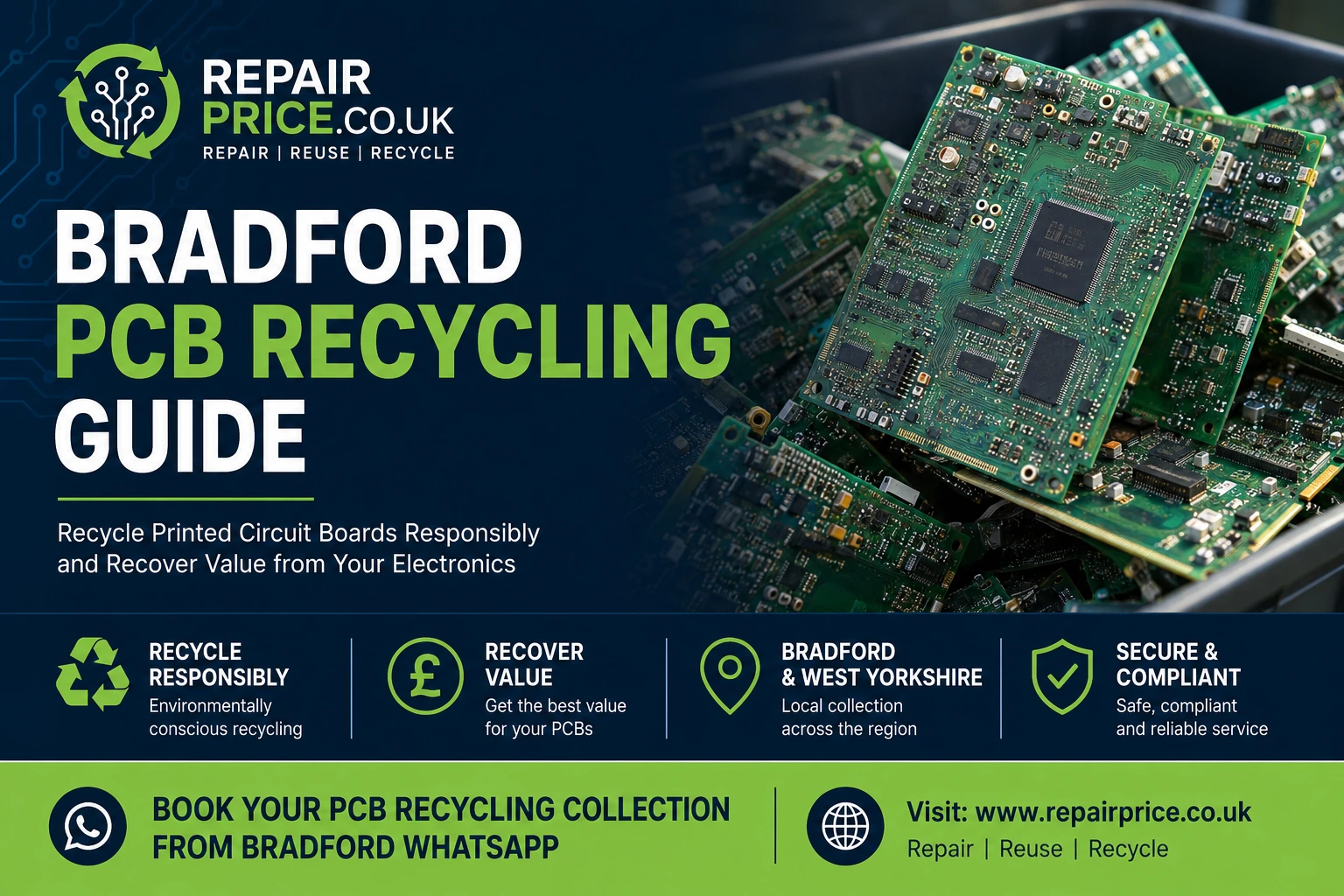
Printed circuit boards are found inside almost every modern electronic device, from computers and networking equipment to industrial electronics, telecoms hardware, servers and mobile devices. When equipment becomes obsolete or uneconomical to repair, the PCB inside it can still contain recoverable materials and components with recycling value. This Bradford PCB recycling guide explains how businesses, repair shops, IT departments, technicians and individuals can identify recyclable circuit boards, separate higher-value material and arrange responsible recycling rather than allowing electronic waste to build up in storage.
If you have printed circuit boards ready for recycling, the quickest place to start is our dedicated PCB recycling service for Bradford customers. This service is designed for people with loose PCBs, dismantled electronics, computer boards and mixed electronic circuit boards who want to understand their recycling options and obtain a quote.
PCB recycling is the process of recovering reusable and recyclable material from printed circuit boards after electronic equipment reaches the end of its useful life. Instead of treating a circuit board as ordinary rubbish, specialist recycling channels can separate boards according to their type, component density, application and potential recoverable material content.
A typical printed circuit board contains a combination of fibreglass substrate, copper tracks, solder, connectors, integrated circuits, processors and other electronic components. The composition varies enormously between products. A small low-grade board from a simple consumer device can be very different from a densely populated telecoms, industrial or computer board.
That difference is important because PCB recycling value is not determined simply by weight. Board type, component density, connectors, processor content, precious-metal-bearing components and contamination can all affect how material is classified. Separating different board categories before requesting a quote can therefore make the recycling process considerably easier.
Electronic equipment is frequently replaced before every component inside it has lost all potential value. Computers may become too slow for commercial use, servers may be decommissioned during infrastructure upgrades and repair businesses may accumulate boards removed from damaged devices. Although the complete equipment may no longer be useful, the internal PCB can remain suitable for specialist recycling.
Recycling also provides an alternative to keeping boxes of obsolete electronics indefinitely. Repair workshops, warehouses, offices, schools, engineering companies and IT departments can gradually accumulate redundant boards that consume valuable storage space. Sorting and recycling these materials can help organisations clear unwanted stock while directing electronic material into a more appropriate recovery route.
For broader electronic recycling requirements, our Bradford circuit board recovery service covers additional types of circuit board material, while the general Bradford electronics recycling service is useful when your load contains complete electronics as well as individual boards.
Many different printed circuit boards may be suitable for recycling. Common examples include computer motherboards, graphics cards, telecoms boards, control boards, network equipment boards, server cards, industrial control PCBs, peripheral boards, expansion cards, power-management boards, mobile-device boards and circuit boards removed from redundant electronic equipment.
It is usually better to keep clearly different categories separate. Mixing high-density computer boards with basic power boards, heavily contaminated electronics or complete appliances may make assessment more difficult. If you are dismantling equipment specifically for recycling, using labelled boxes or containers for each board category can help simplify both identification and quotation.
Desktop and workstation motherboards are one of the most recognisable categories of recyclable PCB. They often contain multiple integrated circuits, connectors, sockets and other components concentrated across a relatively large board. Age, architecture and component configuration can affect how a motherboard is classified.
If most of your material consists of computer mainboards rather than mixed PCB, visit our Bradford motherboard recycling and recovery page. Keeping motherboards together can make it easier to assess a larger batch without mixing them with lower-density electronics.
Processors should generally be separated from ordinary printed circuit boards where possible. CPUs can differ significantly according to package type, generation, manufacturer and construction. Ceramic processors, older pin-based chips and newer processor packages may be assessed differently from the motherboard they were removed from.
For processor-specific material, our Bradford CPU recycling service for obsolete processors explains the dedicated recycling route for CPUs and related processor components.
RAM modules are another category worth separating before recycling a mixed batch of computer electronics. Memory sticks contain their own printed circuit boards and integrated memory chips, but they are normally easier to identify and grade when kept separately from motherboards, processors and general mixed PCB.
If you have removed large quantities of memory during computer refurbishment, upgrades or IT decommissioning, see our Bradford RAM module recycling information for a more focused route.
Mobile phone boards are typically smaller than computer motherboards but can contain densely packed components. They should normally be separated from casings, batteries, screens, charging assemblies and other mobile-phone parts before being treated as a dedicated board category.
Repair shops that regularly strip damaged smartphones can use our Bradford mobile circuit board recycling service to find information specifically relating to boards removed from smartphones and similar handheld electronics.
There is no single universal value that applies to every printed circuit board. PCB recycling prices can depend on the precise material being supplied and the quantity available. This is one reason photographs and a clear description can be useful before material is transported or collected.
Factors that may influence PCB classification include the type of equipment the board came from, its component density, the number and type of integrated circuits, processor or memory content, connector composition, overall cleanliness, whether major components have already been removed and whether the load contains non-PCB material.
A clean, sorted batch is generally easier to assess than several boxes containing circuit boards mixed with steel cases, cables, plastic housings, batteries and miscellaneous scrap. Businesses generating regular quantities of electronic waste can save time by creating a simple internal separation process before the equipment leaves the workbench or dismantling area.
Whether components should be removed depends on what they are and how your material will be recycled. Easily identifiable categories such as CPUs and RAM can often be separated because they have their own recycling routes. Removing random small components from every board, however, may not necessarily improve the overall recycling outcome.
The most practical approach is usually to separate recognisable higher-value categories while leaving the remainder of the board intact unless you already have a specific dismantling process. If you are uncertain, send details of the material before spending significant time manually stripping boards.
Preparation does not need to be complicated. Start by removing obvious batteries and keeping them away from ordinary PCB material. Separate complete devices from loose boards, and create individual groups for computer motherboards, RAM, CPUs, mobile boards and general mixed PCBs wherever practical.
Boards can then be stored in sturdy boxes or suitable containers. Avoid allowing PCBs to become wet or contaminated with oils, chemicals or general rubbish. If you have several categories, label each container clearly. This makes it easier to communicate what is available and reduces confusion when quantities are assessed.
For larger commercial quantities, provide an approximate weight, number of containers and several clear photographs. Include information about where the boards came from where known, such as desktops, servers, network equipment, smartphones, industrial equipment or telecoms hardware.
Computer and electronics repair businesses can generate PCB waste continuously. Faulty motherboards, liquid-damaged boards, failed graphics cards, unusable laptop boards, damaged mobile boards and components removed during parts harvesting can all accumulate behind the workshop.
A practical repair-and-recycling workflow can help separate devices that still deserve repair from parts that are better reused and boards that have reached the end of their usable life. This reduces waste while making better use of recoverable components before final recycling.
Recycling should normally be considered after realistic repair and reuse possibilities have been assessed. A working board can often provide more practical value as a reusable component than as recycling material. Likewise, a device that can be economically repaired may remain in service rather than entering the waste stream prematurely.
For repair shops and IT recyclers, the ideal process is often a hierarchy: test first, reuse working equipment or parts where practical, recover useful components from non-repairable devices, and recycle the remaining electronic boards responsibly.
This approach is especially useful when dealing with mixed stock because not every board should automatically be treated the same way. A working replacement motherboard, specialist industrial board or usable expansion card may have reuse potential, while damaged or obsolete boards may be much more appropriate for recycling.
Business technology upgrades can produce large quantities of redundant equipment at once. Desktop replacements, server refreshes, office closures and network upgrades may generate motherboards, expansion cards, RAID controllers, network cards, RAM, CPUs and other PCB material.
Rather than mixing every component into a single load, an IT department or recycler can separate obvious board categories during asset dismantling. This is particularly worthwhile when equipment is already being opened for storage drives, memory or other reusable components to be removed.
Educational organisations can also accumulate obsolete computers, classroom electronics, networking hardware and laboratory equipment. Storage rooms sometimes contain devices that have remained unused through several upgrade cycles because nobody has implemented a clear recycling process.
Separating reusable equipment from obsolete electronics and then identifying recyclable circuit boards can help create a structured clearance route. Larger organisations may benefit from cataloguing equipment before dismantling so that reusable devices are not accidentally recycled.
PCB recycling requirements extend beyond Bradford itself, and businesses throughout West Yorkshire may produce similar electronic material. If your equipment is located outside Bradford, there are dedicated local pages covering nearby areas.
Customers to the west of Bradford can explore PCB recycling options available around Halifax, while businesses closer to Kirklees can use our printed circuit board recycling service in Heckmondwike.
For customers north of Bradford, the Shipley PCB recycling service for electronic boards provides a more locally focused route. Businesses closer to Leeds can also visit our Pudsey printed circuit board recycling page for local information.
One common mistake is treating all electronic scrap as one category. A container holding PCBs, steel cases, power supplies, cables, batteries and plastic parts may be considerably harder to classify than material that has already been separated into sensible groups.
Another mistake is dismantling valuable board categories without knowing whether the extra labour is worthwhile. Removing every chip, socket and connector manually can consume substantial time. Separating obvious categories such as CPUs, RAM and mobile boards is often more practical than completely stripping each board.
Businesses should also avoid mixing batteries with loose circuit boards. Batteries require appropriate handling and should be kept separate from general PCB material. The same applies to liquids, chemical contamination and unrelated waste.
A useful enquiry should describe what the boards came from, the approximate quantity available and whether they have already been sorted. Photographs are particularly useful because they allow the general PCB type and level of component density to be understood more quickly.
For larger loads, include an approximate weight or number of boxes. If your stock contains several categories, mention them separately rather than describing everything simply as electronic scrap. For example, you might have computer motherboards, mixed expansion cards, RAM, processors and mobile phone boards in the same clearance.
Sorting is useful because different electronic boards have different constructions. It allows processors to be kept apart from general PCB, memory to remain in its own category and mobile boards to avoid being mixed with much larger computer or power-control boards.
This does not mean every board needs to be identified individually. Even basic categories can make a substantial difference. A labelled container of motherboards, another of RAM and another of mixed circuit boards gives a recycler considerably more information than an unsorted pallet of dismantled electronic equipment.
Once electronic boards enter a suitable recycling process, they can be sorted and processed so recoverable materials are directed into appropriate recovery streams. The exact method can vary according to PCB type and downstream processing requirements.
The objective is to recover useful material while reducing the amount of electronic waste that is unnecessarily discarded. PCB recycling forms one part of a wider circular approach that includes repairing products where sensible, reusing working components and recycling material that has genuinely reached the end of its useful life.
Smartphone boards deserve particular attention because they are compact and densely populated. Repair shops may generate them following water damage, severe physical damage or unsuccessful board-level repair. Keeping these boards separate from charging ports, screens, batteries and complete phone housings can simplify downstream sorting.
For a deeper explanation of this category, read our Bradford mobile board recycling guide for repairers and recyclers. It explains how smartphone circuit boards fit into the wider electronics reuse and recycling process.
Keeping specialist electronics as spare parts can be worthwhile when there is a realistic likelihood that they will be reused. However, storage has a cost. Boxes of unidentified or obsolete boards can remain untouched for years while taking up workshop, warehouse or office space.
If a board has no realistic repair, resale or reuse route, recycling can offer a more productive destination. Regular reviews of stored electronic material can prevent old stock from becoming a permanent fixture and help separate genuinely useful components from obsolete equipment.
If you have circuit boards from computers, electronics, networking hardware, telecoms equipment, industrial systems or repair activity, begin by separating the major categories and taking several clear photographs. Keep CPUs, RAM, mobile boards and motherboard material separate where practical and provide approximate quantities when making your enquiry.
The dedicated Bradford printed circuit board recycling quotation page is the main route for PCB-specific enquiries. Whether you have a small workshop quantity or larger commercial stock, providing accurate information about the boards available can help make the quotation and recycling process much more straightforward.
Yes, mixed PCB material may be suitable for recycling, although separating obvious categories such as computer motherboards, RAM, CPUs and mobile boards can make assessment easier.
Some printed circuit boards can contain recoverable materials and components, but classification depends on board type, construction, component density, condition and quantity. Different boards should not automatically be assumed to have the same recycling value.
Where practical, separating easily identifiable CPUs and RAM can be useful because these components have dedicated recycling categories. Avoid unnecessary dismantling unless you understand how the remaining material will be assessed.
Yes. Repair businesses commonly generate damaged motherboards, mobile boards, expansion cards and other electronic boards that cannot economically be returned to service. Reusable parts should ideally be recovered first before the remaining material is recycled.
Businesses, IT departments, repair workshops and organisations with redundant circuit boards can enquire about recycling options. For larger quantities, provide approximate weights, board categories and photographs to help describe the material accurately.
Keep batteries, liquids, general rubbish and unrelated waste separate from circuit boards. Complete electronic equipment should also be identified separately if it has not already been dismantled.
Yes. Nearby PCB recycling information is available for Halifax, Heckmondwike, Shipley and Pudsey, allowing businesses and individuals throughout West Yorkshire to access relevant local recycling routes.
Electronic recycling works best when it comes after sensible repair and reuse decisions. Working equipment should remain in use where practical, reusable components should be recovered from otherwise uneconomical devices and obsolete printed circuit boards should then move into suitable recycling streams.
For Bradford businesses, technicians, repair shops and organisations with unwanted electronic boards, sorting material into clear categories is one of the simplest ways to improve the process. Identify what can still be reused, separate specialist components, keep recyclable boards clean and organised, and use the appropriate Bradford recycling service when the material is ready to leave your premises.
By combining repair, component reuse and responsible PCB recycling, redundant electronics can be managed more efficiently while helping recover value from equipment that might otherwise remain forgotten in storage or enter an unsuitable waste stream.