

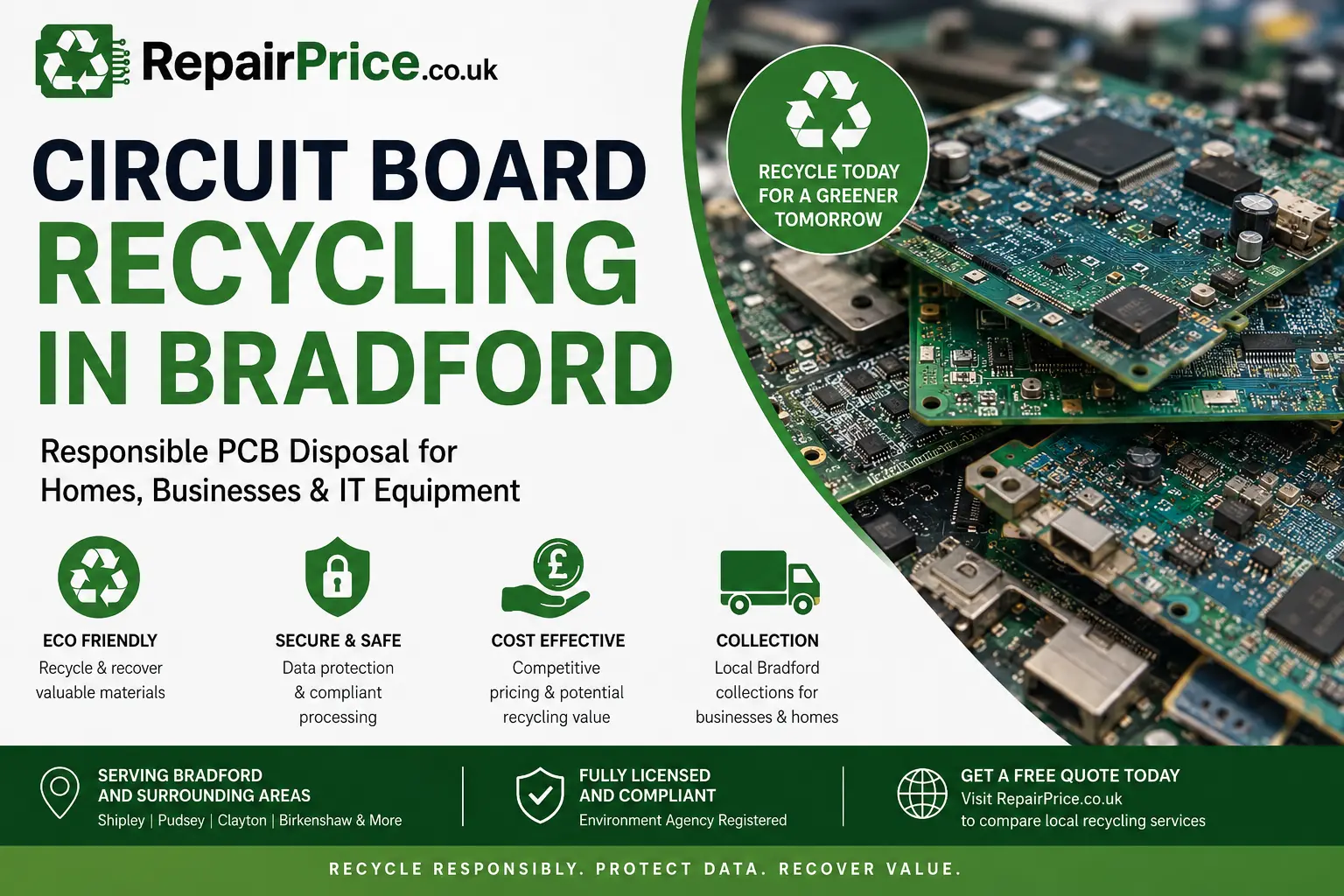
Circuit Board Recycling Bradford: Secure, Responsible PCB Disposal for Homes and Businesses
Old circuit boards should never be treated as ordinary rubbish. Printed circuit boards, commonly known as PCBs, can contain reusable metals, electronic components and materials that require controlled handling. Whether you have one damaged board from a laptop or a commercial quantity of boards removed from computers, televisions, servers, industrial machinery or telecommunications equipment, choosing a responsible recycling route can protect sensitive information, reduce waste and recover valuable resources.
RepairPrice.co.uk helps households, repair shops, offices, schools, landlords and organisations compare suitable options for circuit board recycling in Bradford. Instead of allowing unwanted electronics to remain in storage or enter general waste, you can submit details of the equipment and connect with relevant local recycling providers.
Book Your Bradford Circuit Board Recycling Collection on WhatsApp
What Is Circuit Board Recycling?
Circuit board recycling is the controlled collection, sorting and processing of printed circuit boards found inside electronic equipment. A PCB provides the electrical connections that allow processors, memory chips, power components and other parts to communicate. These boards appear in almost every modern electronic product, including desktop computers, laptops, mobile phones, tablets, televisions, games consoles, routers, printers, servers and household appliances.
When electronic equipment reaches the end of its useful life, the circuit board may still contain recoverable materials. Specialist recyclers can separate boards from larger devices, classify them according to their composition and send them through appropriate recovery processes. This is different from placing an entire electrical item into a household waste bin, where useful materials can be lost and potentially harmful substances may be handled incorrectly.
For a dedicated local route, visit our Bradford printed circuit board recycling service. This page can help you request options for individual PCBs, mixed electronic boards and larger commercial recycling requirements.
Why Recycle Printed Circuit Boards in Bradford?
Electronic waste is one of the most complex waste streams because a single device can contain plastics, glass, batteries, wiring, circuit boards, storage components and several types of metal. Recycling the circuit boards separately can improve material recovery and help prevent valuable resources from being unnecessarily discarded.
Responsible PCB recycling may also support safer data handling. Circuit boards removed from computers, servers, mobile devices and networking equipment can remain connected to storage components or other hardware containing business or personal information. Organisations should therefore identify equipment that may hold data and request an appropriate destruction or sanitisation process before recycling.
Recycling can also help businesses manage storage space. Boxes of outdated computer parts, defective boards, redundant telecommunications equipment and broken electronics can accumulate quickly. Arranging a suitable collection allows these items to be assessed, documented and moved into an appropriate recovery route.
Which Types of Circuit Boards Can Be Recycled?
Recycling providers may accept many different PCB grades and formats. The suitability of a collection can depend on the quantity, board type, attached components and whether the boards are loose or still installed inside equipment. Providing clear details when requesting a quote helps the recycler assess the material correctly.
Common examples include computer motherboards, laptop logic boards, mobile phone boards, tablet boards, television mainboards, power supply boards, server boards, network switch boards, router boards, printer control boards, graphics cards, memory modules, industrial control boards and telecommunications PCBs.
Mixed electronic assemblies may also be accepted, although they may need to be sorted before processing. Batteries, screens, fluorescent components, toner cartridges and other specialist materials should be identified separately rather than being mixed into an unlabelled container of circuit boards.
Repair or Recycle: Which Option Is Better?
Recycling should not always be the first step. If an electronic product can be repaired safely and economically, extending its working life may reduce the need to manufacture a replacement. A failed circuit board does not automatically mean the whole device is beyond repair. Problems can sometimes be caused by damaged ports, failed capacitors, power faults, liquid contamination, broken connectors or individual components that an experienced technician may be able to replace.
For portable computers, compare local diagnostic options through our Bradford laptop fault and motherboard repair page. A technician may be able to identify whether the board can be repaired or whether recycling is the more practical route.
Damaged smartphones can also contain reusable screens, cameras, housings and internal components. Before recycling a handset, explore mobile phone repair services across Bradford to determine whether the device can be restored.
For cracked, unresponsive or non-charging tablets, use our Bradford tablet repair comparison service. Repairing a charging port, battery connection or screen assembly may prevent the entire device from becoming waste.
Televisions can develop power-board, backlight, input or mainboard faults that may be repairable. Visit the Bradford television repair request page before deciding to discard a large screen or its internal circuit boards.
If repair is no longer sensible because of cost, age, severe damage or unavailable parts, the device can then be directed into a responsible recycling route. This repair-first approach helps retain useful products while ensuring genuinely end-of-life equipment is processed correctly.
Typical Circuit Board Recycling Price Guide in Bradford
The cost of circuit board recycling depends on the type of boards, quantity, weight, collection location and whether secure data destruction or specialist handling is required. Some high-grade boards may even have a recycling value, while mixed low-grade boards may incur a collection charge. The guide below provides typical pricing only. Submit an enquiry for an accurate quotation based on your requirements.
| PCB Recycling Service | Typical Price | Suitable For |
|---|---|---|
| Single Circuit Board Recycling | £5 - £20 | Individual household circuit boards |
| Computer Motherboard Recycling | £10 - £35 | Desktop PC motherboards |
| Laptop Logic Board Recycling | £10 - £30 | Faulty laptop motherboards |
| Mobile Phone PCB Recycling | £2 - £15 | Smartphone circuit boards |
| Tablet Logic Board Recycling | £5 - £20 | Tablet internal boards |
| Television Circuit Board Recycling | £10 - £40 | Mainboards and power supply boards |
| Mixed Electronic PCB Box | From £25 | Repair shops and workshops |
| Business PCB Collection | From £75 | Commercial offices and IT departments |
| Secure IT Asset Recycling | From £95 | Data-sensitive electronic equipment |
| Bulk Circuit Board Recycling | Quote Required | Large commercial quantities |
Prices shown are indicative and may vary depending on board grade, collection distance, quantity, current recycling market conditions and whether additional services such as secure data destruction, asset reporting or pallet collections are required. Requesting a quotation ensures you receive pricing tailored to your specific recycling needs.
How the Bradford PCB Recycling Process Works
The process normally begins with an assessment of what you have. You may be asked for the type of boards, approximate quantity, condition, collection postcode and whether the PCBs are loose or still fitted inside devices. Photographs can be helpful for unusual boards or mixed commercial loads.
After the material has been reviewed, a recycling provider may offer a drop-off arrangement, a local collection or a larger scheduled service. Small quantities may be suitable for delivery, while offices, repair centres and IT departments may require boxes, cages, pallets or repeated collections.
Once received, the material can be sorted by board type and contamination level. Reusable parts may be separated where appropriate, while non-reusable boards can enter specialist material recovery processes. The exact method varies depending on the recycler, the equipment and the downstream treatment facility.
Request a Quote from Bradford Circuit Board Recycling Services
Preparing Circuit Boards for Collection
Good preparation can make recycling safer and more efficient. Keep circuit boards dry, avoid breaking them into small pieces and use sturdy containers that prevent sharp edges from causing injury. Heavier boards should be packed in manageable boxes rather than one overloaded container.
Remove loose batteries before packing unless the recycling provider has specifically agreed to accept them in place. Lithium batteries require careful handling because damaged cells can create a fire risk. Do not place swollen, punctured or leaking batteries in a box of mixed circuit boards.
Commercial organisations should also separate data-bearing equipment. Hard drives, solid-state drives, memory cards and some embedded storage components may require secure data destruction. Clearly label any items that need special handling and ask what evidence or documentation can be provided.
Where possible, create a basic inventory showing the equipment type, approximate number of items and any asset identification details. This is especially useful for schools, charities, offices, public-sector organisations and businesses replacing multiple systems.
Business IT Equipment and Data-Sensitive Recycling
Businesses often generate circuit boards as part of computer upgrades, office relocations, equipment failures, server replacements or IT support work. These boards may come from workstations, servers, switches, routers, telephone systems, access-control equipment and other infrastructure.
For wider workplace clearances, our Bradford business IT recycling service can help you explore collection options for computers, monitors, networking equipment, servers, accessories and related electronic hardware.
Before releasing business equipment, confirm how confidential information will be protected. Ask whether drives will be erased, physically destroyed or returned. You may also need serial-number reporting, asset lists, collection records or certificates to support internal compliance procedures.
Do not assume that deleting files or resetting a computer always removes every recoverable piece of information. Data-bearing devices should be identified and processed through an appropriate sanitisation or destruction method before the remaining circuit boards and equipment are recycled.
Electronics Recycling for Mixed Devices
Not every collection consists of loose circuit boards. Many customers have complete or partially dismantled electronic devices containing plastics, wiring, screens, metal frames and PCBs. These mixed items may need a broader electronics recycling service.
Visit our Bradford electronics recycling options page for help with unwanted consumer and business electronics. This may include computers, printers, televisions, entertainment equipment, routers, small appliances and accessories.
Keeping electronics out of general rubbish allows different materials to be assessed and separated. Devices that still work may also have reuse potential, while damaged units can be dismantled for suitable component and material recovery.
Managing E-Waste Responsibly
E-waste is a broad term covering unwanted electrical and electronic equipment. It can include everything from a damaged charging cable to an obsolete office server. Circuit boards form one important part of this waste stream, but other components may require different handling methods.
Our Bradford e-waste collection and disposal page provides a wider route for mixed end-of-life electronics. It is particularly useful when you have several categories of equipment rather than sorted PCBs alone.
You can also read our Bradford e-waste recycling guide for more information about sorting unwanted electronics, protecting data and deciding which devices should be repaired, reused or recycled.
General Recycling Services in Bradford
Some clearances include more than electronic boards and IT equipment. Households, landlords and businesses may have a mixture of broken devices, cables, accessories and other recyclable items. In these situations, a broader local recycling request may be more suitable.
Use the Bradford recycling comparison page to explore additional recycling routes. Providing a clear list of materials will help determine whether the items can be collected together or need to be separated into different waste streams.
Circuit Board Recycling Near Bradford
Customers outside central Bradford may still be able to access local PCB collection or drop-off services. Coverage and collection charges can vary according to distance, quantity and the type of electronic material involved.
Businesses and residents north of Bradford can review printed circuit board recycling options in Shipley. This can be useful for repair businesses, offices and households with redundant electronic components.
For customers closer to the Leeds and Bradford boundary, our Pudsey PCB recycling service page offers another local route for unwanted boards and electronic assemblies.
Residents and organisations in the western Bradford area can visit the Clayton circuit board disposal and recycling page to request suitable local options.
For collections towards south-east Bradford, explore circuit board recycling services covering Birkenshaw. Including the quantity and type of boards in your enquiry can help providers respond more accurately.
Can You Receive Payment for Circuit Boards?
Some circuit boards contain materials with a recoverable value, but this does not mean every board will generate a payment. Value can vary according to board grade, attached components, contamination, quantity, sorting requirements and current material recovery conditions.
A small box of mixed, low-grade boards may cost more to transport and process than the recovered material is worth. Larger quantities of well-sorted boards may be assessed differently. Avoid removing components or attempting to extract metals using heat, chemicals or unsafe dismantling methods. Specialist processing is safer and more effective.
When submitting an enquiry, state whether the boards are sorted, mixed, complete, damaged or still attached to other equipment. A recycler can then explain whether the service involves a collection charge, free acceptance or a potential rebate.
Common Mistakes to Avoid
One common mistake is placing circuit boards in general household or commercial waste. Another is mixing PCBs with damaged batteries, liquids, toner, broken glass or unidentified chemicals. These materials may require different packaging and treatment.
Businesses should avoid handing data-sensitive equipment to an unknown collector without confirming how information will be protected. Price alone should not be the only consideration. Ask what happens to the material, whether the collector handles electronic waste appropriately and what records are available.
It is also unwise to dismantle complex electronics without suitable knowledge. Capacitors, damaged batteries, sharp metalwork and contaminated components can create safety risks. Where necessary, leave the equipment intact and explain its condition to the recycling provider.
Frequently Asked Questions About PCB Recycling in Bradford
Can I recycle a single circuit board?
Some services may accept individual boards, while others focus on larger quantities. Submit the board type, size and your Bradford postcode so suitable options can be compared.
Can complete computers be collected?
Yes, many electronics and IT recycling providers can collect complete computers as well as loose boards. Data-bearing drives should be identified before collection.
Do I need to remove the circuit boards myself?
Not always. If you are unfamiliar with electronic dismantling, it may be safer to provide the complete device. Explain what equipment you have so the recycler can advise whether dismantling is required.
Can damaged or burnt circuit boards be recycled?
They may still be accepted, but boards affected by fire, chemicals, water or heavy contamination should be declared in advance. Special packaging or handling may be necessary.
Are collections available for Bradford businesses?
Collection options may be available for offices, schools, repair shops, warehouses, charities, landlords and other organisations. The availability and cost will depend on the quantity, material type and collection location.
What should I do with batteries?
Keep batteries separate from loose PCBs unless your chosen provider has given different instructions. Damaged lithium batteries require particular care and should never be hidden inside a mixed recycling box.
Arrange Circuit Board Recycling in Bradford
Responsible circuit board recycling helps recover useful materials, reduce unnecessary electronic waste and support safer handling of outdated equipment. The first step is to identify whether the device can be repaired. When repair or reuse is no longer practical, the circuit board and remaining electronic components should be directed into a suitable recycling process.
RepairPrice.co.uk makes it easier to explain what you have and request options from relevant Bradford services. Include the type of equipment, approximate quantity, condition, postcode and whether the items contain batteries or data-storage components. Clear information can lead to a more accurate response and a more efficient collection.
Start with the main Bradford PCB recycling enquiry service to compare an appropriate route for unwanted motherboards, control boards, electronic assemblies and other printed circuit boards.