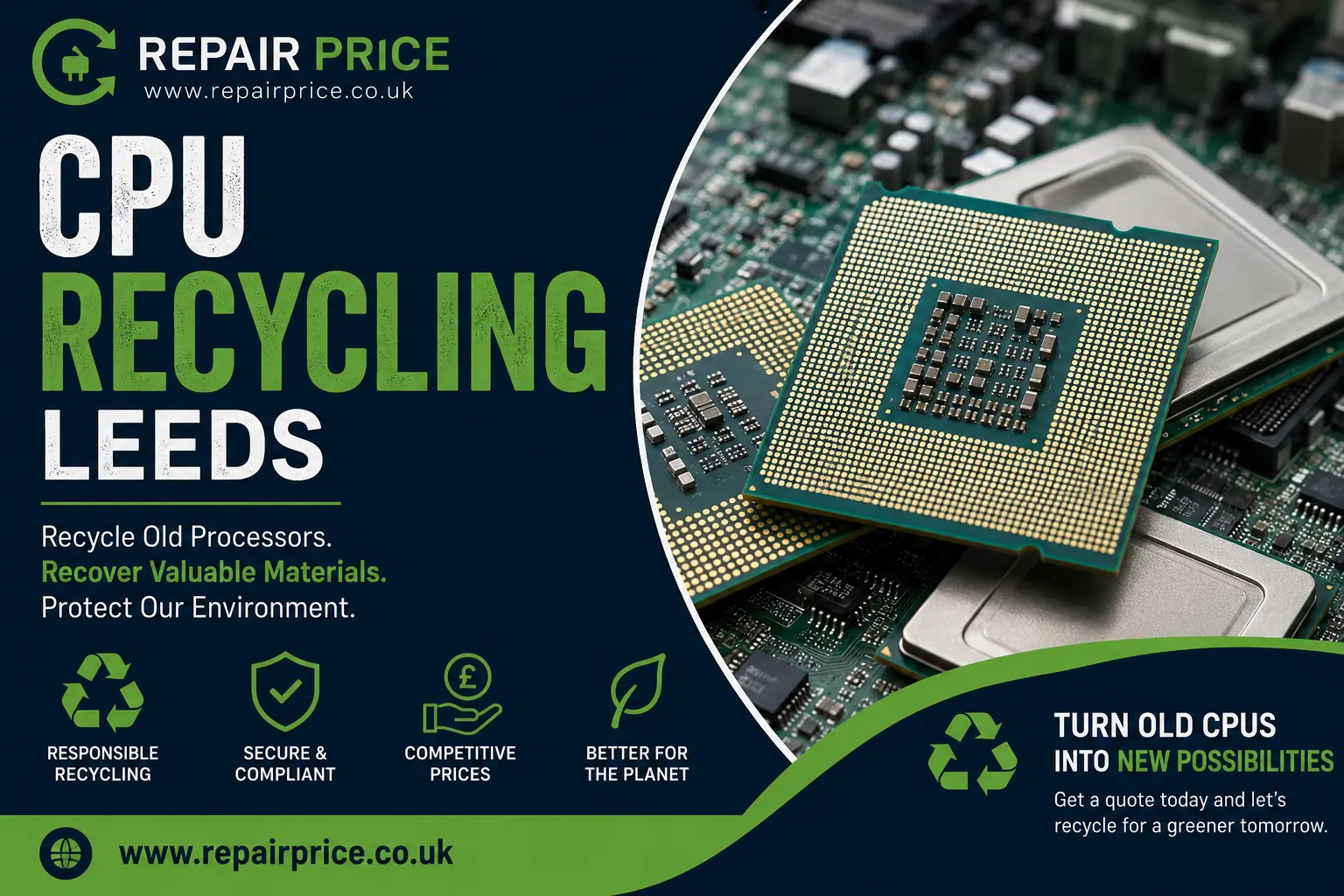
Old computer processors may be small, but they can still contain valuable recyclable materials. If you have unwanted CPUs from desktop computers, servers, workstations or dismantled IT equipment, recycling them through a specialist service can help recover useful materials while keeping electronic components out of general waste. This guide explains how CPU recycling in Leeds works, what types of processors may be accepted, why older processors can have recycling value and how households, repair businesses and organisations can prepare CPUs for responsible recovery.
Repair Price helps people looking for CPU recycling services in Leeds find a practical route for recycling unwanted processors and related electronic hardware. Whether you have several loose CPUs or larger quantities generated through IT upgrades, computer repairs or equipment dismantling, separating processors from mixed electronic waste can make recycling easier and help suitable materials reach the correct recovery stream.
If you already have CPUs ready for recycling, you can make an enquiry about recycling options in Leeds. Providing information about the processor type, approximate quantity and whether you also have motherboards, RAM, circuit boards or server hardware can help establish the most suitable recycling route.
CPU recycling is the process of collecting unwanted computer processors and directing them into specialist electronic recovery channels. CPUs are manufactured using combinations of metals, ceramics, silicon and other materials. Depending on the processor generation and construction, recyclable processors may contain recoverable metals that make them different from ordinary household waste.
Processors are commonly removed when desktop computers, laptops, servers or industrial computer systems are upgraded or dismantled. Instead of leaving these components stored indefinitely or throwing them into mixed waste, they can be separated and processed alongside other recyclable electronics.
For broader electronic equipment that contains many different component types, our Leeds electronic waste recycling service provides a useful next step. Businesses replacing computers or clearing larger volumes of commercial equipment may also find our IT recycling options for Leeds organisations more suitable for mixed hardware collections.
Many generations of processors may be suitable for recycling. These can include desktop CPUs, workstation processors, server processors, older ceramic CPUs, pin-based processors and processors recovered from obsolete computer equipment. Condition is not always the most important factor when the processor is being recycled for material recovery rather than reuse.
Older processors can differ significantly from modern CPUs in their physical construction. Some older models use ceramic packages and exposed pins, while newer processors may have flatter contact surfaces or integrated heat spreaders. Keeping processor types separated can be useful when handling larger quantities because different grades of electronic components may be processed differently.
If CPUs are still installed on boards, you may also want to consider recycling computer motherboards in Leeds. Motherboards contain processors, memory sockets, connectors, chips and printed circuitry, making them an important category of electronic material in their own right.
Electronic equipment is made using materials that require energy and resources to extract and manufacture. Recycling suitable components can help recover part of that material instead of allowing it to remain unused in storage or enter unsuitable disposal routes. CPUs are particularly easy to separate because they are compact and can be stored in relatively small containers even when collecting significant quantities.
Businesses involved in computer refurbishment, IT support and electronics repair may accumulate processors as machines are upgraded or dismantled. Separating CPUs from steel cases, cables, power supplies and other electronic material creates a cleaner recycling stream and makes stock management easier.
Individuals can also accumulate processors over many years. A drawer containing CPUs from old family computers, gaming PCs or previous upgrades may appear insignificant, but combining these processors with RAM, motherboards and circuit boards can create a worthwhile electronics recycling collection.
Computer repair companies often replace processors while diagnosing faults, rebuilding machines or dismantling computers that are no longer economical to repair. Instead of mixing processors with general electronic scrap, repairers can keep a dedicated container for CPUs and other high-grade electronic components.
This approach can also work well for companies involved in IT maintenance, computer refurbishment, data centre equipment removal and office technology upgrades. By sorting components at the point of dismantling, businesses can create separate recycling streams for CPUs, memory, motherboards and printed circuit boards.
Memory modules can be routed through our Leeds RAM recycling service, while loose electronic boards can be directed to our printed circuit board recycling service in Leeds. Keeping these categories separate can make larger electronics clearances easier to organise.
Servers can contain multiple high-performance processors, memory modules, storage devices, power supplies and circuit boards. When older server systems are retired, dismantling them can therefore generate several distinct types of recyclable electronic material.
Processors removed from rack servers, tower servers and enterprise workstations can be collected separately from the remaining equipment. Server memory can be grouped with RAM, while backplanes and system boards can be processed with suitable printed circuit boards.
If your recycling project involves complete servers rather than individual processors, visit our server hardware recycling service for Leeds. This can provide a more suitable route when you have complete units, racks or larger volumes of business IT hardware to clear.
CPUs form only one part of a computer's electronic architecture. Motherboards, controller boards, graphics cards, network cards and server boards also contain recyclable electronic materials. When computer systems are dismantled, separating these components can create a more organised recycling process.
For businesses handling mixed board material, our Leeds PCB material recovery page explains options for printed circuit boards from computers and other electronic devices. You can also read about motherboard recycling for unwanted computer boards where the material consists mainly of desktop, workstation or server motherboards.
Preparing processors does not need to be complicated. Begin by removing obvious non-electronic packaging and keeping the CPUs dry. Where practical, separate loose processors from complete motherboards and other computer parts. Avoid unnecessary damage to processors during removal because intact components are easier to identify and sort.
If you have several processor types, you can place them into separate labelled containers. For example, older ceramic processors can be kept apart from newer desktop CPUs or server processors. Businesses dealing with larger quantities may also find it useful to record approximate weights or unit counts before arranging a recycling enquiry.
Do not attempt to extract metals from CPUs using chemicals, burning, uncontrolled heating or other unsafe methods. Specialist electronic recycling and material recovery processes are designed to handle components using appropriate equipment and controlled procedures.
Some processors can have material recovery value because of the metals and specialist materials used in their manufacture. However, not every CPU has the same composition or recycling value. Processor generation, package type, quantity and market conditions can all influence how recyclable material is graded.
Older processors are sometimes of particular interest because their construction can differ from modern mass-produced CPUs. Nevertheless, it is better to assess actual processor type and quantity rather than assume that every old processor has a high value.
For larger collections, provide as much information as possible when requesting recycling options. Photographs, approximate quantities, processor markings and details about accompanying hardware can make it easier to understand what material you have.
Businesses may generate processors during scheduled IT replacement programmes, office clearances, hardware refresh projects or server upgrades. Establishing a simple internal sorting process can prevent reusable or recyclable electronic materials from being mixed with general waste.
A company replacing multiple desktop computers could separate processors, RAM, motherboards, cables and storage equipment during dismantling. Larger mixed IT projects may be better handled through commercial IT equipment recycling in Leeds, particularly when complete computers and additional office electronics are involved.
For miscellaneous electronics beyond traditional IT hardware, the Leeds e-waste recycling service can provide a route for broader electronic waste categories.
CPU recycling requirements are not limited to Leeds city centre. Individuals, repair businesses and organisations throughout surrounding West Yorkshire areas may also need an appropriate route for unwanted processors and electronic components.
If your equipment is located south of Leeds, see our CPU recycling options in Wakefield. Customers closer to Ossett can use the Ossett processor recycling page, while businesses around Normanton can explore computer CPU recycling in Normanton.
We also provide information for customers searching for CPU recycling services around Dewsbury. These nearby pages help users reach the most relevant local recycling information without relying on a single Leeds-wide landing page.
A CPU recycling collection often forms part of a larger computer equipment clearance. Other commonly separated components include RAM modules, motherboards, printed circuit boards, server boards, expansion cards and complete obsolete IT systems.
If you have memory modules, use our specialist RAM recycling information for Leeds. For computer system boards, see the Leeds motherboard recovery service. Mixed electronic boards can instead be directed towards PCB recycling and material recovery in Leeds.
Customers with complete servers or enterprise hardware should consider recycling unwanted server equipment in Leeds rather than removing every individual component before making an enquiry.
Not every unwanted CPU immediately needs material recycling. A functioning processor that is still useful for repairs, upgrades or refurbishment may have reuse potential. Reuse can extend the working life of existing equipment and delay the need to manufacture replacement components.
However, processors that are obsolete, damaged, incompatible with current hardware or accumulated in quantities beyond practical reuse can be better suited to recycling. The same principle applies to other computer components: reuse where practical, then recycle material that no longer has a realistic second life.
Computer processors are electronic components and should be treated as part of the wider electronic waste stream rather than ordinary household rubbish. Specialist recycling provides an opportunity for suitable materials to be recovered and managed through established electronic processing channels.
Keeping processors separate is also straightforward. Unlike complete computers, CPUs occupy very little storage space. A repair business can collect processors over several months before combining them with other recyclable electronics for a larger collection.
Some recycling projects begin with CPUs but quickly expand once storerooms and unused equipment are reviewed. A business may discover old desktop computers, servers, RAM, motherboards, switches, routers, circuit boards and miscellaneous electronics stored across several departments.
In these situations, separating every individual component may not always be necessary before making an enquiry. Start by identifying the main categories and approximate quantities. A recycling route can then be considered for loose CPUs alongside larger electronic equipment.
For mixed technology clearances, explore Leeds IT asset recycling options. For a broader collection containing miscellaneous electrical and electronic items, visit the local Leeds e-waste recycling page.
If you have processors ready for recycling, provide details about the quantity, type of CPUs and any additional computer components you would like to include. Separating CPUs from motherboards, RAM and mixed electronic boards where practical can help make the material easier to assess.
Repair Price can help direct your enquiry towards relevant recycling options for Leeds. Whether the material comes from a home computer upgrade, repair workshop, office clearance, IT department or server replacement project, starting with a clear description of what you have can make the process more efficient.
Yes. Unwanted processors from desktop computers, workstations, servers and other computer systems can potentially be directed into specialist electronic recycling channels. The most suitable route can depend on the processor type, quantity and whether you also have other electronic components to recycle.
Damaged processors may still contain recoverable materials even when they are no longer functional. Keep damaged CPUs separate from general waste and include them when describing your electronic recycling requirements.
Yes, although separating them into different groups can make sorting easier. RAM modules are a distinct electronic component category, so larger quantities can be handled through dedicated RAM recycling alongside processor recycling.
Yes. Motherboards are commonly generated alongside processors when computers are dismantled. However, processors and motherboards may be graded separately, so keeping loose CPUs apart from complete boards can be useful.
Server processors can form part of a CPU recycling enquiry. If you have complete servers, racks or larger amounts of enterprise equipment, a dedicated server or IT recycling service may be the better route.
Businesses can generate significant quantities of processors through computer upgrades, repair operations, hardware refurbishment and IT replacement programmes. CPU recycling can therefore form part of a wider commercial electronics or IT recycling project.
If processors can be removed safely and easily, separating them can make sorting simpler. However, you should not damage equipment unnecessarily simply to remove a processor. Complete motherboards can also be handled through appropriate electronics recycling routes.
Yes. RAM, motherboards, printed circuit boards, servers and other electronic hardware may all be suitable for recycling. Identifying each component category before making an enquiry can help determine the most appropriate recycling route.
Old processors do not need to remain forgotten in storage or become mixed with general waste. Separating CPUs from obsolete computers gives households, repair companies and businesses an opportunity to route these compact electronic components towards responsible material recovery.
Start with our dedicated Leeds CPU recycling service if processors are your main material. If your collection also contains motherboards, explore Leeds motherboard recycling. For memory modules, see RAM recycling in Leeds, and for mixed circuit boards use our Leeds PCB recycling service.
By separating electronic components, identifying the material you have and selecting the most appropriate recycling route, you can make an old computer equipment clearance more organised while helping useful electronic materials move towards recovery rather than disposal.