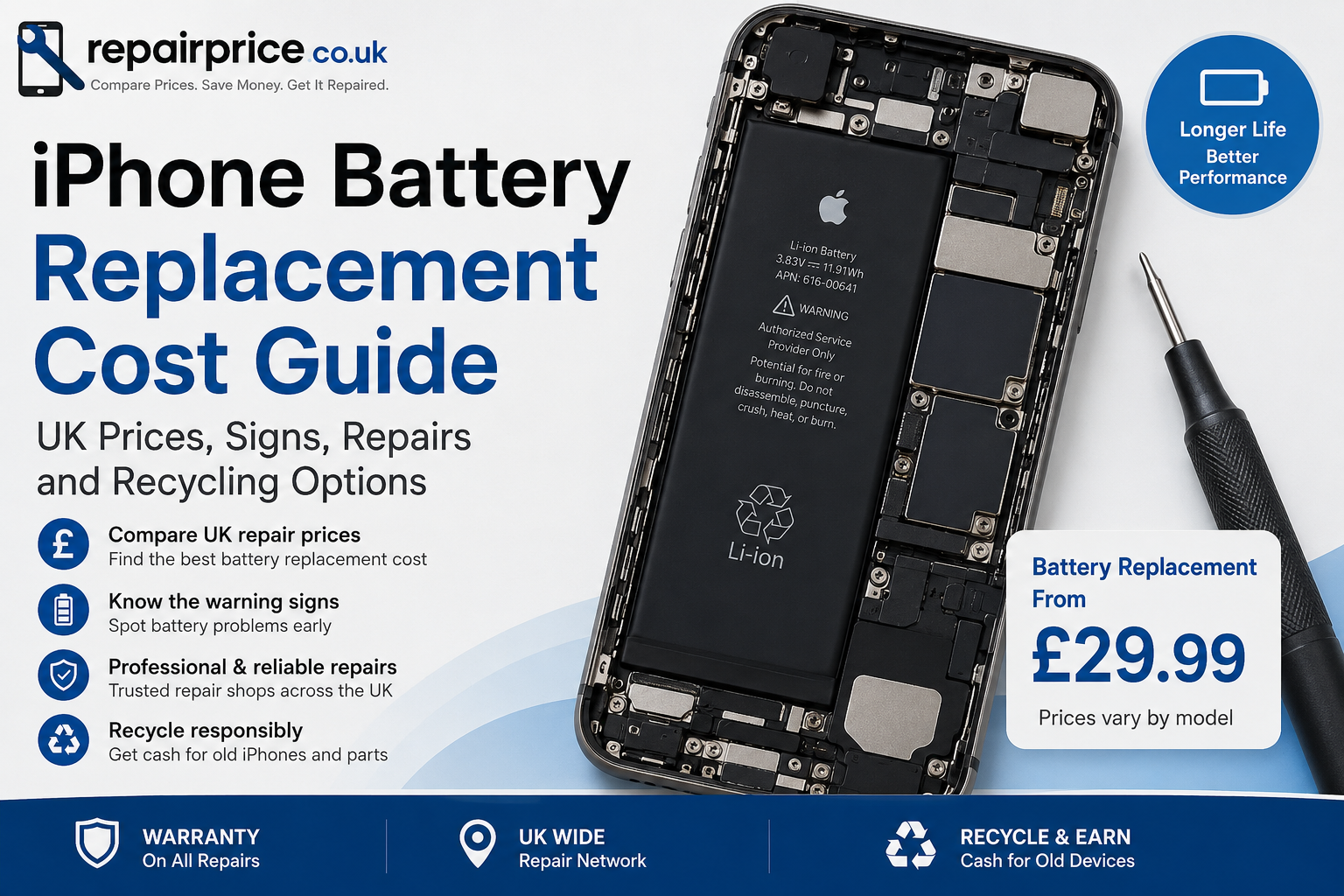
A worn iPhone battery can turn an otherwise reliable phone into a frustrating device that needs charging several times a day, switches off unexpectedly or struggles to deliver normal performance. If your battery health has fallen, understanding the likely replacement cost can help you decide whether repairing the phone is better value than replacing it.
This iPhone battery replacement cost guide explains the main symptoms of battery deterioration, the factors that influence repair prices, how battery replacement works, when other faults may be responsible and when recycling could be the more practical option. For current pricing information, start with our dedicated UK iPhone battery replacement cost comparison.
If your iPhone is draining quickly, shutting down unexpectedly or showing a battery service warning, compare repair options before deciding whether to replace the device. Providing your model and fault details can help repair businesses assess the likely work required.
The cost of replacing an iPhone battery in the UK can vary according to the model, battery quality, labour requirements, repair provider and whether additional faults are discovered during inspection. Newer iPhones can require more careful disassembly because of adhesive, internal component placement and water-resistance seals.
Instead of assuming every iPhone battery repair costs the same amount, it is sensible to compare prices for your exact model. Our iPhone battery replacement pricing page is designed to help users investigate available repair options before booking.
A battery replacement is often considerably more economical than buying another phone, particularly when the display, cameras, charging system and main logic board are still functioning correctly. For a wider assessment of faults and repairs, visit the iPhone repair comparison service.
Several factors can influence the final repair cost. The first is the iPhone model itself. Internal designs vary considerably between generations, and newer devices may require different battery parts, adhesives and repair procedures.
The quality of the replacement battery also matters. Repair businesses may use different grades or sources of components, so the cheapest quotation is not automatically the best option. Ask what battery is being fitted, whether labour is included and what repair warranty is offered.
Additional damage can also increase the total cost. For example, a phone that appears to have a battery problem could have a charging socket fault, liquid damage or another electrical problem. If the phone charges intermittently rather than simply discharging quickly, compare the symptoms with our iPhone charging port repair cost guide.
The most obvious symptom is unusually short battery life. If your iPhone previously lasted most of the day but now requires repeated charging under similar usage conditions, battery ageing may be responsible.
Unexpected shutdowns can also indicate battery deterioration. An ageing battery may struggle to deliver the necessary power during demanding tasks, causing the device to restart or switch off even when the displayed battery percentage is above zero.
Other warning signs include excessive heat during ordinary use, slow charging, rapid percentage drops and an iOS battery health message recommending service. Physical swelling is a more serious warning. If the battery appears swollen or the screen is lifting away from the frame, stop using unnecessary pressure on the device and arrange professional inspection.
Battery replacement is usually worth considering when the rest of the phone remains in good condition. A device with a healthy display, working cameras, reliable Face ID or Touch ID and no major logic-board damage can often gain substantial additional usable life from a new battery.
The decision becomes more complicated when several expensive repairs are required simultaneously. A device that needs a battery, damaged display and charging repair should be assessed based on its current value and the combined repair cost.
If you are dealing with several faults, our broader iPhone repair service directory can help you explore the available repair routes. If the display is damaged as well as the battery, review typical options through the UK iPhone screen replacement cost guide.
The iPhone 16 remains a relatively modern device, so a battery replacement can make financial sense if battery capacity has deteriorated while the rest of the phone remains fully operational. Because modern iPhones contain tightly arranged components and adhesive seals, professional fitting is often preferable to attempting a battery replacement without the correct equipment.
If you own this generation, see the dedicated iPhone 16 repair and fault information page for model-specific repair options.
An iPhone 15 with declining battery endurance may still have many years of useful service remaining. Replacing the battery can be particularly attractive if the device has sufficient storage, remains fast enough for your needs and does not require other major repairs.
Owners can explore additional repair information on our iPhone 15 repair comparison page, including routes for investigating other hardware faults alongside battery deterioration.
The iPhone 13 generation has now been in use long enough for natural lithium-ion battery ageing to become a common reason for reduced runtime. If the phone otherwise performs well, replacing the battery can extend its practical lifespan and delay the cost of upgrading.
For faults affecting this model, visit our iPhone 13 repair information page to compare relevant services and repair choices.
Battery percentage and battery health are not the same measurement. Battery percentage tells you approximately how much charge remains at that moment, while maximum capacity provides an indication of how much energy the battery can hold compared with when it was newer.
A phone can therefore show 100% charge but still have considerably reduced battery endurance if maximum capacity has deteriorated. Usage patterns also matter because screen brightness, mobile signal strength, background applications, navigation, gaming and video recording can all increase power consumption.
Yes. Not every battery problem requires hardware replacement. A recently installed application, persistent background process, poor mobile reception or intensive location services can increase energy usage. Major software updates can also temporarily increase background activity while the device indexes files and completes system tasks.
Before paying for a battery replacement, check whether a particular application is responsible for an unusually high share of battery usage. However, if maximum battery capacity has fallen significantly and daily runtime has steadily deteriorated over months or years, physical battery ageing becomes a more likely explanation.
A professional battery replacement normally begins with an inspection of the device. The technician may check charging behaviour, battery condition and whether other faults could be contributing to the reported symptoms.
The iPhone is then carefully opened using suitable equipment. Internal connectors must be handled correctly before the old battery is removed. Because batteries are generally secured with adhesive, controlled removal is important to avoid damaging surrounding components.
The replacement battery is fitted, relevant connectors and seals are checked, and the phone is reassembled. A competent repair provider should then test charging, startup behaviour and general operation before returning the device.
Repair prices can differ between businesses because labour rates, component sourcing, warranty policies and overheads vary. Comparing quotations gives you a clearer understanding of the market rather than automatically accepting the first price you receive.
When comparing repairs, look beyond the headline price. Ask whether VAT is included where applicable, whether diagnostic work is charged separately, what component specification is being used and whether the repair includes a warranty.
If you are based in West Yorkshire, compare options through our Leeds iPhone repair comparison page. Local repair may be suitable when you want convenient access to a repair provider without posting your phone across the country.
Users in Greater Manchester can explore nearby options using our Manchester iPhone repair service guide. Comparing multiple services can help identify suitable battery replacement options based on your model and repair requirements.
For customers around York, the York iPhone repair comparison page provides a route to local repair information for battery faults and other common iPhone problems.
If you need an iPhone battery replacement in Lancashire, browse the Preston iPhone repair service page for relevant local repair options and further guidance.
Customers in the East Midlands can use our Nottingham iPhone repair comparison service to investigate local repair routes for reduced battery life and related faults.
For users in the South West, our Bristol iPhone repair information page can help connect battery replacement research with other available iPhone repair services.
A phone that does not charge is not automatically suffering from battery failure. The cable, power adapter, charging port, charging circuitry or internal connections could be responsible. Wireless charging behaviour can provide another useful clue when diagnosing certain charging problems.
If the phone charges normally but loses power rapidly, battery deterioration becomes more likely. If charging only works when the cable is held at a certain angle, debris or damage inside the connector may be involved. Separating these symptoms before booking a repair can help you choose the most relevant service.
A replacement battery can improve day-to-day usability when an ageing battery is responsible for shutdowns, unstable power delivery or poor endurance. The biggest difference for most owners is simply being able to use the phone for longer between charges.
However, a new battery will not repair unrelated problems such as a damaged screen, faulty camera, broken charging port or logic-board fault. A complete diagnosis is therefore worthwhile if several symptoms are present.
Extending the life of an existing iPhone can reduce both expenditure and unnecessary electronic waste. Many devices are replaced because of one failing component even though the majority of their hardware remains functional.
A battery is a consumable component that naturally loses capacity over time. Replacing that component can therefore be a practical maintenance decision rather than an indication that the entire phone has reached the end of its life.
Repair will not always be the best financial choice. An older iPhone with extensive physical damage, serious liquid damage, multiple component failures or major logic-board problems may cost more to restore than its usable value justifies.
If repair is no longer economical, avoid leaving the device unused in a drawer or putting it into household waste. Explore our device recycling options to find alternative routes for unwanted electronics.
You can also visit the wider electronics recycling information centre for guidance covering additional devices and responsible end-of-life processing.
An unusable smartphone may contain recoverable metals, circuit boards and reusable components. Specialist recycling processes can separate valuable materials while reducing the amount of electronic equipment entering general waste streams.
Businesses, refurbishers and organisations handling larger quantities of electronics can learn more through our circuit board recycling service.
Mobile phone logic boards are particularly relevant to specialist electronic scrap processing. For more information about potential recycling values, see our scrap mobile phone board recycling price guide.
Back up important photographs, documents and account data before repair whenever possible. Although routine battery replacement should not normally require data removal, maintaining a current backup protects you against unexpected hardware complications.
Make a note of the symptoms you are experiencing and when they occur. Information such as unexpected shutdown percentages, charging problems, overheating or unusually rapid discharge can help a technician diagnose the device more efficiently.
You should also remove accessories that are not required for diagnosis, such as detachable cases, card holders and cables, unless the repair provider specifically asks you to bring them.
Once a new battery is installed, sensible charging and usage habits can help reduce unnecessary stress. Extreme heat is particularly harmful to lithium-ion batteries, so avoid leaving an iPhone in very hot vehicles, direct sunlight or other high-temperature environments for prolonged periods.
You do not need to obsessively manage every charge cycle, but reducing unnecessary heat and using suitable charging equipment can contribute to better long-term battery performance. Updating iOS and reviewing applications with unusually high background activity can also help control avoidable power consumption.
It can be. If the phone remains in good overall condition and the battery is the main problem, replacement can extend its useful life for much less than the cost of purchasing another recent iPhone.
Rapid battery drain can result from battery ageing, intensive applications, poor mobile reception, high screen brightness, location services, software activity or hardware faults. Checking battery usage information can help determine whether the problem is application-related or more consistent with battery deterioration.
Potentially, although screen damage can complicate opening the device safely. A repair provider may recommend addressing the display at the same time if the damage creates a risk during disassembly. Compare screen repair options using our dedicated iPhone display pricing guide before proceeding.
Only when the battery itself is causing the charging problem. Damaged connectors, charging-port contamination, faulty cables, power adapters or internal circuitry can produce similar symptoms, so diagnosis is important.
That depends on the value of the device and the cost of the repair. A healthier battery may make a phone more attractive to a future owner, but you should compare the expected improvement in value with the replacement cost before spending money solely for resale purposes.
If the repair cost is no longer sensible, consider responsible electronics recycling. Even damaged phones can contain reusable components and recyclable materials, while specialist processing provides a better disposal route than household rubbish.
A deteriorating battery does not necessarily mean your iPhone needs replacing. When the rest of the device remains functional, fitting a suitable replacement battery can restore practical daily endurance and extend the phone's useful lifespan.
Start by comparing the likely cost of replacing your iPhone battery, then consider whether any screen, charging or other hardware faults need attention at the same time. Comparing repair options gives you a clearer basis for deciding whether to repair, replace or recycle the device.
If repair remains economical, extending the life of your current iPhone can save money and reduce unnecessary electronic waste. If the device has reached the point where multiple major repairs are no longer worthwhile, responsible recycling provides a practical next step and helps recover useful materials from unwanted electronics.