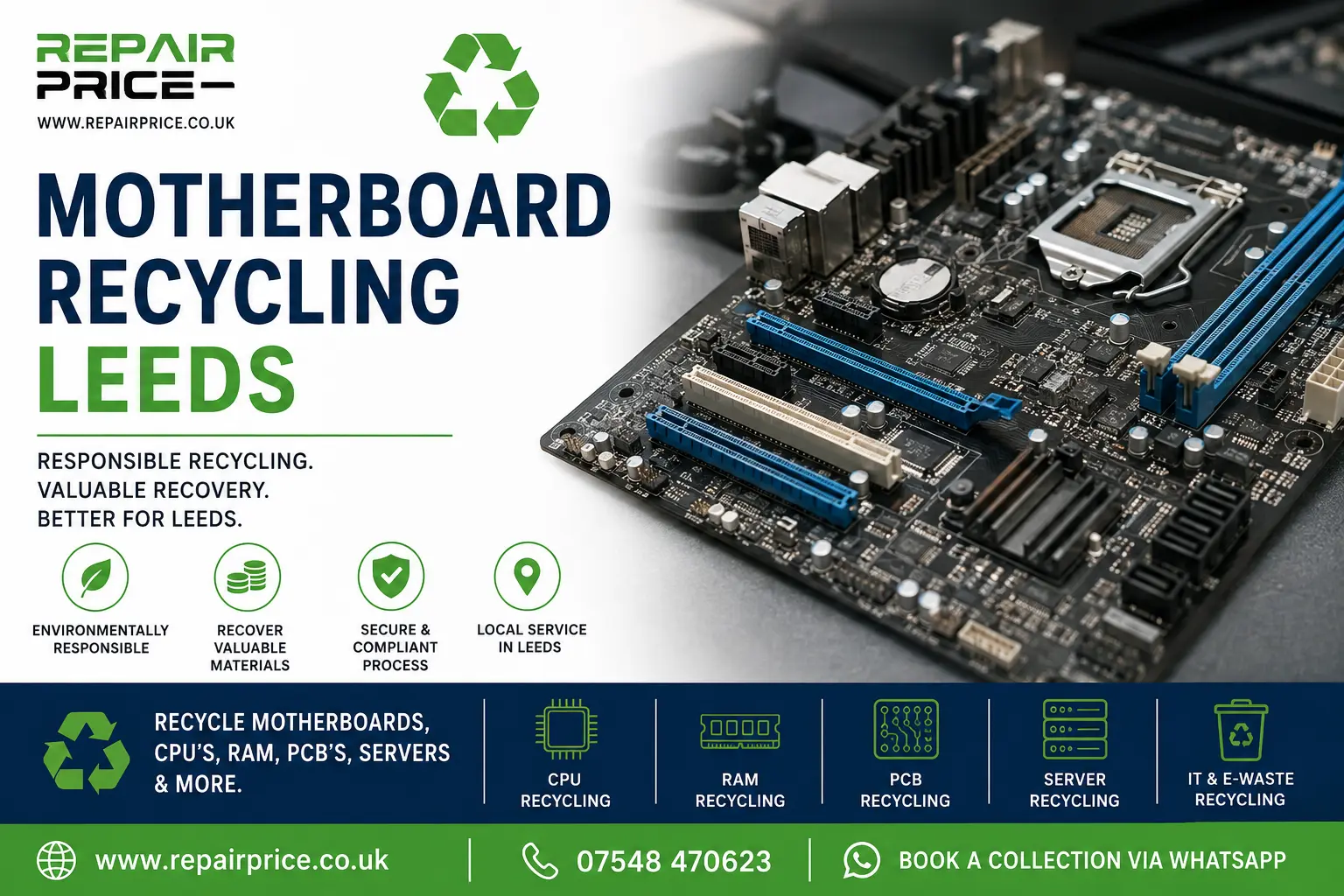
Old computer motherboards can contain a mixture of reusable components, valuable metals and materials that should be recovered rather than disposed of with general waste. If you have redundant desktop PCs, workstation boards, server motherboards or batches of electronic equipment in Leeds, specialist recycling can provide a more responsible route for dealing with unwanted hardware. This guide explains how motherboard recycling works, what types of boards can be processed and how businesses and individuals can arrange recycling through RepairPrice.
For a dedicated local route, visit our motherboard recycling service for Leeds. The service is designed for people and organisations looking to recycle obsolete, damaged or surplus computer boards while separating valuable electronic components from ordinary waste streams.
Whether you have a few boards left after upgrading computers or a larger quantity from an office, workshop, school, repair business or IT department, you can make an enquiry and discuss the type and approximate quantity of equipment you want to recycle.
A motherboard is the main printed circuit board inside a computer. It connects components including the processor, memory, expansion cards, storage interfaces and power connections. Because motherboards are manufactured from multiple materials, they should not normally be treated in the same way as ordinary household rubbish.
Recycling gives usable materials another route into the recovery chain. Instead of allowing complete boards to remain stored indefinitely or enter unsuitable waste streams, specialist processing can separate different electronic fractions and direct them towards appropriate recycling channels.
Motherboards can also contain connectors, integrated circuits, sockets, copper-bearing tracks and other components that make them more suitable for specialised electronic recycling than general mixed waste. The precise recovery value can vary according to the board type, age, specification, condition and quantity available.
Many different computer boards may be suitable for recycling. Examples can include desktop PC motherboards, workstation boards, industrial computer boards, gaming PC motherboards, server motherboards, older legacy boards and damaged units that are no longer economical to repair.
If equipment contains other valuable computer components, it can be useful to separate them before arranging recycling. For example, processors can be directed through our specialist CPU recycling service in Leeds, while memory modules can be handled through our Leeds RAM and computer memory recycling service.
Separating components can make the recycling process easier to understand because different electronic parts can have different material compositions and recovery routes. If you are uncertain whether equipment should be dismantled first, you can describe what you have when making an enquiry.
Computer motherboards belong to the wider printed circuit board category. Printed circuit boards are found throughout modern electronics, including computers, telecommunications equipment, control systems, industrial electronics and consumer devices.
Businesses generating mixed electronic boards may therefore also want to review our printed circuit board recycling options across Leeds. This can be particularly useful when a batch contains more than just standard PC motherboards.
Keeping motherboard and PCB material separate from general waste can also make it easier to identify what has been removed from redundant IT equipment and what still needs to be processed.
Before recycling a computer, check whether storage devices are still connected. Motherboards themselves are not normally the primary location where personal files are stored, but complete computers can contain hard drives, SSDs and other storage devices that may hold confidential information.
Businesses handling redundant IT equipment should therefore consider the entire computer rather than focusing only on the motherboard. Storage media, memory, processors, power supplies, cables and chassis components can all require different handling.
If you are clearing multiple computers or office systems, our Leeds IT equipment recycling service provides a broader route for redundant technology. This can be more appropriate when your disposal project includes computers, networking hardware, office electronics and related equipment rather than loose boards alone.
Commercial organisations can accumulate electronic hardware surprisingly quickly. Computer upgrades, office relocations, equipment refresh programmes and failed hardware can all produce redundant motherboards and related components.
Keeping obsolete equipment in storage may appear convenient initially, but over time it can occupy valuable space and make future IT clearances more complicated. Establishing a regular recycling route allows older equipment to be dealt with more systematically.
Repair shops and IT service companies can also produce collections of damaged boards that are no longer suitable for economical repair. Instead of mixing these boards with general scrap, separating them for electronics recycling can create a more organised disposal process.
Server hardware can contain larger or differently configured motherboards compared with ordinary desktop computers. Businesses replacing servers may also have processors, RAM modules, backplanes, controllers, network cards and other enterprise components to recycle.
For larger infrastructure clearances, our server hardware recycling service covering Leeds provides a more relevant route for complete or dismantled server equipment.
Separating enterprise hardware into appropriate categories can help ensure that reusable and recyclable materials are not unnecessarily mixed together.
Processors are often removed when computers are upgraded or dismantled. Depending on the age and type of CPU, these components can have different recycling characteristics from the motherboard itself.
If your motherboard recycling batch contains loose processors, visit our Leeds processor and CPU recovery page for information specifically related to these components.
Keeping CPUs separate can be particularly useful when processing quantities from computer repair businesses, IT departments or equipment refurbishment operations.
Memory modules are another common component removed from desktop computers and servers. Businesses may build up quantities of DDR, DDR2, DDR3, DDR4 or other generations of memory during equipment upgrades.
Rather than leaving unwanted modules attached to discarded boards, you can direct them towards our computer memory recycling solution for Leeds. This provides a dedicated route for RAM removed during equipment dismantling.
Not every recycling project consists exclusively of computer components. A business clearance may include monitors, computers, peripherals, networking equipment, printers, cables and other electronic devices.
For mixed electronic equipment, our electronic waste recycling service in Leeds can help direct a wider range of unwanted electrical and electronic equipment into suitable recycling channels.
This broader approach can be useful when motherboard recycling is only one part of a larger office or commercial electronics clearance.
A motherboard does not necessarily need to function to be considered for recycling. Boards affected by component failure, damaged sockets, broken connectors or other faults may still contain recyclable material.
However, boards should be described accurately when making an enquiry. Quantities, board types and whether components have already been removed can all help determine the most suitable recycling route.
There is no single answer for every batch because it depends on what equipment you have and how it has already been processed. Repair businesses may already have removed processors and RAM during diagnostics, whereas offices clearing complete computers may still have fully assembled systems.
If CPUs have already been separated, use our dedicated Leeds CPU recycling information. When memory is stored separately, the Leeds RAM recycling resource provides the corresponding recycling route.
RepairPrice also provides location-specific recycling information for neighbouring areas. This can be useful for businesses operating across West Yorkshire or organisations managing equipment at several premises.
For equipment located west of Leeds, see our motherboard recycling options for Bradford. Businesses and residents south of Leeds can find information through our Wakefield motherboard recycling service page.
For recycling requirements around north-west Leeds, visit our Yeadon computer motherboard recycling page. Equipment located further south around Ossett can be directed through our motherboard recycling information for Ossett.
Start by identifying approximately how many boards you have. If possible, separate loose motherboards from complete computers and keep CPUs, RAM, storage devices and other components organised rather than mixing everything together.
Businesses may also find it useful to create a simple inventory showing the number of complete machines, loose motherboards, processors, memory modules and other electronic items. This can make it easier to explain the collection when requesting recycling assistance.
If you have complete systems rather than dismantled components, do not dismantle equipment unless you are comfortable doing so safely. A wider IT recycling service may be more suitable.
Repair shops regularly encounter boards that are beyond economical repair. Faults may involve power circuits, damaged sockets, liquid damage, failed components or extensive board-level issues.
Creating a dedicated container or storage area for redundant boards can help repair businesses separate recyclable electronics from reusable parts and normal waste. Once a suitable quantity has accumulated, the boards can then be directed towards specialist recycling.
Repair businesses handling several categories of boards should also consider the broader Leeds PCB recycling service for mixed circuit boards.
Office upgrades often generate more than just old computers. Organisations may replace desktop systems, servers, networking equipment and peripherals at the same time. This can leave IT teams with a mixture of reusable hardware, obsolete equipment and components suitable for recycling.
Planning recycling at the beginning of an upgrade project can help prevent unwanted equipment from being moved into long-term storage. It also allows different categories of equipment to be separated as they are decommissioned.
For larger technology clearances, combining motherboard recycling with commercial IT recycling across Leeds can provide a more practical route than treating every component as an isolated disposal task.
Electronic boards are manufactured using a complex mixture of materials. Treating them as ordinary rubbish can prevent potentially useful materials from reaching specialist recovery processes.
Recycling also encourages businesses to think about the entire lifecycle of their technology. Equipment can first be assessed for reuse or repair, with components that are genuinely obsolete then directed towards appropriate recycling.
This hierarchy is especially useful for organisations replacing large quantities of IT hardware because it avoids treating every old computer as identical waste.
Some motherboards can be repaired, particularly when the fault is isolated and suitable replacement components are available. In other cases, repair may not be economical because of extensive damage, unavailable parts, obsolete technology or the cost of diagnostic work.
When equipment is no longer practical to repair or reuse, recycling provides another route. The decision should consider the age of the computer, replacement cost, availability of parts and whether the system still meets the user's requirements.
A motherboard may be the starting point of a recycling enquiry, but many customers discover that they also have other redundant electronics requiring attention. These can include old laptops, desktop computers, servers, networking equipment, memory modules, processors and mixed circuit boards.
Using related recycling services makes it easier to direct these materials into appropriate categories rather than treating everything as one mixed load.
For loose computer boards, start with our Leeds motherboard recovery and recycling service. For broader electronic material, move through the relevant CPU, RAM, PCB, server, IT or e-waste recycling pages depending on the type of equipment you have.
If you have redundant computer motherboards, damaged boards or larger quantities of IT components in Leeds, provide information about what you have and the approximate quantity. This can help identify the most appropriate local recycling route.
RepairPrice helps connect recycling enquiries with relevant services while also providing information about related electronic waste categories. Whether your equipment comes from a home computer upgrade, office clearance, IT department, repair business or server replacement programme, separating the equipment correctly can make the recycling process more straightforward.
Old motherboards should not automatically be considered worthless waste. They form part of a wider stream of electronic equipment containing recoverable materials and components. By separating motherboards, processors, RAM and other circuit boards, individuals and organisations can create a clearer route for responsible recycling.
Start with the specialist Leeds motherboard recycling page for motherboard-specific enquiries. If your equipment includes other computer components, explore the related CPU, RAM, PCB, server, IT and electronic waste recycling services throughout RepairPrice to find the most suitable route for each category of hardware.