

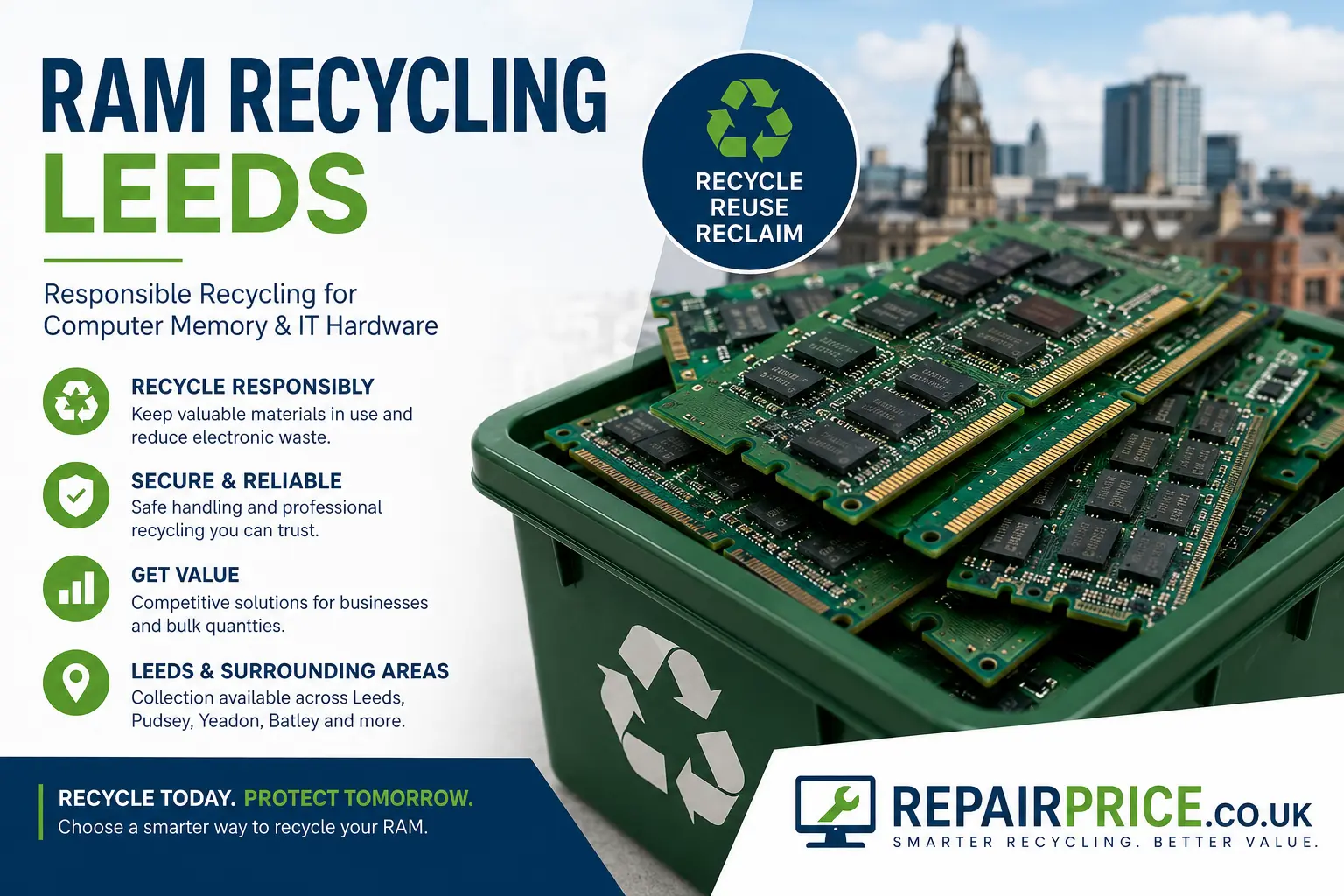
RAM Recycling Leeds: How to Recycle Computer Memory Responsibly
Old computer memory can easily end up forgotten in drawers, storage rooms, repair workshops and retired office computers. However, RAM modules contain reusable materials and electronic components that should be recovered through an appropriate recycling route rather than being placed in general household or commercial waste. This guide explains how RAM recycling in Leeds works, what types of computer memory can be recycled, why responsible disposal matters and how households, repair businesses, IT departments and organisations can arrange a practical recycling solution.
If you already have DDR, DDR2, DDR3, DDR4, DDR5, laptop memory, server RAM or mixed computer memory ready for recycling, visit our dedicated RAM recycling service for Leeds customers to find out how to move your unwanted memory into a specialist recycling route.
Book Your RAM Recycling Collection from Leeds WhatsApp
What Is RAM Recycling?
RAM recycling is the process of collecting redundant computer memory modules and directing them towards reuse, component recovery or specialist electronic waste processing. Random Access Memory modules are used in desktop computers, laptops, workstations, servers and many other computing systems. As equipment is upgraded or dismantled, large quantities of memory can become surplus even when the modules themselves are relatively small.
Rather than disposing of these modules with ordinary rubbish, RAM can be separated from other electronic equipment and processed as a distinct category of electronic material. This helps useful metals, circuit-board material and reusable components remain within the recycling chain. Businesses replacing large numbers of computers may accumulate significant quantities of memory over time, making organised RAM recycling particularly useful during IT refresh projects.
What Types of RAM Can Be Recycled in Leeds?
A wide range of computer memory may be suitable for recycling. This can include older SIMM and DIMM modules, SDRAM, DDR, DDR2, DDR3, DDR4 and DDR5 memory, laptop SO-DIMM modules, ECC memory, registered server RAM and memory removed from workstations or enterprise hardware. Mixed generations of RAM can usually be kept together when preparing material for recycling, although separating computer memory from unrelated electronic waste can make identification and handling easier.
Server environments can produce especially large quantities of memory when infrastructure is upgraded. If you are dismantling complete server systems as well as RAM, our Leeds server hardware recycling service provides another route for redundant enterprise equipment that may include processors, memory, boards and other server components.
Why Should Old RAM Be Recycled?
Computer memory should be treated as electronic material rather than ordinary waste. Every memory module consists of a printed circuit board populated with semiconductor chips, contacts and other materials. Individually, a single module is small, but when hundreds or thousands of modules are collected from businesses, repair shops, schools, data centres and IT refurbishment operations, the total volume becomes much more significant.
Recycling RAM helps keep potentially useful materials in circulation and reduces unnecessary disposal. It also encourages businesses to separate valuable electronic fractions before computers and servers are discarded. A structured recycling process can therefore form part of a wider IT asset disposal or electronics recycling programme.
Organisations clearing complete computer systems may also benefit from our business and IT equipment recycling in Leeds, which can provide a broader route when your redundant equipment includes desktops, laptops, networking equipment and related technology rather than RAM alone.
Where Does Recyclable RAM Come From?
RAM requiring recycling comes from many different sources across Leeds. Computer repair businesses may collect failed or uneconomical memory while upgrading customer devices. Companies frequently replace RAM during workstation upgrades or when entire fleets of computers reach the end of their operational life. Schools, universities and public organisations can also generate large quantities during scheduled technology refreshes.
Other sources include data centres, server maintenance companies, IT support providers, electronics recyclers, computer refurbishers and individuals upgrading home PCs. Even working memory may eventually become unsuitable for modern systems because of generation changes, capacity requirements or compatibility issues.
RAM Recycling During Computer Upgrades
Upgrading a computer is one of the most common reasons for removing memory. A desktop may move from lower-capacity modules to larger DIMMs, while a laptop could be upgraded with a complete replacement kit. In many cases the old memory is kept as a spare, but over time these unused modules can accumulate without a practical future use.
Before recycling working RAM, consider whether it can still be reused in another compatible machine. Reuse can extend the useful life of electronic equipment. If there is no practical reuse option, recycling becomes the next sensible route. Keeping reusable equipment and recyclable electronic material separate can help ensure each follows the most appropriate destination.
RAM and Printed Circuit Board Recycling
RAM modules are effectively compact printed circuit boards populated with memory chips. This means they form part of the wider PCB recycling sector. Organisations producing mixed boards as well as memory may need more than one recycling pathway depending on the materials involved.
If you also have assorted circuit boards from computers, telecoms equipment or other electronics, see our printed circuit board recycling options in Leeds. Separating RAM from larger or different PCB grades can make it easier to identify the material being presented for recycling.
What About Motherboards and CPUs?
Computer dismantling rarely produces RAM alone. Removing memory from desktops and servers will often leave processors, motherboards and other circuit boards that also require an appropriate recycling route. Keeping these components separated by type can help businesses organise their electronic waste more efficiently.
For main system boards, our motherboard recycling service in the Leeds area provides information about recycling desktop, laptop and server motherboards. These boards are substantially larger and more complex than memory modules and may be handled separately.
Processors removed during system upgrades can also be recycled. Our CPU and processor recycling service for Leeds covers redundant computer processors and related CPU material. Separating processors, RAM and motherboards before recycling can make large computer clearances easier to manage.
RAM Recycling for Leeds Businesses
Businesses can accumulate RAM surprisingly quickly. An office upgrading fifty computers could remove dozens or even hundreds of memory modules depending on the configuration of each machine. Larger organisations carrying out multi-site refresh projects can produce considerably more.
A simple approach is to create separate storage containers for RAM, processors, motherboards and other electronic components during dismantling. This prevents small memory modules from becoming mixed with general waste or disappearing inside boxes of unrelated equipment. Once a suitable quantity has accumulated, the material can be assessed for recycling.
Companies clearing broader categories of electrical equipment should also consider our electronics recycling solutions across Leeds for devices and electronic hardware that extend beyond traditional IT equipment.
Can Laptop RAM Be Recycled?
Yes. Laptop RAM modules are generally smaller than desktop DIMMs and are commonly known as SO-DIMMs. They are found in laptops, compact PCs and some specialist computing equipment. Older laptop memory may no longer be suitable for modern machines, but it can still be separated and directed towards an appropriate electronics recycling route.
When dismantling laptops, remove batteries and storage devices separately where appropriate and keep RAM modules together. Organisations processing larger volumes of retired laptops may find it useful to sort reusable components before sending the remaining material into recycling.
Can Server RAM Be Recycled?
Server memory is frequently generated during data-centre upgrades and enterprise hardware replacement. Servers may contain many more RAM modules than ordinary desktop computers, so removing memory from even a relatively small number of systems can produce a substantial quantity.
ECC, registered and buffered memory can all become surplus as servers are upgraded or replaced. Where complete servers are being retired, businesses can combine component sorting with a broader server disposal strategy rather than treating each component in isolation.
How to Prepare RAM for Recycling
Preparing memory modules does not usually require complicated processing. Keep the RAM dry, avoid unnecessary physical damage and place the modules in a secure container so that small pieces are not lost during storage or transport. If you have several different types of electronic components, label containers clearly so processors, RAM, motherboards and mixed circuit boards remain separate.
There is generally no benefit in cutting, crushing or dismantling RAM modules before recycling. Leaving modules intact makes them easier to identify and reduces the chance of creating unnecessary fragments. Businesses should also maintain appropriate records for their wider electronic waste disposal procedures where required.
RAM Recycling Around Leeds and Nearby Areas
Demand for computer component recycling extends well beyond Leeds city centre. Businesses, repair shops and households across the surrounding West Yorkshire area also generate redundant computer memory through upgrades, refurbishments and equipment clearances.
For customers west of Leeds, our RAM recycling information for Pudsey provides a dedicated local route. Customers in the north-west Leeds area can view computer memory recycling options in Yeadon.
We also provide location-focused information for recycling unwanted RAM in Birkenshaw and RAM and computer memory recycling in Batley. These location pages help users identify the most relevant route when recycling equipment outside central Leeds.
RAM Recycling as Part of a Wider Electronics Clearance
Many recycling projects begin with one component but quickly expand into a much larger clearance. A business may start with several boxes of RAM and later identify old desktop computers, servers, switches, monitors, motherboards and other redundant hardware stored on site.
Rather than allowing different categories of electronic equipment to remain unused indefinitely, organisations can create a structured inventory of what they need to recycle. Components can then be grouped into RAM, CPUs, boards, complete computers, servers and general electronics. This makes it easier to determine which specialist recycling pages or services are most relevant.
Should Working RAM Be Reused Before Recycling?
Where practical, working memory may still have value as a reusable component. Computer refurbishers, repair workshops and organisations maintaining older systems may be able to reuse compatible modules. Testing memory before deciding whether to recycle it can therefore be worthwhile where sufficient equipment and technical knowledge are available.
However, older RAM generations eventually become difficult to reuse because compatible systems are being retired. Very low-capacity modules may also offer little practical benefit in modern computers. When storage becomes inefficient and there is no realistic reuse demand, recycling provides an alternative to keeping obsolete components indefinitely.
Why Separate RAM from General Electronic Waste?
Sorting material helps create a clearer recycling stream. RAM is easy to identify and compact to store, so keeping memory separate from bulky electrical equipment requires relatively little effort. Repair businesses and IT departments can maintain a dedicated RAM container and add modules whenever systems are upgraded or dismantled.
The same principle can be applied to processors and motherboards. Component-level sorting can make stock management easier and provides a clearer picture of how much recyclable electronic material an organisation is producing.
Build a Responsible Computer Recycling Process
A good computer recycling process begins before equipment reaches the end of its life. Businesses can identify which devices are likely to be replaced, determine whether equipment can be reused and plan how remaining components will be recycled. When computers are dismantled, RAM, processors and boards can be grouped by category instead of being mixed together.
This approach is particularly useful for IT support companies and repair businesses that generate electronic components continuously. Instead of arranging disposal every time a single component is replaced, material can be consolidated safely until there is an appropriate quantity for recycling.
Arrange RAM Recycling in Leeds
If you have accumulated unwanted desktop RAM, laptop memory, server RAM or mixed computer memory, RepairPrice can help you move towards an appropriate recycling route. Start with our dedicated Leeds computer RAM recycling page for service information and the next steps.
If your recycling project also includes processors, motherboards, server hardware or general IT equipment, use the related service links throughout this guide to separate each category and identify the most appropriate recycling option.
Get a Leeds RAM Recycling Quote
Frequently Asked Questions About RAM Recycling in Leeds
Can old DDR3 and DDR4 RAM be recycled?
Yes. DDR3, DDR4 and other generations of computer memory can be collected for recycling when they are no longer required or practical to reuse. Older DDR, DDR2 and other memory types can also be included.
Can broken RAM modules be recycled?
Failed or damaged RAM may still be suitable for recycling as electronic material. Keep damaged modules together and avoid unnecessarily breaking them into smaller pieces.
Can businesses recycle large quantities of RAM?
Yes. Businesses upgrading multiple computers, servers or workstations may generate significant quantities of memory. Separating the RAM during the equipment refresh can make later recycling much easier.
Should RAM be removed from computers before recycling?
If you are specifically recycling RAM as a separate component category, removing the modules allows them to be stored and identified independently. If complete computers are being recycled through a broader IT recycling service, component removal may not always be necessary.
Can server memory be recycled with desktop RAM?
Server memory can generally be included as recyclable computer memory, although larger recycling projects may benefit from separating server components by category. This can include server RAM, processors, motherboards and backplanes.
Do you cover areas outside Leeds?
Dedicated RAM recycling information is also available for nearby areas including Pudsey, Yeadon, Birkenshaw and Batley. Use the location links above to find the page most relevant to where your material is located.
Start Recycling Your Unwanted Computer Memory
RAM is small enough to ignore but valuable enough, from a resource-recovery perspective, to deserve a proper recycling route. Whether you have a few modules left after a home PC upgrade or boxes of memory produced during a business IT refresh, separating the material and arranging responsible recycling can prevent useful electronic components from entering general waste.
For Leeds customers, the simplest next step is to review our RAM recycling service, separate any additional processors, motherboards or server hardware and contact RepairPrice when your material is ready. By treating memory as part of a wider electronics recycling strategy, households and businesses can create a cleaner and more organised approach to redundant technology.