

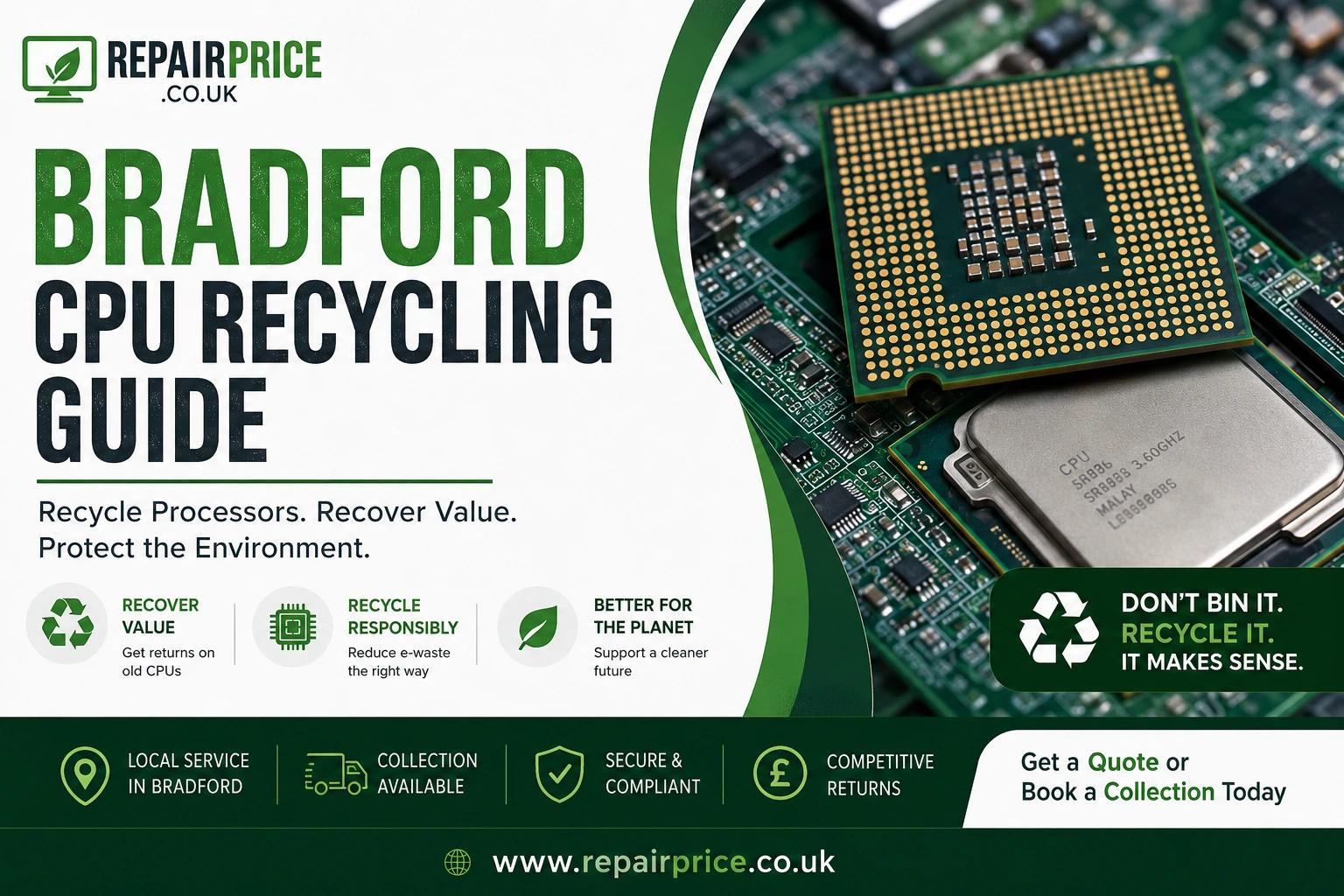
Bradford CPU Recycling Guide: How to Recycle Processors, Recover Value and Dispose of Computer Components Responsibly
If you have old computer processors, server CPUs, obsolete desktop chips or redundant IT equipment in Bradford, recycling them properly can help recover reusable materials while keeping electronic waste out of general rubbish. CPUs may be physically small, but they can contain valuable metals and specialist materials that make them worth separating from ordinary computer waste. This Bradford CPU recycling guide explains what can be recycled, how processor value can vary, what to do with complete computers and circuit boards, and how Repair Price can help connect you with suitable recycling options in Bradford and across West Yorkshire.
Whether you are clearing a single home computer, emptying a repair workshop, upgrading office equipment or dealing with a larger batch of redundant IT hardware, it is worth separating CPUs from other electronic components before disposal. For a dedicated local route, visit our Bradford CPU recycling service to learn more about processor recycling, collections and potential recovery options.
Need CPU Recycling in Bradford?
If you already have processors, computer components or mixed electronic equipment ready to recycle, you can request help from local recycling and repair businesses through Repair Price. Tell us what equipment you have, the approximate quantity and whether the processors are loose or still attached to motherboards. Providing useful information at the start can make it easier for participating businesses to assess the material.
Quote from Bradford CPU Recycling Specialists
Book Your CPU Recycling Collection from Bradford WhatsApp
Why Should Old CPUs Be Recycled?
Computer processors are designed to perform billions of calculations, but once the computers containing them are retired, damaged or upgraded, those processors can easily end up sitting unused in drawers, workshops and storage rooms. Throwing them into general rubbish wastes materials that may still have recycling value and mixes electronic components with ordinary household or commercial waste.
Specialist CPU recycling focuses on recovering usable materials from processors that may no longer have practical value as working computer parts. Depending on the processor generation and construction, CPUs can contain metals including copper and small quantities of precious-metal-bearing material. Some older processors can be particularly interesting to specialist recyclers because their physical construction differs considerably from that of modern processors.
Recycling also helps businesses improve the way they handle redundant electronic equipment. Repair shops, offices, IT companies, educational organisations and other commercial premises can accumulate large quantities of outdated hardware over time. Separating processors, RAM, motherboards and other circuit boards into appropriate categories can make a computer clearance more organised and may improve the potential recovery value of the material.
What Types of CPUs Can Be Recycled in Bradford?
A wide range of processors can enter specialist recycling streams. These can include desktop CPUs removed from old computers, laptop processors where removable, server processors, workstation CPUs, ceramic processors, fibre-based processors, older pin-style chips and various integrated processing components recovered from obsolete electronics.
Processors do not necessarily need to be recent or working. In many recycling situations, the physical material composition is more important than whether the CPU can still operate. Damaged pins, obsolete architecture or an inability to reuse the chip in a modern computer does not automatically mean it has no recycling potential.
If processors are still installed on boards, you may also want to review our motherboard recycling options for Bradford computer hardware. Separating processors from compatible boards may be appropriate in some situations, while in others it can make more sense to recycle the assemblies according to the recycler's preferred grading process.
Are Old Computer Processors Worth Money?
Some CPUs can have recycling value, but there is no single price that applies to every processor. Value can vary according to processor construction, age, grade, quantity, condition, current commodity markets and the requirements of the recycler receiving the material. A box of older ceramic processors may therefore be assessed differently from a collection of newer fibre processors.
Quantity also matters. One processor may have limited standalone recycling value once transport and handling are considered, whereas larger batches generated by IT departments, repair businesses or equipment clearances can be more attractive to specialist buyers. This is why users with mixed computer components should consider grouping CPUs with other recyclable electronic material rather than disposing of each item individually.
Do not assume that the newest processor is automatically the most valuable for scrap recovery. Older CPUs were sometimes manufactured using different materials and packaging techniques, and specialist recycling grades can vary substantially. Identifying processors accurately before requesting a quotation can therefore help you understand what you actually have.
CPU Recycling and Motherboard Recycling Are Closely Connected
Processors are usually removed from computer motherboards, which means CPU recycling often forms part of a wider circuit-board recycling process. When dismantling desktops, workstations or servers, you may find CPUs alongside mainboards, memory modules, expansion cards, power supplies, storage devices and wiring.
Instead of discarding the remaining board after removing a processor, consider sending it into an appropriate electronic recycling stream. Our Bradford service for recycling printed circuit boards from computers and electronics explains how a wider range of PCB material can be handled.
This approach is especially useful for repair shops and businesses carrying out regular equipment dismantling. Keeping processor grades, boards and other components separated can reduce contamination between categories and help recyclers identify materials more efficiently.
Do Not Throw Old RAM Away With Computer Waste
When CPUs are recovered from desktop computers or servers, RAM modules are often removed at the same time. Memory sticks contain their own printed circuit boards and electronic components and should normally be separated from general waste.
For dedicated information about memory recovery, see our Bradford RAM and computer memory recycling service. Keeping memory modules together rather than mixing them with cables, plastic casings and low-grade equipment makes the resulting material easier to categorise.
You can also read the Bradford RAM recycling guide for redundant computer memory if you want to understand more about separating memory modules, recognising different types and deciding whether equipment should be reused or recycled.
What About CPUs Removed From Servers?
Server recycling can generate larger quantities of processor material than typical household computer recycling. A decommissioned server environment may contain multiple CPUs, large quantities of memory, server motherboards, backplanes, network cards and other electronic components.
Businesses clearing older infrastructure should avoid treating the entire server as one undifferentiated waste item if specialist recycling routes are available. Our Bradford server hardware recycling service provides another route for organisations dealing with redundant server equipment and components.
Before recycling equipment that has been used to store business information, remember that CPUs are not normally the main data-storage component. Hard drives, solid-state drives and other storage media should be identified separately so appropriate data-handling procedures can be followed before the hardware leaves your control.
How to Prepare CPUs for Recycling
Start by gathering processors together and removing obvious non-electronic packaging or unrelated waste. If you have several processor types, keeping different physical styles separated can make assessment easier. For example, older ceramic processors can be stored separately from modern fibre processors, while server chips can be grouped away from low-value mixed electronic material.
Avoid unnecessary destructive processing. Cutting, grinding, burning or chemically treating processors yourself can introduce health, safety and environmental risks and can also make material more difficult for legitimate recyclers to assess. In most cases, keeping components intact and allowing a specialist recycling route to process them is the better option.
If you have a larger quantity, photographs can also be useful when requesting an initial assessment. Clear images showing the processors, approximate volume and any identifying markings can help a recycler understand the batch before arranging collection or delivery.
What If You Have Mixed Electronic Waste Rather Than CPUs Alone?
Many Bradford customers do not have processors in isolation. You may instead have old desktops, laptops, networking equipment, cables, computer boards, power supplies, peripherals and other redundant electronics. In that situation, a broader recycling solution may be more suitable than a CPU-only route.
For mixed household and business electronics, visit our Bradford electronics and general recycling information. This can help you identify an appropriate next step when your clearance contains several different equipment categories.
Businesses dealing specifically with computers, office hardware and redundant technology can also explore IT equipment recycling services serving Bradford organisations. Combining compatible equipment into a planned clearance can be more practical than arranging individual recycling journeys for every component type.
CPU Recycling for Bradford Computer Repair Shops
Computer repair businesses can build up recyclable processors surprisingly quickly. Diagnostic jobs, motherboard replacements, customer upgrades and machines judged uneconomical to repair can all result in removed CPUs and related electronic components entering workshop storage.
Creating separate containers for processors, RAM, motherboards and mixed PCBs can make recycling easier when sufficient material has accumulated. This also prevents higher-grade electronics from becoming mixed with metal cases, plastics, packaging and general workshop rubbish.
A repair-first approach should still come before recycling whenever practical. If a processor or computer can be tested, reused, refurbished or supplied for parts, extending its useful life can often be preferable to immediately breaking the equipment down for material recovery. Recycling becomes the next stage for components that are obsolete, damaged or unsuitable for economical reuse.
CPU Recycling for Bradford Businesses and IT Departments
Office upgrades frequently generate batches of similar equipment at the same time. A company replacing twenty desktop computers, for example, may suddenly have processors, RAM, motherboards and other components that are no longer needed internally.
Before disposing of them, organisations should determine whether complete machines have reuse potential. Working systems may be suitable for refurbishment, resale or redeployment. Machines that cannot reasonably be reused can then be dismantled or directed into appropriate recycling channels.
Keeping a basic inventory of equipment can also help when arranging a larger clearance. Record approximate computer quantities, whether processors have already been removed, what other board material is present and whether collection is required. Better information usually leads to a more useful conversation with the businesses assessing your material.
CPU Recycling Near Bradford Across West Yorkshire
Repair Price also supports users looking for processor recycling options outside Bradford itself. If your equipment is located north-east of the city, our CPU recycling service covering Yeadon can help you explore a more locally relevant route.
Businesses and households positioned towards Calderdale may prefer our Brighouse processor recycling information, particularly when dealing with redundant desktops, repair stock or computer components generated locally.
For larger clearances elsewhere in Calderdale, see our Halifax computer CPU recycling options. Keeping recycling routes geographically relevant can make collections and equipment handling more practical, especially where bulky computers accompany the processors.
If you are closer to the northern side of Bradford, our Shipley CPU and processor recycling service provides another location-focused route for unwanted computer components.
Why PCB Recycling Matters Alongside CPU Recycling
Processors represent only one small part of the electronic material inside a computer. Motherboards, memory modules, controller cards and server boards all contain printed circuitry and components that may be suitable for specialist recovery. Sending a CPU for recycling while throwing the remaining boards into general rubbish therefore misses much of the environmental benefit available from properly separating electronics.
A more complete process involves assessing the entire machine. First determine whether it can be repaired or reused. If reuse is not practical, identify any storage devices requiring secure handling. Processors, RAM and other boards can then be separated into appropriate recycling categories, while cases, cabling and other materials can follow suitable downstream routes.
Our Bradford CPU recycling service forms part of this wider approach, helping connect processor recycling with motherboard, PCB, RAM, server and general IT recycling rather than treating each component as an isolated waste problem.
Should You Repair, Reuse or Recycle an Old Computer?
Recycling should not automatically be the first decision just because a computer is old. Many machines can remain useful after relatively straightforward upgrades such as additional RAM, a replacement SSD, cleaning, operating-system maintenance or another compatible processor. Extending the life of usable equipment reduces the need to manufacture and purchase replacement hardware.
If the machine is too old, badly damaged or uneconomical to repair, component harvesting may be the next option. Working CPUs, memory and other parts can sometimes support repairs to similar systems. Only after practical reuse options have been considered should non-reusable components move into material recycling.
This repair, reuse and recycling hierarchy helps extract more useful life from electronics while still providing a responsible end-of-life route when hardware can no longer serve a practical purpose.
Frequently Asked Questions About Bradford CPU Recycling
Can Intel and AMD processors be recycled?
Yes. Processors from major manufacturers can potentially enter specialist recycling streams regardless of brand. The recycler will generally be more interested in the processor's construction, grade, quantity and condition than the logo printed on the component.
Can damaged processors still be recycled?
In many cases, yes. A processor with bent pins, damaged contacts or no functional reuse value may still contain recyclable material. Keep damaged processors separate and describe their condition when requesting an assessment.
Should I remove the CPU from the motherboard?
That depends on how your chosen recycler grades material. If you are confident working with computer hardware, processors and boards can often be separated. If you are unsure, avoid forcing components apart and ask the recycling business how it prefers to receive the equipment.
Can businesses arrange CPU collections in Bradford?
Collection possibilities will depend on the participating recycling business, equipment type, quantity and location. Larger batches are generally more suitable for collection than one or two small components, so provide an approximate quantity when making your enquiry.
Can I recycle complete computers as well as processors?
Yes. If your equipment has not been dismantled, broader Bradford IT or electronics recycling services may be more appropriate. Complete systems can first be assessed for potential reuse before recyclable components are separated.
Are old CPUs always valuable?
No. Some processor categories may have stronger material recovery value than others, and values can vary with market conditions and recycler grading. Avoid assuming that every CPU has a high scrap value simply because it contains small amounts of valuable material.
Build a Better Recycling Route for Your Bradford Computer Components
CPU recycling works best when it forms part of a structured approach to old technology. Instead of placing processors, boards and memory into one mixed box of general waste, separate the materials, identify anything that can still be reused and direct the remaining components towards appropriate specialist recycling routes.
If you are dismantling computers, remember to consider the other valuable component categories at the same time. Motherboards can move into specialist board recycling, RAM can be grouped separately, general printed circuit boards can be graded independently and server hardware may require a dedicated approach because of its size and component density.
For Bradford households, repair shops, businesses and IT departments, this creates a practical pathway from repair and reuse through to responsible recycling. It can reduce unnecessary electronic waste, make larger clearances easier to organise and ensure potentially recoverable components are not simply discarded.
Start With Bradford CPU Recycling
If you have obsolete processors, dismantled computer components or complete IT equipment ready for assessment, start with the dedicated CPU recycling page for Bradford. From there you can explore recycling options suited to the type and quantity of equipment you have.
For mixed technology clearances, use the broader Bradford recycling and IT recycling routes linked throughout this guide. If your processors came from servers, desktop computers or workshop repair stock, consider separating motherboards, RAM and printed circuit boards as well so each material can enter the most appropriate reuse or recycling stream.
Repair Price is designed to help connect repair, reuse and recycling rather than allowing usable equipment and recyclable components to disappear into general waste. Whether you have a handful of old CPUs or a larger commercial batch, providing accurate information about what you have is the best first step towards finding the right Bradford recycling solution.