

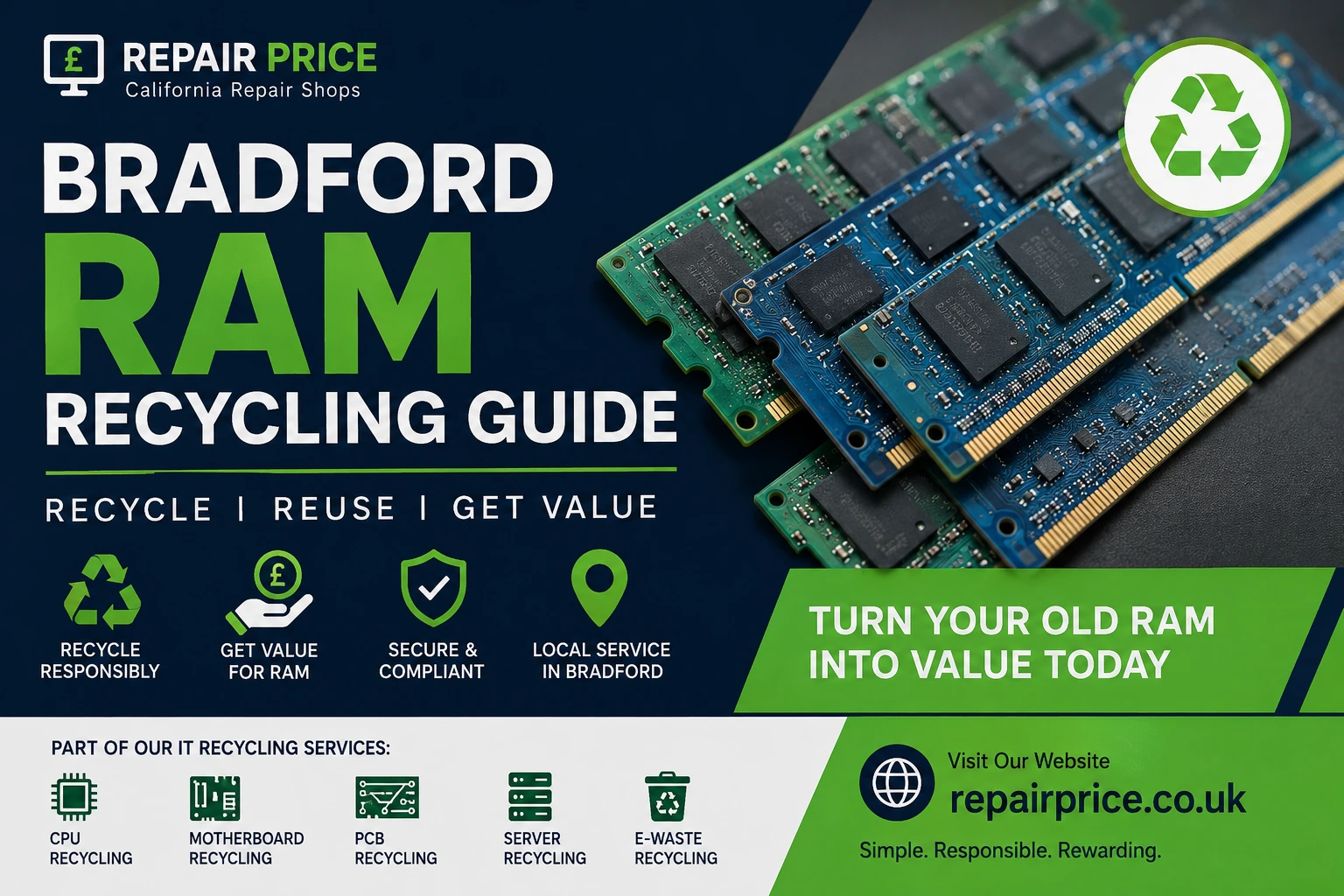
Bradford RAM Recycling Guide: Sell, Reuse and Recycle Computer Memory Responsibly
Old computer memory can easily end up forgotten in storage boxes, workshop drawers, server rooms and redundant desktop computers. However, RAM modules still contain reusable components and recoverable materials, which means they should not automatically be treated as general waste. This Bradford RAM recycling guide explains what happens to unwanted memory, which types of RAM can be recycled, how businesses and households can prepare modules for collection, and how Repair Price can help connect you with recycling options across Bradford and West Yorkshire.
If you have DDR, DDR2, DDR3, DDR4, DDR5, laptop SO-DIMM memory, server RAM or mixed computer memory, start with our dedicated RAM recycling service for Bradford. The page is designed for people who want to move unwanted computer memory into a reuse or recycling route rather than leaving it unused or disposing of it with general rubbish.
Arrange RAM Recycling in Bradford
Repair Price helps make it easier to find local recycling and technology services without having to contact multiple businesses individually. Whether you are clearing one computer or dealing with larger quantities of redundant IT equipment, you can submit details about the RAM and related hardware you want to recycle and obtain information from relevant businesses.
Get a Bradford RAM Recycling Quote
Book Your Bradford RAM Recycling Collection on WhatsApp
What Is RAM and Why Should It Be Recycled?
RAM, or Random Access Memory, is the temporary working memory used by computers, laptops, workstations and servers. Memory modules are fitted to motherboards and allow operating systems and applications to access information rapidly while a device is running. When computers are upgraded or retired, perfectly usable RAM can often be removed long before the rest of the machine reaches the end of its practical life.
Because memory is modular, it is particularly suitable for reuse. A working DDR4 module removed from one desktop computer may still be useful in another compatible machine. Even when memory is obsolete, faulty or physically damaged, specialist recycling can separate the module from the general waste stream and recover suitable materials through downstream processing.
Recycling RAM also fits into a wider approach to responsible electronics management. If your clearance includes complete computers, monitors, cables, storage devices and peripherals, our Bradford electronic waste recycling service can help you consider the entire batch rather than concentrating only on memory modules.
Types of Computer Memory We Commonly See
Computer memory has changed considerably over the years, and a typical IT clearance can contain several generations of modules. Desktop DIMMs, laptop SO-DIMMs, ECC memory and server modules may all be found together, especially when equipment has been stored for a long time.
Common recyclable memory can include DDR, DDR2, DDR3, DDR4 and DDR5 modules, laptop memory, registered server RAM, ECC memory, workstation RAM and mixed memory boards removed from older equipment. Modules can differ in capacity, speed, manufacturer, generation and condition, so separating them into obvious groups can make assessment easier.
You do not necessarily need to test every module before enquiring about recycling. If the memory has already been removed from retired computers, provide as much information as you reasonably can. Photographs showing the labels, module type and approximate quantities can be particularly useful when dealing with larger batches.
Should Working RAM Be Reused Before Recycling?
Where practical, reuse should be considered before material recycling. Working RAM may still have a useful life in compatible computers, refurbishment projects or parts inventories. Extending the life of functioning hardware reduces demand for replacement components and keeps electronics in productive use for longer.
Some memory, however, will no longer have a realistic reuse market. Very old modules, damaged boards, corroded contacts or memory that fails testing may be better suited to recycling. The important point is to avoid mixing potentially reusable computer components into general household or commercial rubbish where their remaining value can be lost.
If you are also removing processors from the same systems, our Bradford processor and CPU recycling page explains how redundant CPUs can be handled separately from memory.
RAM Recycling for Bradford Businesses
Businesses regularly accumulate memory during computer upgrades, server replacements, office relocations and IT refresh programmes. A company replacing dozens of desktop computers may suddenly have a substantial quantity of RAM alongside processors, motherboards, storage devices, cables and power supplies.
Keeping components separated can make the recycling process easier to manage. RAM can be grouped independently from complete circuit boards, CPUs and larger electronic items. This makes it easier to identify reusable material and understand which recycling route is most suitable for each category.
For mixed electronic clearances where computer boards form a significant part of the load, visit our Bradford printed circuit board recycling service. This provides a broader route for PCBs that do not fall neatly into the RAM, CPU or motherboard categories.
What About Server RAM?
Servers can contain much larger amounts of memory than ordinary desktop computers. Enterprise systems may use ECC DIMMs, registered memory and higher-capacity modules, and data centres or IT departments can accumulate significant quantities when servers are upgraded.
Server clearances also tend to generate other valuable electronic components. Backplanes, processor boards, controller cards and server motherboards can often be separated before the remaining chassis is processed. If your memory has come from decommissioned servers, see our Bradford server hardware recycling options for a more complete route.
You can also read our Bradford server recycling guide for more information about dealing with redundant rack servers, internal boards, memory, processors and related enterprise equipment.
Motherboards and RAM Should Be Separated Where Practical
RAM is normally installed directly into motherboard memory slots, so computer dismantling frequently produces both components at the same time. Removing the RAM makes it easier to determine whether it has reuse potential while leaving the motherboard available for its own recycling route.
If you have already dismantled desktop computers or workstations, keep the boards separate from loose memory modules where possible. Motherboards contain a much wider mix of sockets, integrated circuits, connectors and other components than standard memory sticks, so they may be categorised differently by recyclers.
For these boards, use our Bradford motherboard recycling service rather than mixing everything into a single unidentified electronics pile.
How to Prepare RAM for Recycling
Preparing computer memory does not need to be complicated. Remove the RAM carefully from the device where it is safe to do so, avoid unnecessary damage to the circuit board and keep modules dry. If you have a large quantity, separating desktop memory, laptop memory and server memory can make your enquiry clearer.
Do not scrape, burn, chemically treat or manually break memory modules in an attempt to recover materials yourself. Specialist electronic recycling relies on controlled processing methods and appropriate downstream treatment. Keeping modules intact is normally safer and also preserves the possibility that working units may be identified for reuse.
When submitting an enquiry, useful information includes the approximate number of modules, whether they are loose or still installed in computers, the type of equipment they came from, whether they are believed to work and whether additional electronic equipment is included in the collection.
Can RAM Be Included With a Larger Bradford Recycling Collection?
Yes. Many enquiries involve more than one type of electronic product. An office clearance, repair workshop or computer refurbishment operation might have RAM, processors, circuit boards, complete PCs, monitors and miscellaneous electronics ready for disposal at the same time.
If the collection contains a broad range of recyclable materials rather than only computer memory, start with our general recycling options in Bradford. This can help you identify a suitable route when the items fall across several recycling categories.
Separating higher-value or easily identifiable electronic components before collection can still be worthwhile. RAM, processors and motherboards are much easier to assess when they are not buried inside mixed general waste.
RAM Recycling Around Bradford and West Yorkshire
Repair Price also provides local pages for surrounding West Yorkshire areas so customers can find a service relevant to where their equipment is located. This is particularly useful for businesses with several offices, technicians working across different towns or organisations arranging collections from more than one site.
If your unwanted computer memory is located west of Bradford, explore RAM recycling services covering Pudsey. This local route can be useful for businesses and households between Bradford and Leeds that have old desktop, laptop or server memory ready for reuse or recycling.
For equipment located closer to the M62 corridor, our Cleckheaton computer memory recycling page provides a dedicated option for unwanted RAM and related technology components.
Customers north of Bradford can use our Bingley RAM recovery and recycling service when clearing older computers, upgrading office hardware or disposing of redundant memory modules.
For businesses and residents toward Calderdale, visit our Brighouse RAM recycling information for another local route covering unwanted desktop, laptop and server memory.
Why RAM Should Not Go in General Waste
Computer memory is electronic equipment rather than ordinary household rubbish. Throwing RAM into general waste removes the opportunity for reuse and can prevent recyclable materials from entering an appropriate recovery process. It can also lead businesses to lose track of electronic equipment generated during IT upgrades.
A better approach is to separate RAM at the point where computers are dismantled. Even a small container dedicated to memory, processors and similar components can make future recycling significantly easier. Repair workshops and IT departments that regularly replace hardware can adopt this as part of their normal workflow.
RAM Recycling for Computer Repair Shops
Computer repair businesses can generate a steady stream of memory modules from upgrades and faulty machines. Some modules can be tested and reused, while others become surplus because the generation is too old or the component has failed.
Instead of allowing obsolete memory to build up indefinitely, repair businesses can periodically separate reusable stock from modules intended for recycling. This creates a clearer inventory, frees workshop storage space and makes larger recycling collections easier to organise.
The same principle can be used for CPUs, motherboards and miscellaneous circuit boards. Sorting components as they are removed usually requires far less effort than trying to identify everything later after several months or years of mixed storage.
Does RAM Have Recycling Value?
The potential value of computer memory varies. Factors can include the generation of RAM, module specification, condition, quantity, whether it can be reused and the recycling route available at the time. A modern working module may have more reuse potential than obsolete or damaged memory, while larger sorted quantities are generally easier to assess than a handful of unidentified parts.
Because markets and recycling requirements change, it is better to submit current details rather than relying on an old assumed price. Providing photographs and quantities allows potential collectors or recyclers to understand what you actually have.
What Other Computer Components Can Be Recycled?
RAM is only one part of a computer. When a desktop, laptop, workstation or server reaches the end of its useful life, other components may also be suitable for reuse or recycling. CPUs, motherboards, network cards, graphics cards, storage devices, power supplies, cooling components and additional printed circuit boards should all be assessed rather than automatically discarded.
Breaking equipment down into sensible categories can improve the overall recovery process. For example, memory can follow the dedicated Bradford RAM route, processors can use the CPU recycling service, motherboard assemblies can be separated, and remaining electronic boards can be handled through PCB recycling.
From Repair and Reuse to Responsible Recycling
The most sustainable outcome for working electronics is often continued use. Repairing an existing computer, upgrading its memory or reusing working modules can extend equipment life without purchasing a complete replacement system. When reuse is no longer practical, responsible recycling becomes the next step.
This repair, reuse and recycling approach helps prevent usable electronics from being discarded prematurely. It also provides a clearer end-of-life route for components that genuinely cannot be returned to service.
Start Your Bradford RAM Recycling Enquiry
If you have redundant desktop RAM, laptop memory, server DIMMs or mixed computer memory in Bradford, begin by identifying the approximate quantity and whether other electronic components are included. You can then use the dedicated Bradford RAM recycling service to find the most suitable next step.
For larger clearances, consider separating CPUs, motherboards, server components and general circuit boards before submitting your enquiry. If complete electronics are also involved, use the Bradford recycling and e-waste pages to build a wider recycling route rather than treating every item as the same material.
Whether you are a household clearing old computers, a repair shop managing accumulated components, an IT department replacing office equipment or a business decommissioning servers, Repair Price can help move unwanted hardware toward repair, reuse and responsible recycling instead of general disposal.
Bradford RAM Recycling FAQs
Can old DDR3 RAM be recycled?
Yes. DDR3 RAM can be recycled, and working modules may still have reuse potential depending on capacity, specification and demand. Faulty or obsolete modules can be directed toward an appropriate electronics recycling route.
Can DDR4 and DDR5 RAM be reused?
Working DDR4 and DDR5 modules may be suitable for reuse in compatible systems. Testing and identifying the specification before recycling can help prevent usable memory from being processed unnecessarily.
Do you accept laptop RAM?
Laptop SO-DIMM memory can be included in a RAM recycling enquiry. Where possible, keep laptop memory separate from desktop DIMMs and server memory so the different types can be identified easily.
Can server memory be recycled with ordinary RAM?
Server memory can be submitted for recycling, although ECC and registered modules may be assessed separately because their specifications differ from typical desktop memory. Larger server clearances should also identify any processors, motherboards and backplanes being removed.
Should RAM be removed from computers before recycling?
If it is safe and practical to do so, separating RAM can make reuse assessment and recycling categorisation easier. However, complete computers can also be handled through suitable e-waste services when dismantling is not appropriate.
Can businesses arrange RAM recycling in Bradford?
Yes. Businesses, repair workshops, schools, organisations and IT departments can enquire about recycling unwanted memory and associated computer equipment. Providing quantities, photographs and collection information can help make the enquiry more useful.
Can I recycle RAM with motherboards and CPUs?
Yes, these components can form part of the same wider IT clearance, although separating the different categories is recommended. RAM, CPUs, motherboards and miscellaneous PCBs can then be directed toward the most suitable recycling or reuse pathway.