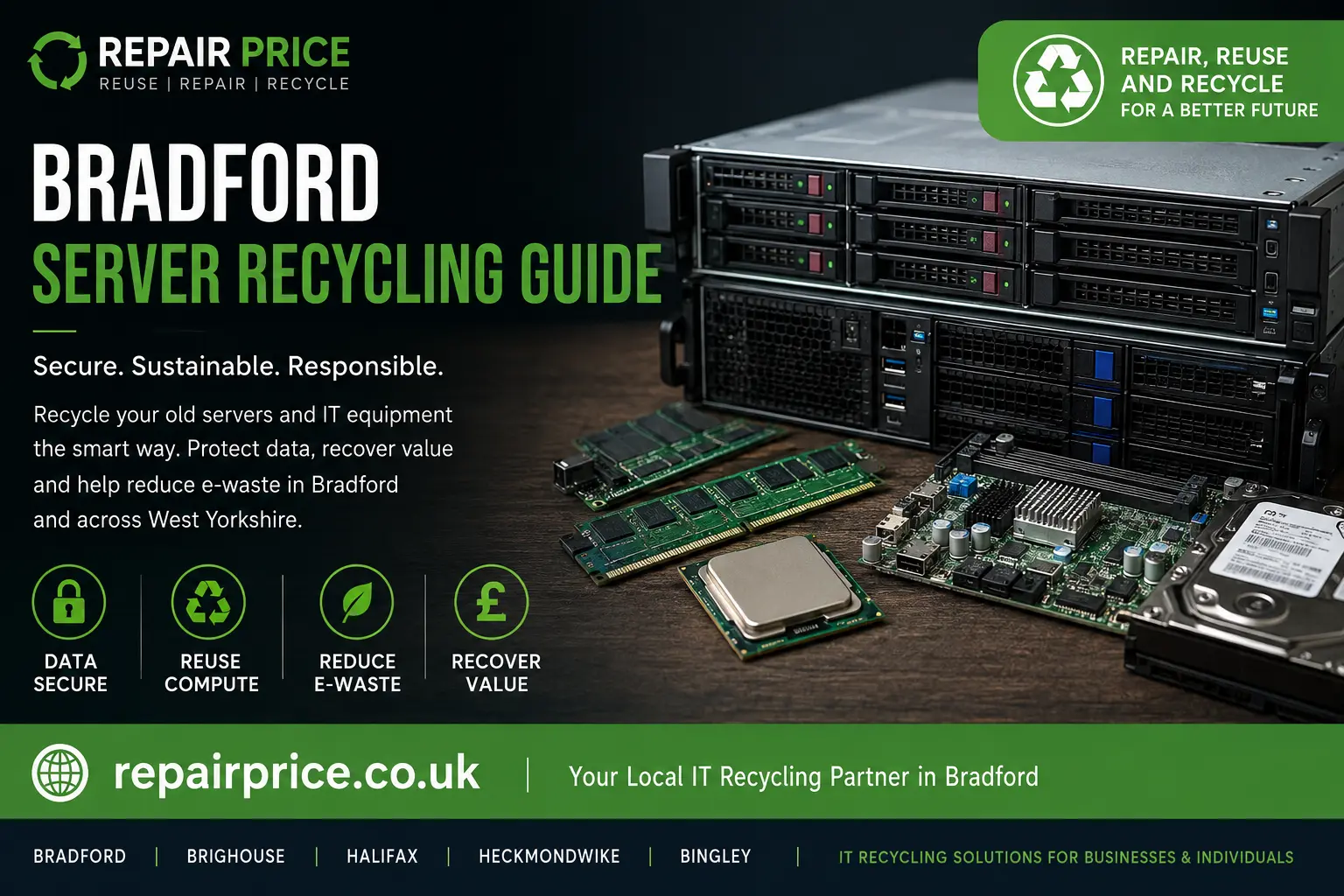
Old servers can contain valuable components, reusable hardware and large amounts of sensitive business data. Whether you are upgrading a server room, closing an office, replacing rack-mounted equipment or clearing redundant IT infrastructure, choosing the right disposal route is important. This Bradford server recycling guide explains how businesses, organisations and individuals can deal with unwanted servers responsibly while considering data security, component reuse, recycling value and the environmental impact of electronic waste.
Repair Price helps connect unwanted technology with repair, reuse and recycling opportunities. Instead of automatically treating an old server as waste, equipment can be assessed to determine whether complete systems, motherboards, processors, memory, drives or other parts still have further useful life. If you already have equipment ready for disposal, visit our dedicated server recycling service for Bradford to start exploring suitable recycling and reuse options.
Servers are very different from ordinary household electronics. A decommissioned server can contain enterprise-grade processors, multiple memory modules, specialist motherboards, RAID controllers, network cards, power supplies, cooling systems and storage devices. Even when the complete machine is no longer suitable for active business use, many of these components may still have reuse, repair or material recovery potential.
Allowing old server hardware to sit unused in a storeroom creates unnecessary clutter and can leave organisations holding equipment that still contains business information. Responsible recycling provides a structured route for removing obsolete hardware while giving reusable parts an opportunity to remain in circulation. Equipment that cannot be reused can then move further down the recycling process for responsible material recovery.
Businesses dealing with a broader range of redundant technology can also review our Bradford business IT recycling options. This can be particularly useful when a server clearance includes desktop computers, networking equipment, storage devices and other workplace electronics.
Server recycling can cover many different types of equipment, from individual systems removed during a small office upgrade to multiple rack servers from larger infrastructure changes. Tower servers, rack-mounted servers, workstation-class machines, storage servers and older enterprise hardware may all contain recoverable components.
The condition of the system does not necessarily determine whether recycling is worthwhile. A server that no longer boots may still contain usable RAM, CPUs, heatsinks, fans, power supplies or circuit boards. Machines with damaged cases or failed storage can also contain parts that may be suitable for testing, repair or responsible recycling.
This is why separating server components can sometimes provide a better recycling route than viewing the entire machine as one piece of scrap equipment. Individual hardware categories can be assessed more accurately and directed towards reuse or specialist recycling where appropriate.
The motherboard is one of the most substantial electronic assemblies inside a server. Server boards can contain processor sockets, memory banks, controller chips, capacitors, connectors and many other electronic components. When complete servers are no longer reusable, these boards should be kept within responsible electronics recovery channels rather than being mixed with ordinary waste.
If you are clearing loose boards or dismantled machines, our dedicated Bradford motherboard recycling service provides a more focused route for unwanted motherboard assemblies. This can be useful for repair businesses, IT departments and organisations that already separate components during equipment decommissioning.
Motherboard recycling can also form part of a wider PCB strategy. Different boards can contain different component densities and may require different downstream processes. Keeping boards separated from general waste helps maintain their potential for reuse, parts recovery and specialist electronic recycling.
Many business and enterprise servers contain one or more removable processors. These CPUs may still be usable even when the surrounding server has reached the end of its working life. In other cases, older processors may no longer be commercially useful as computing hardware but should still remain within appropriate electronics recovery channels.
Before disposing of a complete server without inspection, it can therefore be worthwhile identifying whether processors can be removed and assessed separately. For systems already dismantled, see our CPU recycling options in Bradford for a dedicated route covering unwanted processors and related hardware.
Server upgrades can also generate batches of processors when older machines are replaced at the same time. Keeping those components together can simplify assessment compared with allowing them to become mixed with general electrical waste.
Servers often contain significantly more memory than ordinary desktop computers. A single rack server may contain numerous DIMMs, while a larger decommissioning project can generate substantial quantities of server memory. Depending on specification, age and condition, some modules may have continued reuse potential.
Working server memory can sometimes be used for repairs, replacement systems or compatible legacy hardware. Modules that are damaged, obsolete or unsuitable for reuse can still be directed into electronics recycling rather than being placed in general rubbish.
For separated memory modules, use our Bradford RAM recycling route. This helps create a clearer recycling pathway for memory removed from servers, workstations and other computing equipment.
Data security should be considered before any server leaves your possession. Servers can contain customer records, business documents, account information, application databases, backups, internal communications and other confidential material. Removing a server from active use does not automatically remove information stored on its drives.
Organisations should therefore follow their own data-retention and destruction policies before recycling equipment. Storage devices should be identified and handled separately where required. Depending on the organisation and the sensitivity of the information, this may involve secure erasure, destruction or retention of particular drives.
The physical server chassis and its remaining electronic components can then continue through the appropriate reuse or recycling route. Maintaining a clear distinction between data-bearing hardware and other server parts makes the decommissioning process easier to manage.
An effective electronics strategy should consider whether equipment or components can remain in use before reducing them to raw materials. Some older servers may still have value for testing, development, parts harvesting, repairs or specialist legacy applications. Others may be unsuitable as complete systems but contain useful individual components.
Repair and reuse can extend the working life of existing hardware and reduce the immediate demand for replacement components. Once practical reuse opportunities have been exhausted, responsible recycling provides the next route for recovering materials from equipment that has genuinely reached the end of its useful life.
Repair Price is designed around this repair, reuse and recycling approach. By connecting equipment with suitable routes, unwanted electronics can be assessed more intelligently rather than automatically being classified as waste from the start.
Server replacements are often part of wider office or infrastructure upgrades. A project may also leave behind switches, desktops, laptops, cables, monitors, power equipment and other electronic hardware. In these situations, it can be more practical to consider the entire clearance rather than dealing with every item independently.
Our Bradford recycling network provides a broader route for people and organisations looking to deal with unwanted items beyond server hardware alone.
For end-of-life electronic equipment specifically, you can also explore electronic waste recycling services across Bradford. This is useful when a clearance contains mixed electrical and electronic equipment that is no longer suitable for continued use.
Businesses around Brighouse may also need to remove redundant server equipment following office relocations, hardware upgrades or infrastructure changes. Instead of storing old machines indefinitely, organisations can investigate local repair, reuse and recycling routes for complete servers and separated components.
Our Brighouse server recycling information provides a location-specific route for equipment originating in and around Brighouse while remaining connected to the wider West Yorkshire electronics recycling network.
Halifax businesses, repair companies and IT users may generate redundant server equipment when upgrading storage, replacing networking infrastructure or moving workloads to newer systems. The same principles apply: secure any data first, identify reusable components and then direct remaining hardware into appropriate recycling channels.
For a dedicated local route, visit our server recycling service covering Halifax for more information about dealing with unwanted server systems and components.
Older server hardware can quickly accumulate when systems are replaced but not immediately removed. This is particularly common for smaller businesses that keep redundant equipment as an emergency backup before eventually deciding it is no longer required.
Once equipment has reached that point, our Heckmondwike server recycling page provides another route into the wider West Yorkshire repair, reuse and recycling network.
Organisations in Bingley can also benefit from separating reusable server components before disposing of complete systems. RAM, processors and other hardware may still have value even when an older server no longer meets current performance requirements.
Visit our Bingley server recycling service if your equipment is located around Bingley and you want to explore a more appropriate route for redundant server hardware.
Servers contain numerous circuit boards beyond the primary motherboard. RAID cards, network adapters, storage controllers, backplanes, power-management boards and other electronic assemblies can all form part of a server recycling project. Understanding how these boards are handled can help businesses make more informed decisions about dismantling and recycling.
For additional information about circuit boards, component recovery and recycling routes, read our Bradford PCB recycling guide for businesses and electronics owners. It provides useful supporting information for anyone dealing with dismantled server boards or other electronic assemblies.
There is no single age at which every server should be recycled. Some systems remain useful for many years, particularly when they continue to perform a specific function reliably. Others become inefficient because of increasing power consumption, limited hardware support, expensive replacement parts or compatibility problems with modern applications.
A sensible decision should consider whether the machine is still useful, whether it can be repaired economically, whether its components can be reused elsewhere and whether continued storage serves a practical purpose. If the system no longer provides useful value, recycling may be preferable to leaving it unused indefinitely.
Before arranging recycling, create a basic inventory of the equipment being removed. Record the number of servers, approximate type of hardware and whether systems contain storage drives. If you are dealing with a larger business clearance, separating servers from unrelated electrical items can make the process easier to assess.
Where practical, keep useful components such as processors, RAM and specialist cards with the relevant machines until you know whether they will be reused or recycled separately. Avoid damaging boards unnecessarily during dismantling, because working parts may still have reuse potential.
Data-bearing drives require particular attention. Do not assume that deleting files or removing a server from the network has securely erased its information. Follow an appropriate data-management process before releasing storage hardware.
Traditional disposal models often focus only on removing unwanted equipment. A repair and reuse network takes a broader view by considering whether devices or components can continue to provide value before they enter final recycling.
This approach can be particularly useful for servers because they are modular systems containing many separate components. One failed part does not necessarily mean the entire machine has reached the end of its useful life. Memory, processors, boards, power supplies and other parts can sometimes continue supporting repairs or compatible equipment.
Where reuse is no longer practical, responsible electronic recycling remains an important final stage. The goal is to keep useful technology and recoverable materials in circulation while reducing unnecessary electronic waste.
If you have old servers, dismantled server components or other business IT equipment ready to clear, Repair Price can help you explore repair, reuse and recycling routes. Providing basic details about the equipment can help identify the most suitable next step, whether you have a single unwanted server or a larger quantity of redundant hardware.
Removing redundant server hardware does not need to mean sending useful technology directly into the waste stream. By identifying reusable equipment, separating valuable components, protecting stored data and using appropriate electronics recycling routes, businesses can manage server disposal more responsibly.
Start with our Bradford server recycling and reuse service if you have complete servers ready for assessment. For dismantled hardware, the dedicated motherboard, CPU and RAM recycling pages provide more specific routes, while our Bradford IT and e-waste services can help with larger mixed-equipment clearances.
Whether your equipment is located in Bradford, Brighouse, Halifax, Heckmondwike or Bingley, the objective remains the same: protect data, maximise opportunities for repair and reuse, and ensure equipment that has genuinely reached the end of its useful life enters an appropriate recycling pathway.