

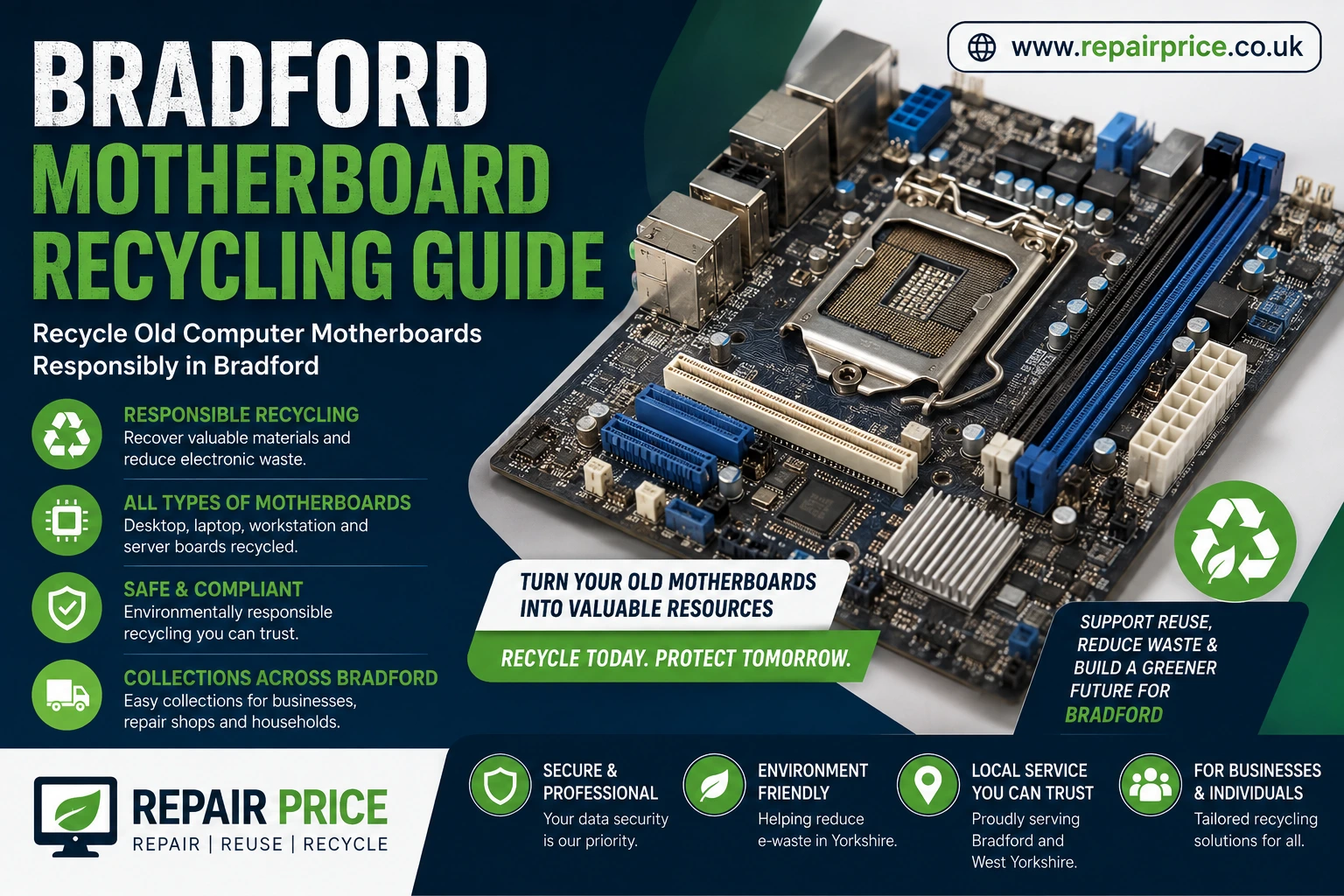
Bradford Motherboard Recycling Guide: Recycle Old Computer Motherboards Responsibly
Old computer motherboards can contain a surprising amount of reusable material. From desktop PCs and laptops to business workstations, servers and specialist electronics, the motherboard is one of the most important circuit boards inside a computer. When equipment becomes obsolete, damaged or uneconomical to repair, recycling the motherboard separately can help recover metals, electronic components and other materials that might otherwise be lost in mixed waste.
This Bradford motherboard recycling guide explains what motherboard recycling involves, which types of boards may be suitable, how businesses and households can prepare equipment for recycling, and why separating valuable circuit boards from general electronic waste can improve the recycling process. If you have motherboards ready to recycle, visit our dedicated motherboard recycling service for Bradford to find out how to arrange the next step.
Arrange Motherboard Recycling in Bradford
If you already have old motherboards, redundant computers or dismantled IT equipment ready for collection, you can contact Repair Price directly. Providing basic information about the equipment, approximate quantities and whether the boards have already been removed from the devices can make it easier to determine the most appropriate recycling route.
Book Your Motherboard Recycling Collection from Bradford WhatsApp
For larger quantities, business clearances, repair-shop stock or collections involving several types of circuit board, describe the material as accurately as possible. Separating motherboard stock from CPUs, RAM, server boards and mixed PCBs can make the recycling process clearer and more efficient.
What Is a Computer Motherboard?
A motherboard is the main printed circuit board within a computer. It connects components such as the processor, memory, storage interfaces, power connections, expansion cards and peripheral controllers. Depending on the age and type of equipment, a motherboard may also contain integrated networking, audio, graphics and other electronic functions.
Because motherboards contain many different electronic components, connectors, soldered parts and metallic materials, they should not normally be treated in the same way as ordinary household rubbish. Responsible recycling helps move these materials into appropriate recovery streams while reducing the amount of electronic equipment being discarded unnecessarily.
Motherboards can come from desktop PCs, office computers, gaming systems, workstations, industrial computers, point-of-sale equipment and some specialist electronics. Server equipment can contain much larger boards with different layouts and component densities, so organisations with data-centre or server-room equipment may also want to review our Bradford server board recycling service.
Which Motherboards Can Be Recycled?
Many common motherboard types can enter an electronics recycling stream even when they are no longer functional. Boards do not necessarily need to be working because the recycling value is often based on their material composition rather than their ability to operate.
Examples can include ATX and micro-ATX desktop motherboards, older PC mainboards, workstation boards, laptop mainboards, industrial computer boards and server-related circuit boards. The exact route may depend on the board type, quantity, condition and whether major components have already been removed.
If your material is broader than computer motherboards and includes assorted electronic boards from different equipment, our Bradford PCB recycling information may be more relevant. This is useful for mixed printed circuit boards that do not fall neatly into a single computer component category.
Why Recycle Motherboards Separately?
Separating motherboards from general waste or low-grade mixed electronics can help identify the material more accurately. A motherboard is very different from an empty computer case, power cable, plastic enclosure or steel chassis. Keeping board material separate can therefore simplify sorting and reduce unnecessary mixing of different recycling streams.
Computer motherboards may contain copper tracks, connectors, soldered components and small quantities of other recoverable materials. Modern recycling processes aim to recover useful materials from electronic equipment so they can re-enter manufacturing and processing chains rather than being permanently discarded.
For repair businesses, IT departments and computer refurbishers, motherboard separation can also be incorporated into routine workshop practices. Faulty boards can be placed into a dedicated container rather than being mixed with batteries, screens, cables, plastics and other parts removed during repairs.
Repair, Reuse or Recycle?
Recycling should not automatically be the first destination for every motherboard. A working board, or one that can be economically repaired, may still have reuse value. Extending the life of an existing component can sometimes be preferable to replacing it immediately.
Repair shops may be able to diagnose faults involving power delivery, connectors, BIOS problems, damaged sockets or individual components. However, there are also situations where repair is not practical. Severe liquid damage, extensive corrosion, burnt components, cracked boards, unavailable replacement parts or the low value of older hardware can make recycling the more realistic route.
The preferred hierarchy is therefore straightforward: consider repair where practical, reuse working components where there is genuine demand, and recycle equipment responsibly when continued use is no longer realistic.
Motherboards from Business IT Clearances
Bradford businesses regularly replace desktop computers, workstations and servers as hardware reaches the end of its useful life. This can leave IT teams with large quantities of equipment that must be sorted and routed appropriately.
Where whole computers are being cleared, it can be useful to separate reusable machines from equipment intended for dismantling. Working systems may have opportunities for reuse, while obsolete or damaged equipment can be directed towards recycling. Once machines are dismantled, motherboards, CPUs, memory and other circuit boards can be separated into their own categories.
Businesses dealing with wider equipment clearances should also review our Bradford electronics recycling options. This provides a route for broader recycling requirements where the collection contains more than motherboard material alone.
Motherboard Recycling for Computer Repair Shops
Computer repair businesses can accumulate faulty motherboards surprisingly quickly. Diagnostic replacements, liquid-damaged laptops, failed desktops and customer devices that are beyond economical repair can all create a steady stream of electronic parts.
Instead of storing these boards indefinitely, repair shops can create a simple recycling process. Keep motherboards dry, avoid mixing them with batteries or liquids, separate particularly different board categories where practical, and arrange recycling when enough material has accumulated.
Processor stock removed from computers can also be separated. If your workshop has accumulated processors as well as motherboards, see our Bradford CPU recycling service for guidance on recycling computer processors separately.
Quote from Bradford Repair Shops
Do Not Mix Batteries with Motherboards
One of the most important practical steps when preparing electronic parts is keeping batteries separate. Lithium batteries and other battery types require appropriate handling and should not simply be thrown into a box of circuit boards.
Laptop batteries, phone batteries, UPS batteries and other energy-storage devices should be identified and separated from motherboard material before collection. If equipment still contains a battery that cannot be safely removed, make this clear when describing the equipment rather than attempting a risky removal.
What About RAM Removed from Motherboards?
Memory modules are commonly removed from desktop and laptop motherboards during dismantling. These small circuit boards should be kept separate where possible because they are a distinct category of electronic component.
If you have DIMMs, SODIMMs, older memory sticks or mixed computer memory from IT equipment, visit our Bradford RAM recycling page. Separating RAM from motherboards also makes inventory and recycling quantities easier to understand.
Can Whole Computers Be Collected?
Not every customer wants to dismantle computers before arranging recycling. Businesses may have complete desktops, servers, damaged computers or obsolete systems still containing motherboards and other parts.
Whether whole equipment or separated boards are more appropriate can depend on the collection. Providing a clear description of what you have is therefore important. A batch consisting entirely of removed motherboards is different from a room containing complete computers, monitors, servers, cables and miscellaneous electronics.
For collections involving mixed circuit-board material, our Bradford circuit board recycling service provides additional information for businesses and individuals with a wider variety of electronic boards.
How to Prepare Motherboards for Recycling
Preparing motherboards correctly does not need to be complicated. Keep the boards somewhere dry, protect them from unnecessary contamination and avoid placing unrelated hazardous materials into the same container.
If you are handling a large quantity, grouping similar boards can be helpful. Desktop motherboards can be kept together, server boards can be separated, and processors or RAM can be placed into their own containers. There is usually no need to aggressively strip every small component from a motherboard unless you have specifically been advised to do so.
Businesses should also consider data security before disposing of complete computers. The motherboard itself is not normally where ordinary user files are stored, but complete systems may still contain SSDs, hard drives or other storage devices. These should be identified and handled according to your organisation's data-security requirements.
Motherboard Recycling Around Bradford and West Yorkshire
Recycling requirements are not limited to Bradford city centre. Repair businesses, offices, households and organisations across surrounding West Yorkshire communities may also accumulate unwanted computer boards and electronic equipment.
Customers close to Shipley can find location-specific information through our motherboard recycling service covering Shipley. This is useful for local businesses and residents looking for a recycling route without relying on general mixed-waste disposal.
For equipment located west of Bradford, our Clayton motherboard recycling information explains the local route for obsolete computer boards and related electronic components.
We also provide information for organisations and households looking for motherboard recycling around Pudsey, helping connect nearby West Yorkshire areas into the wider repair, reuse and electronics recycling network.
Further north, customers can visit our Bingley computer motherboard recycling page for location-focused guidance covering unwanted PC boards and similar electronic material.
What Happens After a Motherboard Is Recycled?
Electronic recycling typically involves sorting equipment so that different material categories can be processed appropriately. Circuit boards may pass through specialist processes designed to separate and recover useful materials.
The exact recycling process can vary depending on the type of board and downstream recycling facility. In general, the aim is to recover useful material while reducing unnecessary disposal. This is one reason accurate sorting at the beginning of the recycling chain matters.
A motherboard mixed into general waste can be difficult to recover responsibly. A motherboard already identified as circuit-board material can be directed towards a more suitable processing stream.
Motherboard Recycling and the Circular Economy
Computer hardware requires raw materials, energy, manufacturing and international transport before it reaches the user. Extending the life of equipment through repair and reuse therefore has an important role in reducing unnecessary replacement.
When reuse is no longer practical, recycling helps recover some of the material contained within obsolete equipment. Although recycling does not eliminate the environmental impact of producing electronics, it helps reduce the amount of potentially useful material being lost.
Repair Price is designed around this broader repair, reuse and recycling approach. Equipment that can still be repaired should have the opportunity to remain in use, while genuinely end-of-life electronics should have a responsible recycling route.
Motherboards, CPUs, RAM and Other High-Component Boards
A typical computer dismantling job produces several different types of electronic material. The motherboard is only one category. Processors, memory modules, expansion cards, storage devices, power supplies, server backplanes and other PCBs may all be removed from the same machine.
Separating these categories can make it easier to understand exactly what is being recycled. For example, server environments often contain boards that differ considerably from normal desktop motherboards. Likewise, processors and RAM have different physical structures and should not automatically be treated as identical material.
If you regularly dismantle computers or manage IT equipment, creating clearly labelled containers for each common component category can simplify ongoing recycling and reduce workshop clutter.
When Should You Arrange a Recycling Collection?
There is no universal quantity at which motherboard recycling becomes appropriate. A household may only have one or two old computers, while a repair business or IT department may accumulate dozens or hundreds of boards over time.
For businesses, it often makes sense to arrange recycling periodically rather than allowing equipment to occupy valuable storage space indefinitely. Keeping a basic record of what is being stored can also help identify when a collection has become worthwhile.
When requesting recycling, describe whether you have loose motherboards, complete PCs, server equipment or mixed electronic waste. Mentioning approximate quantities can help make the enquiry more useful from the start.
Could the Processor Be Reused Before Recycling?
Processors removed from obsolete motherboards sometimes remain operational even when the main board has failed. Depending on age, specification and market demand, there may be an opportunity for reuse before recycling.
If reuse is not practical, processors can be separated for an appropriate recycling route. Our related Bradford CPU recycling guide explains how processors differ from general circuit boards and what to consider when sorting them for recycling.
Why Local Electronics Recycling Matters
Providing clear recycling routes for Bradford and surrounding West Yorkshire areas makes it easier for repair businesses, organisations and households to avoid treating electronic components as ordinary rubbish.
Localised recycling information also helps users understand that different electronic parts may require different routes. A computer motherboard, lithium battery, hard drive and metal computer chassis are not the same material, even though they may all come from a single computer.
Better separation at the start can support more efficient downstream recycling while encouraging businesses to think about repair and reuse before equipment reaches the end of its useful life.
Bradford Motherboard Recycling for Repair, Reuse and Responsible Recovery
If you have old desktop motherboards, laptop boards, server boards or other computer circuit boards in Bradford, the first step is to determine whether the equipment can still be repaired or reused. Working hardware should not be discarded unnecessarily, and usable components may still have value within refurbishment or repair.
When a motherboard has genuinely reached the end of its useful life, responsible recycling provides the next route. Keeping boards separate from batteries, mixed rubbish and unrelated waste helps maintain a cleaner recycling stream and makes the material easier to identify.
Whether you are clearing a repair workshop, upgrading office computers, dismantling obsolete servers or simply dealing with several old PCs at home, you can start with our Bradford motherboard recycling collection and enquiry page. For larger mixed collections, the related Bradford recycling and circuit-board services above can help you choose a more suitable route.
Frequently Asked Questions About Motherboard Recycling in Bradford
Can faulty computer motherboards be recycled?
Yes. A motherboard does not normally need to be operational to enter an appropriate electronics recycling stream. Faulty, obsolete and damaged boards may still contain recoverable materials.
Should I remove the CPU before recycling a motherboard?
Where practical, separating CPUs can make sorting easier because processors are a separate electronic component category. However, the correct preparation can depend on the equipment and collection, so describe what you have when making an enquiry.
Should RAM be removed from old computers?
RAM modules can be separated from motherboards and grouped independently. Working memory may have reuse potential, while end-of-life modules can enter an appropriate recycling route.
Can businesses recycle multiple motherboards at once?
Yes. Repair shops, offices, IT departments, schools and other organisations may accumulate larger quantities of computer boards. Providing approximate quantities and describing whether the boards have already been removed can help when arranging recycling.
Can complete computers be recycled instead of dismantling them?
Mixed electronic equipment may require a broader recycling route than loose motherboard material. When contacting a recycling service, explain whether you have complete computers, separated components or a combination of both.
Do motherboards contain personal data?
Normal user files are generally stored on storage devices such as hard drives and SSDs rather than on the motherboard itself. However, complete computers should always be checked for data-bearing storage devices before disposal or recycling.
Do you cover areas outside Bradford?
Yes. Location-specific motherboard recycling information is available for nearby West Yorkshire areas including Shipley, Clayton, Pudsey and Bingley, with links provided earlier in this guide.
Start Your Bradford Motherboard Recycling Enquiry
Do not leave unwanted motherboards, processors, memory and circuit boards gathering dust indefinitely. Identify anything that can still be repaired or reused, separate genuinely end-of-life components, and use the appropriate Bradford recycling route for the remaining material.
Starting with properly sorted motherboard material can make the whole process clearer, whether you have a few boards from old household computers or a larger quantity generated through repair work, office upgrades or commercial IT clearances. Repair Price connects repair, reuse and recycling so that electronic equipment has a practical route at each stage of its lifecycle.