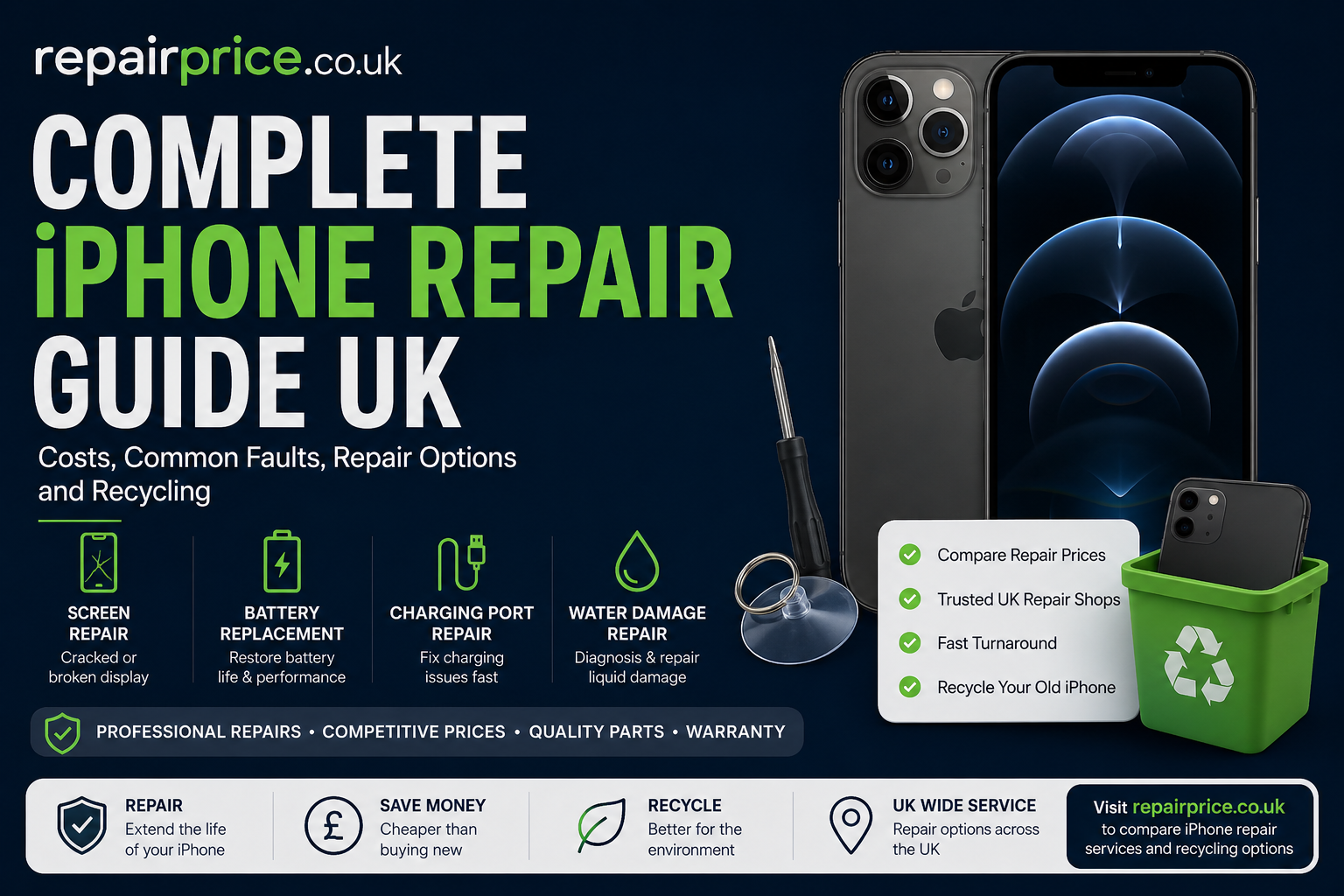
If your iPhone has a cracked screen, weak battery, charging problem, water damage or another hardware fault, deciding what to do next can be confusing. The Complete iPhone Repair Guide UK explains the main repair options available, what can affect the price of an iPhone repair, when professional diagnostics are worthwhile and when recycling or replacing the device may make better financial sense.
Repairing an iPhone can often extend its usable life considerably. Instead of immediately replacing a damaged handset, comparing repair options can help you understand whether a screen, battery, charging port or another component can be replaced economically. Repair Price helps UK customers compare relevant repair services and explore alternatives when a phone has reached the end of its practical life.
The first step is identifying the likely fault and comparing suitable repair options. You can start with the dedicated UK iPhone repair comparison page to explore repair routes for different models and faults. Comparing options is particularly useful because repair prices can vary according to the iPhone model, replacement part, severity of the damage and complexity of the work required.
Although an iPhone contains many individual components, several faults account for a large percentage of repair enquiries. Cracked displays, deteriorated batteries, unreliable charging connections and liquid-related problems are among the most common. Cameras, speakers, microphones, buttons and internal components can also develop faults, particularly after impact damage or prolonged use.
If you are unsure which service applies to your phone, the broader iPhone repair services guide can help you explore available repair categories before requesting a quote.
A damaged display is one of the most visible iPhone problems. Damage can range from a small crack in the outer glass to severe display failure affecting the touchscreen, OLED or LCD panel. Symptoms can include black areas, coloured lines, flickering, unresponsive sections or a completely blank display.
A screen that still displays an image is not necessarily safe to keep using indefinitely. Cracks can spread, sharp glass can become exposed and additional moisture or debris may enter through damaged sections of the display. If the touchscreen is behaving unpredictably, accidental inputs can also make the phone increasingly difficult to use.
Before arranging a repair, check the iPhone screen repair cost guide for the UK. This provides a useful route for comparing screen replacement options rather than choosing a repair solely on the first price you find.
There is no single price covering every iPhone screen replacement. Older models generally use different display technology and components from newer Pro and Pro Max devices. Screen type, model generation, replacement part specification and the extent of any surrounding frame damage can all influence the final quote.
For example, a straightforward cracked-screen replacement may be different from repairing an iPhone that has suffered a major impact and has display, housing and internal component damage. This is why describing the fault accurately when requesting a quote can help repairers provide more relevant pricing.
Rechargeable lithium-ion batteries gradually lose capacity through normal use. If your iPhone no longer lasts through the day, shuts down unexpectedly or drops rapidly from a seemingly healthy charge level, the battery may be approaching the stage where replacement is worthwhile.
Other warning signs can include excessive heat, inconsistent charging or visible battery swelling. A swollen battery should be treated carefully because it can place pressure on the display and other internal components. Avoid pressing a lifted screen back into position or puncturing a damaged battery.
Our UK iPhone battery replacement cost guide explains the service in greater detail and provides a route for comparing battery replacement rather than replacing an otherwise functional phone.
Battery replacement can be particularly cost-effective when the rest of the phone remains in good condition. If the camera, screen, storage capacity and overall performance still meet your needs, replacing one worn component may give the device a significantly longer useful life.
However, battery replacement needs to be considered alongside the overall condition and value of the handset. If the phone also requires a display, charging connector, housing and other repairs, comparing the combined repair cost against replacement or recycling becomes more important.
A phone that does not charge correctly does not automatically need a new charging port. Dust, pocket lint, damaged cables, worn accessories and software issues can sometimes produce similar symptoms. Testing with a known-working compatible cable and power adapter is therefore a useful first check.
If charging remains unreliable, the connector itself may require inspection. Common symptoms include having to hold the cable at a particular angle, repeated connecting and disconnecting, no wired charging response or a connector that feels unusually loose.
For more information, visit the iPhone charging port repair cost guide to understand the repair route before deciding whether the handset needs professional attention.
Liquid damage can be difficult to predict because two phones exposed to similar amounts of moisture can develop very different faults. One device may continue working normally while another develops charging, display, camera, battery or motherboard problems hours or days later.
If an iPhone has suffered significant liquid exposure, disconnect it from chargers and accessories and avoid repeatedly powering it on to test whether it still works. Drying the exterior does not guarantee that internal moisture or corrosion has been eliminated.
The iPhone water damage repair cost guide covers this type of fault in more detail and can help you decide whether diagnosis and repair are financially appropriate.
Screen, battery and charging problems receive a large proportion of attention, but they are far from the only faults that can be repaired. Depending on the model and condition of the handset, repairers may also investigate faulty cameras, damaged camera lenses, speakers, microphones, vibration motors, buttons, proximity sensors and other internal components.
If several symptoms appeared after a significant drop or liquid incident, diagnosis can be particularly valuable. What initially looks like a single failed component may involve more than one damaged part.
iPhone owners can choose between different repair routes depending on the device, warranty position, fault and personal priorities. Some customers prefer manufacturer-supported servicing while others compare independent repair providers based on price, convenience, turnaround and the type of replacement parts offered.
If you want to explore broader repair options for Apple devices, visit the Apple device repair comparison page. When comparing services, ask what is included in the quoted price and whether there are any important conditions attached to the repair.
Repair prices can differ significantly, even for faults that appear similar. The exact iPhone model is one of the biggest factors because components are not interchangeable across generations. Newer or higher-specification models can also use more expensive display assemblies, camera modules and internal components.
The severity of damage matters too. A simple display fault may require one replacement assembly, whereas a heavily damaged phone may also have frame distortion, camera damage or internal connector problems. Labour, replacement part quality, diagnostic work and the repairer's service terms can also affect the quoted price.
Before committing to a repair, confirm exactly which component is being replaced, whether the quoted price includes labour, how long the repair is expected to take and what warranty or guarantee applies to the completed work. It can also be useful to ask what happens if further damage is discovered after the phone is opened.
Comparing like-for-like quotations is more valuable than simply selecting the lowest advertised figure. A quote that initially appears cheaper may represent a different repair specification from another service.
The right choice depends on the value of the phone, its age, condition and the combined cost of the required work. A single screen or battery repair can make excellent financial sense, especially when the handset still performs well and has enough storage for your needs.
Replacement becomes more attractive when multiple expensive repairs are needed or when the handset has extensive structural, liquid or motherboard damage. Consider the entire device rather than viewing each fault independently.
For example, spending money on a display replacement may be sensible if the battery and housing are in excellent condition. The same repair may be less attractive if the phone also needs a battery, charging assembly and major rear housing work.
Customers in the capital can use the London iPhone screen repair page to explore relevant local repair options. Comparing providers can be particularly useful in a large city where prices, repair methods and service availability may vary substantially between businesses.
If you are based in Greater Manchester, the Manchester iPhone repair guide provides a dedicated route into local repair services. Describe the exact model and symptoms when requesting prices so that businesses can respond with more useful information.
West Yorkshire customers can explore iPhone repair services in Leeds when looking for help with cracked screens, battery problems, charging issues and other common faults. Comparing local options can help you balance price with convenience and repair requirements.
For customers in Bradford and surrounding areas, our Bradford iPhone repair comparison page provides another route to relevant repair information. Supplying the model number and a clear description of the damage can make quote comparisons easier.
Users in the West Midlands can explore Birmingham iPhone repair services when deciding whether to repair a damaged handset locally. Consider the complete price, service terms and suitability of the proposed repair before making a decision.
South Yorkshire customers can visit the Sheffield iPhone repair page to investigate options for damaged or malfunctioning Apple phones. A local comparison can be useful for repairs where returning the device quickly is important.
Whenever possible, create an up-to-date backup before handing your phone over for repair. Depending on your setup, this may be completed through iCloud or another suitable backup method. A repair does not necessarily erase the device, but maintaining your own current copy of important information is sensible whenever hardware work is being performed.
Also make sure you know your Apple Account credentials and understand any preparation instructions provided by your chosen repairer. Requirements can differ depending on the service being undertaken.
Your iPhone may contain photographs, messages, email accounts, financial applications and other private information. Ask the repair provider whether they require access to the unlocked device and why. Many physical component replacements do not require unrestricted access to all of your personal information, although functionality tests may require limited interaction with the handset.
If the phone is being permanently recycled rather than repaired, remove personal information wherever the condition of the device allows. Signing out of relevant accounts and securely erasing the handset before transfer can help prepare it for responsible reuse or processing.
Not every damaged iPhone should be repaired. A severely damaged older handset may require several replacement components whose combined price exceeds what is sensible for the device. In that situation, keeping the phone forgotten in a drawer is not the only alternative.
Repair Price also provides routes into device recycling services, allowing customers to explore a more responsible end-of-life option for unwanted electronics.
An iPhone that is no longer suitable for everyday use may still contain reusable parts and recoverable materials. Recycling helps move unwanted electronics into appropriate reuse and recovery channels instead of leaving devices unused indefinitely or placing them into general household waste.
For a broader overview of available options, visit our electronics recycling information centre. Recycling may be appropriate for damaged, obsolete, uneconomical or unwanted devices as well as other electronics that have reached the end of their practical service life.
Inside every iPhone is a densely populated logic board containing processors, connectors, integrated circuits and numerous other electronic components. When devices are dismantled at the end of their usable life, these boards require specialist handling rather than disposal with ordinary waste.
Businesses, recyclers and organisations handling larger volumes of electronic hardware can learn more through the circuit board recycling service. This provides a dedicated route for printed circuit boards and related electronic material.
Printed circuit boards from mobile devices may have recycling value depending on their type, grade, quantity and prevailing recovery conditions. Values should not be assumed simply from the original retail price of the phone because specialist recyclers assess electronic material according to its recoverable content and processing requirements.
If you handle quantities of dismantled mobile phone boards, consult the UK scrap mobile phone board recycling price guide for more specialised information about this category of electronic scrap.
Extending the usable life of an existing device can delay the need for another handset and keep functioning electronics in service for longer. That does not mean every phone should be repaired regardless of cost. Instead, repair should be considered alongside the age, condition, expected remaining lifespan and financial value of the device.
A practical approach is to repair devices where the work is proportionate, reuse functional phones wherever possible and recycle equipment responsibly when further repair is no longer economically or technically sensible.
When submitting an enquiry, include the exact iPhone model, the main fault, when the problem started and whether the phone suffered a drop, impact or liquid exposure. Mention any additional symptoms even if they seem unrelated. For example, a cracked display combined with intermittent charging could indicate more than one repair requirement.
Photographs of visible damage can sometimes help a repairer understand the likely condition, although internal faults may still require physical diagnosis. The more accurate your initial description, the easier it becomes to compare relevant quotations.
The cheapest repair is not automatically the best value, just as the most expensive service is not automatically the highest quality. Compare what each quotation actually includes. Look at the replacement component specification, labour, testing, turnaround, aftercare and any warranty provided with the work.
Your aim should be to find a repair that makes sense for the remaining value and expected life of your iPhone rather than simply locating the lowest headline figure.
Some faults are easy to identify, while others produce similar symptoms. A phone that will not power on could have a battery fault, charging problem, display issue or more complicated internal damage. Replacing components based purely on guesswork can result in unnecessary expense.
Professional diagnosis can therefore be valuable when the cause is uncertain, particularly with liquid-damaged phones, devices that have suffered major impact or handsets displaying several faults simultaneously.
Yes, depending on their condition and the required repair. An older phone that needs only a relatively straightforward repair may still provide substantial additional use. This can be attractive for customers who are satisfied with the device and do not need features offered by the newest generation.
However, the calculation changes if an older handset requires multiple expensive components. Always compare the repair total with the phone's realistic value, your expected future use and alternative replacement options.
A small crack does not always stop a phone from functioning immediately, but damage can become progressively worse. Cracked glass may expose sharp edges, compromise the display assembly and allow additional contamination into the phone. If the display begins lifting, flickering or producing unusual touch behaviour, arranging an assessment becomes more important.
Some liquid-damaged phones can be repaired, but the outcome depends on where the liquid reached, how long it remained inside and which components have been affected. Corrosion can also continue developing after the initial incident, making early assessment useful for valuable devices.
A successful repair cannot be assumed before the handset is examined, which is why diagnostic work is often an important part of liquid-damage enquiries.
If poor battery performance is the main problem and the rest of the handset remains suitable, battery replacement can be considerably more practical than replacing the entire device. Evaluate the phone as a whole, including screen condition, software usefulness, storage capacity and any other existing faults.
Once a phone is genuinely beyond economical repair, consider whether it can be reused for parts or transferred through an appropriate electronics recycling route. Avoid placing mobile phones and their lithium-ion batteries into ordinary household waste where specialist processing is available.
Start by identifying your exact model and primary fault. Check whether other problems are present, compare the likely total repair requirement and obtain suitable quotes. Consider the phone's current condition, expected remaining lifespan and replacement value before committing to expensive work.
If repair is affordable and proportionate, extending the life of the handset can be a sensible option. If the repair total becomes difficult to justify, move to reuse, resale where appropriate or responsible recycling rather than continuing to spend money on a device that has reached the end of its economical service life.
Whether you need help with a smashed screen, worn battery, unreliable charging connection, liquid damage or another iPhone fault, comparing repair options before making a decision gives you a clearer picture of the likely cost and appropriate next step.
Repair where it makes financial sense, maintain devices that still have useful life and recycle responsibly when they no longer do. By following that approach, you can make a better-informed decision for both your budget and the electronics you already own.