Last updated: August 2026
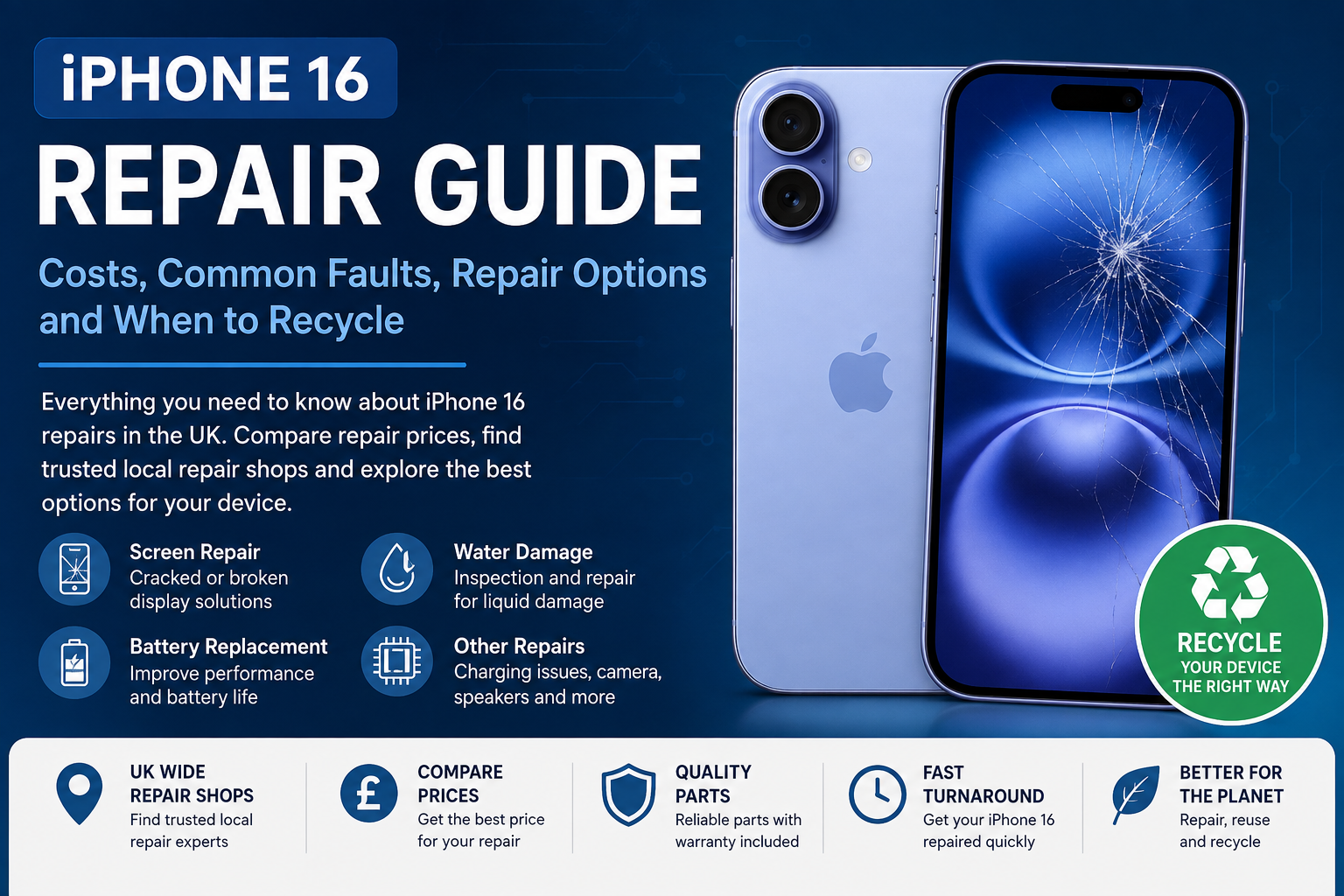
If your iPhone 16 has a cracked screen, weak battery, charging fault, damaged camera, broken rear glass or signs of liquid exposure, understanding your repair options before booking can help you avoid unnecessary expense. This iPhone 16 repair guide explains the faults owners commonly encounter, what can influence repair prices, how to compare independent repair services and when replacing or recycling the handset may make more financial sense.
The iPhone 16 is a valuable device, so even relatively minor damage can be frustrating. Repair costs vary according to the component affected, the replacement part used, the amount of labour required and the repair shop carrying out the work. Before agreeing to a repair, compare the complete price, warranty terms, expected turnaround and replacement-part specification rather than choosing a provider based only on the lowest advertised figure.
Repair Price helps users compare independent repair options rather than automatically replacing a damaged phone. You can start with the dedicated iPhone 16 repair price comparison page to review the repair route for this particular model and then explore the specialist services that match the fault affecting your handset.
There is no single price that applies to every iPhone 16 repair. A simple battery replacement may involve substantially less work than replacing a damaged display assembly, rear housing or several components after liquid exposure. Prices can also differ between independent repair businesses because technicians may use different grades of replacement parts and offer different warranty periods.
The condition of the phone matters as well. A handset that has only a visibly cracked display can be easier to assess than an iPhone that has been dropped heavily and now suffers from screen damage, camera problems, frame distortion and intermittent charging. Where several faults are present, ask the repairer to identify which components genuinely require replacement before approving the full job.
For a broader overview of available Apple handset services, visit the UK iPhone repair comparison service. Comparing providers can be particularly useful when the phone is outside warranty or when you want to understand the difference between repairing the device and replacing it.
A cracked or damaged display is one of the most common reasons an iPhone owner searches for a repair. Damage can range from a small crack in the outer glass to more serious display problems such as black areas, coloured lines, flickering, touch-response failure or a completely blank screen.
The severity of visible damage does not always show how badly the internal display has been affected. A phone with relatively modest external cracking may develop touch problems, while another handset with extensive cosmetic damage may continue working normally. A technician should therefore assess display operation as well as the physical condition of the glass.
If the display is the main problem, compare current options through the iPhone screen repair cost guide. When reviewing quotes, check whether the price includes fitting, testing and any applicable repair warranty.
Battery performance gradually declines as a phone ages and completes repeated charging cycles. Symptoms can include noticeably shorter runtime, unexpected shutdowns, inconsistent battery percentages, excessive heat or a phone that requires charging much more frequently than before.
Before arranging a battery replacement, consider whether unusual battery drain could be caused by software activity, background applications, poor signal conditions or demanding usage. When the battery itself has substantially deteriorated, however, replacement can extend the useful life of the handset and may be considerably cheaper than buying another phone.
You can review typical considerations and repair choices in the iPhone battery replacement cost guide. Ask whether the quoted replacement includes installation and post-repair testing and whether a warranty is provided with the battery.
If an iPhone 16 will not charge correctly, the charging port is not automatically the cause. Problems can originate from a damaged cable, unsuitable charger, debris inside the port, battery failure or an internal charging-related component. Testing another compatible charging cable and power source can help eliminate simple accessory problems before the handset is booked for repair.
A charging connection that works only at a particular angle may indicate contamination or physical wear around the port. Avoid forcing connectors into the handset because this can make existing damage worse. If careful inspection and basic troubleshooting do not solve the problem, professional diagnostics are usually preferable to replacing components without confirming the cause.
Liquid exposure can produce unpredictable faults. A phone may initially appear to work normally and then develop charging, display, speaker, camera or power problems later. Internal corrosion can continue after the outside of the device looks completely dry, so early inspection can be valuable when important components have been exposed.
Avoid repeatedly connecting a charger to a phone that may still contain moisture. If the device contains important data, explain this to the technician before work begins so that data preservation can be considered during the diagnostic process.
For more information about assessment and potential repair routes, see the iPhone water damage repair cost guide. Liquid-damaged phones can vary significantly in repair complexity, which is why accurate diagnostics are particularly important.
Camera faults can include blurred images, focus problems, vibration, black camera previews or physical damage to the lens area. Before assuming that a camera module needs replacement, check whether the problem affects every camera mode and whether restarting or updating the handset changes the behaviour.
Speaker and microphone problems may appear as distorted audio, poor call quality, weak sound or difficulty being heard by other callers. Dirt and obstruction can sometimes reduce performance, while impact or moisture damage may require component-level repair. Accurate fault diagnosis helps prevent paying to replace a part that is not actually responsible for the problem.
A heavily dropped iPhone 16 may sustain more than cosmetic damage. Cracked rear glass can be accompanied by housing deformation, damaged camera surrounds or internal component movement. Where the frame has been distorted, simply replacing the visibly broken section may not completely restore the handset.
Ask the repair shop to check the overall condition of the device if the impact was severe. Identifying additional damage before repair starts reduces the chance of discovering further costs after one component has already been replaced.
If repair costs are becoming substantial, comparing the iPhone 16 with closely related models can help you decide whether investing in the existing handset still makes sense. Owners considering a larger device can review iPhone 16 Plus repair and ownership options, while users with a higher-specification handset can compare the iPhone 16 Pro repair page.
For people comparing the standard model with Apple's alternative entry in the same generation, the iPhone 16e repair comparison page provides another useful reference. Looking at repairability and potential future costs across related devices can help when deciding whether to repair the phone you already own or move to another model.
The cheapest advertised price is not necessarily the best overall value. Before booking, establish exactly what the quote includes. Ask about the replacement component, labour, testing procedures, warranty duration and whether any additional charge could be introduced after inspection.
It is also useful to describe the fault accurately. For example, saying that a phone has a cracked display but still responds normally to touch provides more information than simply requesting a screen quote. Mention additional symptoms such as overheating, rapid battery drain, intermittent charging or camera failure so the repair provider can make a more informed initial assessment.
Where possible, compare several repair businesses instead of relying on the first price you find. Repair Price is designed to make this comparison process easier by helping customers connect with relevant independent repair providers.
Repair availability and pricing can differ between towns and cities, so comparing local providers can help you identify a convenient service as well as a competitive quote. Customers in North Yorkshire can explore iPhone repair options in York, while users in Somerset can compare Bath iPhone repair services.
In the Midlands, the Birmingham iPhone repair comparison page provides a route to relevant services. West Yorkshire customers can use the Bradford iPhone repair page when looking for independent technicians closer to Bradford.
Customers on the south coast can compare Brighton and Hove iPhone repair providers, while those in the South West can explore local iPhone repair services in Bristol. Comparing location-specific services can be especially useful when turnaround time and travel distance are important.
Repairing usually makes sense when the handset otherwise performs well, the repair cost represents a reasonable proportion of the phone's value and you expect to continue using it. Screen and battery repairs can often extend the practical life of an otherwise functional handset.
Replacement becomes more attractive when several expensive faults exist simultaneously, the device has serious structural or liquid damage, or the total repair cost approaches the value of an equivalent replacement handset. Your decision should also consider data needs, remaining useful life and whether you are already planning to upgrade.
Before discarding a faulty phone, obtain a repair assessment where practical. A device that appears beyond repair to its owner may have one replaceable failed component. Equally, professional inspection can confirm when additional repair spending would be difficult to justify.
Not every damaged handset should be repaired indefinitely. When an iPhone 16 has severe impact damage, extensive liquid corrosion, several failed components or repair costs that exceed its practical value, recycling can provide a more responsible route than storing the phone unused or placing it in general household waste.
Visit the device recycling comparison service to explore options for unwanted electronics. You can also read the wider electronics recycling information hub for guidance on dealing with end-of-life devices and other electrical equipment.
Before recycling a working or partially working iPhone, back up any information you need, sign out of relevant accounts where possible and follow appropriate procedures for protecting personal data. A handset that is no longer economical to repair can still contain reusable components and recoverable materials.
Mobile phones contain printed circuit boards populated with processors, connectors and numerous electronic components. When a handset can no longer be economically restored, specialist processing can recover useful materials from this electronic hardware rather than allowing it to enter the general waste stream.
Businesses and organisations dealing with larger quantities of electronic equipment can learn more through the circuit board recycling service. This is particularly relevant for repair businesses, IT companies and organisations accumulating damaged boards or electronic components.
For information specifically related to the potential recycling value of mobile handset boards, see the scrap mobile phone board recycling price guide. Separating suitable electronic material for specialist recycling can support material recovery while reducing unnecessary electronic waste.
Once a repair has been completed, basic preventative measures can reduce the likelihood of further damage. A protective case can help absorb some impact during a drop, while an appropriate screen protector may reduce minor scratching and surface damage. Neither can guarantee that the handset will survive a major impact, but they can reduce everyday risk.
Avoid exposing the phone unnecessarily to extreme heat, moisture or contaminants around charging openings. Use compatible charging equipment and investigate unusual battery behaviour rather than continuing to use a handset that becomes excessively hot or repeatedly shuts down.
Regular backups are also important. Hardware can fail without warning regardless of a device's age, and having an up-to-date backup can make repair, replacement or recycling decisions considerably easier if a serious fault occurs.
Ask whether diagnostics are included, whether the quoted price covers both labour and parts, what type of replacement component will be fitted and how long the repair warranty lasts. You may also want to confirm whether the repair provider needs access to the handset passcode for testing and what data-handling procedures are followed.
If your iPhone has more than one fault, request an itemised assessment where possible. This makes it easier to distinguish essential repairs from cosmetic work and decide whether completing every repair remains financially sensible.
In many cases, yes. If the handset is otherwise in good condition and requires one main repair such as a display or battery replacement, repairing it can be more economical than replacing the entire device. The final decision should be based on the complete repair cost, condition of the phone and how long you intend to keep it.
A cracked display can often be replaced, although the repair required depends on whether damage is limited to the glass or also affects the underlying display and touch functions. A technician can inspect the phone and determine the appropriate repair.
If battery performance is the main problem and the rest of the handset remains in good condition, battery replacement can be an effective way to extend its useful life. Replacement of the entire phone becomes more relevant when several costly faults are present at the same time.
Some liquid-damaged devices can be repaired, but the outcome depends on which areas were exposed and whether corrosion has affected critical components. Diagnostic inspection is normally required before the viability and cost of repair can be established.
Consider a specialist electronics recycling route rather than placing the handset in household waste. Phones contain batteries, circuit boards, metals and other materials that should be handled appropriately and may have recoverable value.
A damaged iPhone 16 does not automatically need to be replaced. Start by identifying the fault, compare appropriate repair providers and understand exactly what each quote includes. Screen damage, battery deterioration, charging problems and many other faults may be repairable at a cost that allows you to continue using the phone for considerably longer.
If the handset has reached the point where repair is no longer financially sensible, move to the recycling route rather than leaving it unused. Repairing suitable devices and responsibly recycling uneconomical ones can reduce waste while helping owners recover the maximum practical value from their electronics.
For model-specific information and repair comparison, return to the complete iPhone 16 repair guide or continue to the dedicated iPhone 16 repair service page to compare your next repair options.