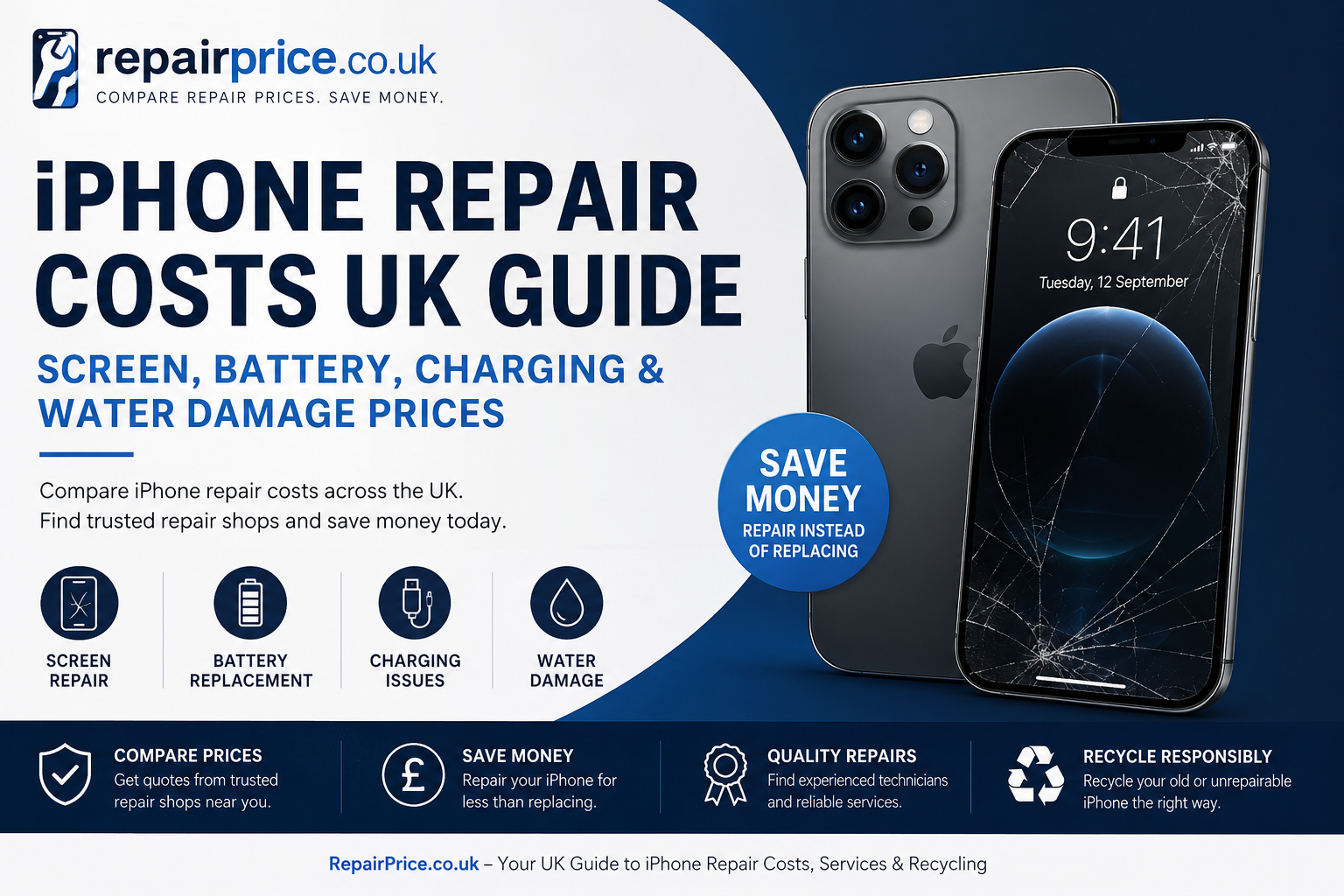
Understanding iPhone repair costs in the UK can help you decide whether to repair your handset, replace it, sell it, or recycle it responsibly. Prices can vary considerably depending on the iPhone model, the damaged component, the quality of replacement parts required, labour complexity and the repair shop carrying out the work. A straightforward battery replacement on an older iPhone will normally involve a very different level of work from repairing a damaged display, charging circuit or liquid-damaged newer model.
This UK iPhone repair cost guide explains the main repairs owners are likely to encounter, the factors that influence quotations and the questions worth asking before choosing a technician. RepairPrice.co.uk can also help you compare options through our dedicated UK iPhone repair comparison service, allowing you to investigate repair rather than immediately spending money on another handset.
Before deciding that an iPhone is beyond economical repair, it is worth obtaining a quotation. A cracked screen, worn battery, faulty charging port or damaged camera can make a handset frustrating to use while still leaving most of the device in perfectly serviceable condition. Comparing repair options gives you a clearer idea of whether restoring the existing phone makes financial sense.
When requesting a quotation, provide the exact iPhone model and describe the symptoms as accurately as possible. Mention whether the display is cracked, whether touch response still works, how quickly the battery drains, whether the charging cable needs to be held at an angle, or whether the phone has recently been exposed to liquid. Better information can help a repair business assess the likely work before carrying out physical diagnostics.
There is no single iPhone repair price that applies to every handset. The final amount depends on the model and fault. Newer devices frequently use more expensive display assemblies, increasingly integrated components and additional sealing methods. Older handsets can sometimes be cheaper to repair because compatible replacement parts are more widely available, although sourcing high-quality components remains important.
Owners comparing several faults at once should consider the combined repair cost rather than evaluating each repair separately. A handset that needs a new screen and battery may still represent good value if the rest of the phone is in strong condition. By contrast, a device with extensive liquid damage, damaged housing, motherboard faults and multiple non-working components may be a better candidate for recycling.
For a broader overview of repair options covering different generations, visit the iPhone repair service information page. It provides another route into the repair process when you already know the handset needs professional attention but have not yet identified the exact fault.
Screen damage remains one of the most common reasons for iPhone repair. Damage can range from a small crack in the outer glass to complete display failure. Black patches, coloured vertical lines, flickering, unresponsive touch areas and a completely blank screen can all indicate that more than the surface glass has been affected.
The cost of a screen repair depends heavily on the model and replacement display specification. Newer premium models normally cost more to repair than older devices because their displays are more sophisticated and replacement assemblies are more expensive. If your main concern is display damage, our dedicated UK iPhone screen repair cost guide explains the subject in greater detail.
Before approving a screen replacement, ask what type of display is being supplied, whether the quotation includes fitting and whether any warranty applies to the repair. The cheapest advertised figure is not automatically the best option if substantial compromises are being made in component quality.
Battery deterioration tends to happen gradually, which means owners often adapt to poor performance without realising how much usability has been lost. Common symptoms include rapid discharge, unexpected shutdowns, excessive heat, reduced runtime under moderate use or a phone that needs charging several times during the day.
Battery replacement is often one of the most practical ways to extend the working life of an otherwise functional iPhone. If the handset still performs well, stores enough data for your requirements and remains compatible with the apps you use, replacing a worn battery can delay the considerably higher cost of replacing the entire device.
You can read our specialist iPhone battery replacement price guide for more information about common battery symptoms, repair considerations and deciding when replacement becomes worthwhile.
An iPhone that refuses to charge does not always need a charging-port replacement. The issue may be caused by compacted debris, damaged cables, charging accessories, a worn connector, battery problems or an internal electrical fault. A competent diagnostic process should identify the most likely source rather than replacing parts unnecessarily.
Other frequently repaired faults include damaged rear cameras, faulty microphones, speaker problems, broken buttons, damaged rear glass and intermittent connectivity issues. Because several symptoms can have more than one cause, an accurate diagnosis can be as important as the replacement component itself.
Liquid exposure is one of the hardest repair categories to price without inspection. Two iPhones exposed to apparently similar amounts of water can suffer very different internal damage. One may require cleaning and a relatively minor component repair, while another may develop corrosion across connectors, power-management circuitry or the logic board.
If your handset has been exposed to liquid, avoid repeatedly powering it on simply to check whether it still works. Continuing to apply power to compromised internal circuitry can potentially contribute to further problems. Our iPhone water damage repair cost guide covers assessment, repair considerations and the factors that can influence whether restoration is economically sensible.
Owners of newer handsets should expect repair pricing to reflect the value and complexity of modern components. If you own Apple's newer generation, our iPhone 17 repair page provides model-specific information to help you compare potential repair routes rather than relying on generic figures intended for older devices.
When evaluating an iPhone 17 repair, compare the quotation against the handset's remaining value, condition and expected period of future ownership. Paying more for a high-quality repair can make sense when you plan to retain a relatively new phone for several more years.
The iPhone 16 repair information page is useful for owners researching faults affecting this generation. Screen condition, battery health, frame damage and any secondary faults should all be considered together when deciding how much money it makes sense to invest.
A repair quotation should be evaluated against the replacement cost of a comparable handset rather than automatically compared with the price originally paid for the phone. A professionally repaired iPhone 16 may still offer substantial usable life and therefore avoid unnecessary replacement expenditure.
For the previous generation, visit our iPhone 15 repair guide. As these devices remain capable and valuable, repairing common faults such as damaged displays or degraded batteries can frequently be worth considering before upgrading.
Owners should also consider the overall physical condition of the handset. If the frame, cameras, storage capacity and core functions remain suitable for your needs, repairing one failed component may offer significantly better value than replacing the entire device.
The right decision depends on the relationship between repair cost, handset value and future usefulness. Repair normally becomes more attractive when the fault is isolated, the device is otherwise reliable and the repair cost is substantially lower than replacing it with a comparable handset.
Replacement may become more sensible when multiple expensive faults are present, software support is a concern or the device no longer has sufficient storage or performance for your needs. Even then, the damaged handset should not automatically be treated as ordinary waste. Working components and recyclable materials can retain value.
Repair prices can differ between locations, particularly where operating costs and local competition vary. Customers in the capital can use our London iPhone screen repair comparison page to investigate repair options relevant to London.
If you are based in Greater Manchester, our Manchester iPhone repair guide provides a dedicated route for researching local repair services and comparing solutions for common handset faults.
West Yorkshire customers can explore the Leeds iPhone repair comparison page when looking for repair businesses serving Leeds. Comparing quotations is particularly useful when the repair involves higher-value components such as newer-generation displays.
For customers closer to Bradford, use our Bradford iPhone repair information to investigate available repair routes and determine whether restoring your existing handset represents better value than replacing it.
Customers in the West Midlands can visit the Birmingham iPhone repair page for location-specific information. Checking more than one repair option can help you compare service levels rather than selecting a provider based solely on headline price.
South Yorkshire customers can also research services through our Sheffield iPhone repair guide. Local comparison can be especially useful when you need to balance price, turnaround expectations and the specification of replacement components.
A useful repair quotation should make the proposed work reasonably clear. Ask whether the quoted price includes the replacement component, labour and any diagnostic charge. You should also understand whether further faults discovered after opening the device could result in additional costs.
Where applicable, ask about the repair warranty and what it covers. Warranty terms vary between businesses and may apply only to the specific part replaced rather than accidental damage or unrelated future faults. Keeping a copy of the invoice and repair documentation can be useful if an issue later develops.
Price matters, but it should not be viewed in isolation. Replacement-part specification, technician experience, diagnostic quality, warranty terms and aftercare can all influence the overall value of a repair. A slightly higher initial cost may be worthwhile when it reduces the likelihood of needing the same work repeated.
Ask questions whenever a quotation seems unusually low compared with alternatives. Understanding exactly what is being supplied makes it easier to compare like with like and avoid choosing purely on an advertised starting price.
Some handsets reach a point where repair is technically possible but financially unattractive. Extensive housing damage, severe board corrosion, multiple defective components or a combination of screen, battery and internal faults can push the total repair cost beyond what makes sense for that particular handset.
If your iPhone falls into this category, recycling offers an alternative to leaving it unused in a drawer. Our main device recycling service provides a route for unwanted electronics, while the broader electronics recycling information centre explains additional options for dealing with end-of-life technology responsibly.
An unwanted iPhone contains metals, electronic components, circuit boards, batteries and other materials that should be handled appropriately. Recycling helps divert electronic equipment away from general waste while allowing useful materials to enter suitable recovery processes.
Recycling can also make sense when a handset has little practical resale value because of extensive damage. Rather than continuing to store a broken phone indefinitely, owners can move it into an appropriate recycling route and clear unwanted electronic equipment responsibly.
Phones that cannot economically be restored may still contain circuit boards suitable for specialist material recovery. Repair businesses, recyclers and organisations handling larger quantities of damaged electronics can learn more through our circuit board recycling service.
Printed circuit boards contain a mixture of metals and electronic materials, making them different from ordinary household waste. Correct segregation and specialist recycling are particularly relevant for businesses accumulating damaged handsets, replacement boards or dismantled electronics.
If you handle larger quantities of damaged or dismantled smartphones, our scrap mobile phone circuit board price guide provides further information about recycling mobile boards and understanding the factors that may influence their recyclable value.
Board values can vary depending on category, composition, quantity and the recycler's grading requirements. Businesses should keep different types of electronic material appropriately separated where possible, as mixed loads can be harder to classify accurately.
The most useful approach is normally to assess repairability before discarding a handset. A cracked display, weak battery or faulty charging component can often be addressed without replacing the entire phone. Repair extends the practical life of equipment that still meets your needs and can reduce unnecessary expenditure.
When repair no longer represents reasonable value, recycling provides the next route. This creates a straightforward hierarchy: diagnose the problem, compare repair quotations, repair when economically worthwhile and recycle the handset or its recoverable components when continued use is no longer practical.
Before handing an iPhone to a repair provider, back up important information whenever the device remains functional enough to do so. Photos, contacts, documents, authentication details and other personal information may be difficult to recover if an already damaged handset deteriorates further during normal handling or diagnostics.
You should also confirm any preparation instructions given by the repair provider. Requirements can differ depending on the fault being investigated. Avoid attempting complex dismantling yourself simply to reduce the quoted labour cost, as accidental damage to connectors, batteries or internal components can make the eventual professional repair more difficult.
If you have decided to recycle rather than repair the handset, back up any information you want to retain and remove personal accounts where the phone remains operational. Follow appropriate manufacturer procedures for erasing personal information before transferring ownership or sending the device into a recycling process.
Devices containing damaged lithium batteries need particularly careful handling. A swollen, punctured or overheating battery should not be treated like an ordinary intact handset. Seek appropriate advice from the recycler handling the device and avoid unnecessary pressure or physical manipulation of a damaged battery.
It often can be, particularly when only one component has failed. A screen or battery repair may cost considerably less than replacing the complete handset. The comparison becomes less favourable when several major repairs are required simultaneously.
Different businesses can use different replacement-part specifications, labour structures, warranty terms and diagnostic processes. Location and operating costs can also contribute to price differences. This is why comparing the full repair offering is more useful than considering only the lowest advertised number.
No. Liquid damage varies considerably in severity. Some devices can be restored, while others develop extensive corrosion or board-level damage that makes repair uneconomical. Inspection is usually required before the likely outcome can be assessed properly.
If battery performance is the main problem and the handset otherwise meets your needs, battery replacement can be an efficient way to extend its useful life. Replacement becomes more attractive when the phone has several additional faults or no longer suits your requirements.
Yes. A handset does not need to be fully operational to enter an appropriate recycling route. Broken devices can still contain recoverable materials and reusable components, although the correct process depends on condition and battery safety.
Yes. Circuit boards from dismantled mobile phones can be handled through specialist electronics and PCB recycling routes. This is particularly relevant for repair shops and commercial organisations accumulating larger quantities of failed boards.
Knowing the likely repair category is the first step towards making a better decision about your iPhone. Screen damage, declining battery performance, charging problems and water exposure each require different diagnostic and repair approaches, and the correct price depends heavily on the exact model and condition of the handset.
RepairPrice.co.uk is designed to help UK customers investigate repair options before replacing useful technology unnecessarily. Start with our complete iPhone repair costs UK guide, move into the relevant repair or model page for your fault, and compare available options before committing to a repair.
If repairing the handset no longer represents sensible value, the journey does not need to end with the phone sitting unused or entering general waste. Move into one of our recycling routes instead, allowing damaged handsets, electronics and circuit boards to be handled through a more appropriate recovery process.