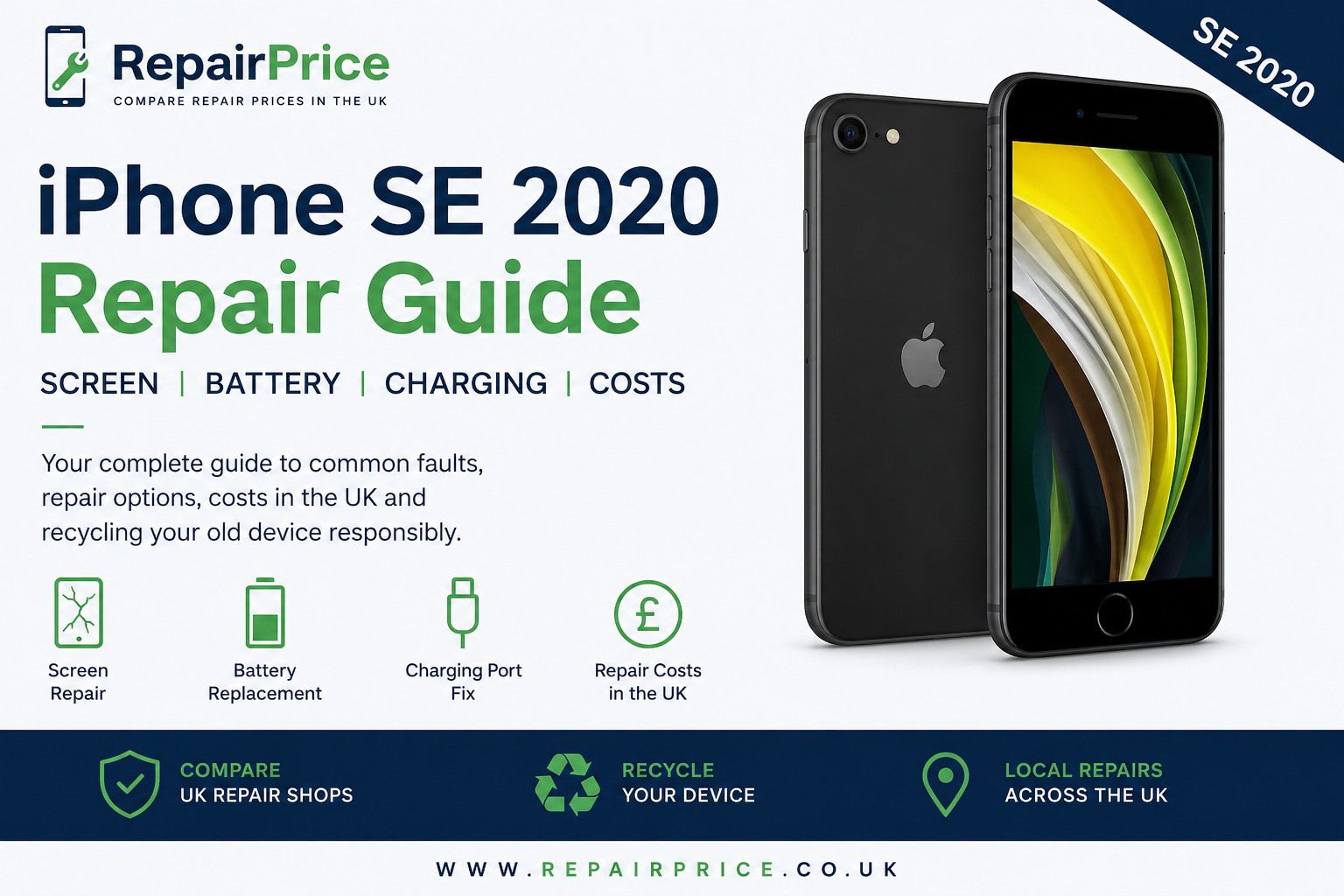
The iPhone SE 2020 remains a practical and affordable Apple handset, combining the familiar compact design of the iPhone 8 generation with the faster A13 Bionic processor used in the iPhone 11 family. Although it is now an older model, many devices remain perfectly usable and can often be kept working for several more years with the right repair. This iPhone SE 2020 repair guide explains the most common faults, when a repair makes financial sense, when replacement should be considered and what to do with a handset that is no longer economical to fix.
If your handset has a cracked display, weak battery, unreliable charging port, faulty speaker, damaged camera or another hardware problem, start by checking the dedicated iPhone SE 2020 repair and price comparison page. Comparing repair options before replacing your phone can help you understand whether restoring the handset offers better value than purchasing another device.
In many cases, yes. The most important question is not simply the age of the handset but the type of fault and the overall condition of the phone. An iPhone SE 2020 with a damaged screen but a healthy motherboard, cameras and charging system may still be a strong repair candidate. A relatively straightforward component replacement can potentially extend its useful life without the higher cost associated with changing to a newer handset.
Repair becomes less attractive when several major problems occur at the same time. For example, a phone with a damaged display, severely degraded battery, faulty charging circuit and liquid-damaged motherboard may require enough work that replacement becomes the more sensible option. Before deciding, compare the likely repair cost against the value of the handset and the cost of an alternative model.
You can explore a wider range of faults through the UK iPhone repair service comparison. This is particularly useful if you are uncertain which component has failed or need help comparing repair options for more than one fault.
A damaged screen is one of the most common reasons an iPhone SE 2020 needs professional attention. Screen damage can range from cosmetic cracks across the outer glass to complete display failure. Symptoms can include coloured lines, dark areas, flickering, an unresponsive touchscreen or a completely black display even though the handset continues to vibrate or make sounds.
A small crack may initially appear harmless, but continuing to use a badly damaged display can allow moisture, dust and debris to enter the phone. Sharp broken glass can also make the device uncomfortable or unsafe to handle. If touch responsiveness is deteriorating, arranging a repair sooner can reduce the chance of losing practical access to your data.
For a broader comparison of display repair considerations and pricing, visit the UK iPhone screen repair cost guide. Comparing prices is especially useful for an older handset such as the SE 2020 because you want the repair price to remain proportionate to the phone's current value.
Battery ageing is another common issue. Lithium-ion batteries gradually lose their ability to hold the same amount of charge, and an older iPhone SE 2020 may therefore need charging considerably more often than when it was new. You might notice the battery percentage falling rapidly, unexpected shutdowns, poor performance in cold conditions or the phone struggling to last through a normal working day.
Battery condition can usually be checked within the iPhone battery settings. However, the percentage shown there should be considered alongside real-world behaviour. A battery that produces sudden shutdowns or severe daily inconvenience may justify replacement even if the handset otherwise works correctly.
You can compare the typical considerations involved in replacement through the iPhone battery replacement cost service. A fresh battery can be one of the most cost-effective ways to extend the usable life of an older iPhone if the screen, motherboard and other essential components remain in good condition.
A phone that refuses to charge does not automatically need a new charging port. Compact debris can accumulate inside the Lightning connector and prevent the cable from seating correctly. A damaged cable or charger can produce similar symptoms, so testing a known-working charging cable and power source is a sensible first diagnostic step.
When the problem remains, possible causes include worn internal contacts, physical connector damage, corrosion, liquid exposure or an electrical fault elsewhere inside the handset. Intermittent charging when the cable is moved to a particular angle is a common indication that further inspection may be required.
For more information about this specific repair category, see the iPhone charging port repair cost guide. Correct diagnosis is important because replacing a charging connector will not solve a fault caused by a battery or motherboard charging circuit.
The iPhone SE 2020 retained Apple's physical-style Home button and Touch ID system, making it different from many newer Face ID models. If the Home button becomes unreliable after an impact or previous screen replacement, careful diagnosis is particularly important. Touch ID functionality involves security-linked hardware, so repairs should not be approached in exactly the same way as replacing an ordinary mechanical button.
If Touch ID stops working after physical damage, avoid repeatedly dismantling the handset unless you have the appropriate technical knowledge. Additional damage to the associated flex cables can make the original problem harder to resolve.
Not every iPhone fault requires replacing the complete handset. A blurry rear camera, failed microphone, distorted earpiece or weak loudspeaker may be isolated to one component. Before arranging repair, remove any case or screen accessory that could obstruct a microphone opening or camera lens and restart the phone to rule out a temporary software issue.
If the problem survives basic troubleshooting, a technician can determine whether the component itself has failed or whether the problem originates elsewhere in the device. This distinction matters because similar symptoms can have very different repair requirements.
The iPhone SE 2020 was designed with water resistance, but water resistance should never be treated as permanent waterproofing. Seals can weaken with age, impacts and previous repairs. Liquid can therefore reach internal components and cause corrosion, short circuits or delayed faults.
If the handset becomes heavily wet, disconnect charging accessories and avoid repeatedly attempting to power it on. Charging a device while moisture is present can increase the chance of electrical damage. Professional inspection is especially worthwhile where important photographs, messages or other locally stored data may be involved.
If your SE 2020 needs an expensive repair, comparing it with neighbouring Apple models can make the repair-or-replace decision easier. The iPhone 11 repair and comparison page covers a larger handset with Face ID and a larger display. It may suit users who want more screen space while remaining within an older, established iPhone generation.
However, replacing a phone simply because it is newer is not automatically the best financial choice. If your SE 2020 needs only one reasonably priced component replacement and still meets your requirements, repair can avoid the expense and inconvenience of changing handsets.
The iPhone 12 repair and device page provides another useful comparison when deciding whether to repair or move to a newer generation. The iPhone 12 introduced a different body design and OLED display, making it a more significant upgrade than moving sideways to another handset from the same era.
When comparing the options, consider more than the purchase price. Think about battery condition, storage capacity, display preferences, expected software support, repairability and whether your existing accessories remain useful. A working SE 2020 that only needs a battery may still offer better overall value than purchasing another used handset whose battery condition is unknown.
It is worth confirming your exact model before ordering parts or comparing repair prices. Apple has produced multiple SE generations and many visually similar iPhones. If your device does not match the models covered in the main repair categories, use the other iPhone model repair comparison to explore additional options rather than assuming that SE 2020 parts or repair procedures will apply.
Repair availability and pricing can differ between locations, so checking services closer to you can make comparisons more relevant. Users in Lincoln can begin with the Lincoln iPhone repair comparison, while customers across Merseyside can explore iPhone repair services in Liverpool.
For customers in the capital, the London iPhone repair service page provides a local route into available repair options. If you are based in Greater Manchester, visit the Manchester iPhone repair comparison to investigate suitable repair services for screen, battery and hardware problems.
Other regional options include the Milton Keynes iPhone repair guide for Buckinghamshire customers and the Newcastle upon Tyne iPhone repair page for customers searching across the North East.
Before handing over or posting your phone for repair, create a current backup wherever possible. Depending on the service being completed, technicians may not need access to your personal files, but having a backup protects you if an unexpected hardware problem occurs during diagnostics.
Remove unnecessary accessories such as cases, card holders and detachable screen covers unless the repairer specifically asks you to leave them fitted. If the handset is being sent by post, use suitable protective packaging and follow the repair provider's instructions regarding activation locks, SIM cards and passcodes.
A sensible decision should consider the complete condition of the phone. A cracked display on an otherwise reliable SE 2020 is very different from a handset suffering from screen damage, battery degradation, charging failure and motherboard corrosion simultaneously. Add together the repairs you realistically need rather than judging each problem in isolation.
Also consider what you actually require from your phone. If calls, messaging, banking, navigation, photography and everyday applications continue to work adequately for you, extending the life of your existing handset can be more economical than upgrading purely because a newer model exists.
There comes a point where additional repair spending may not be justified. Severe motherboard failure, extensive liquid corrosion or several expensive component faults can make replacement the better financial option. This does not mean the old handset should be thrown into household waste.
Instead, start with the device recycling service to see what options are available for unwanted phones and electronics. Recycling can recover reusable devices, components and materials while reducing the amount of electronic waste entering general waste streams.
An iPhone does not necessarily need to switch on to have recycling value. Handsets contain circuit boards, metals, connectors, cameras, housings and other components that may be suitable for recovery or responsible processing. If repair is uneconomical, recycling provides a practical next stage in the device lifecycle.
You can learn more about the wider process through the electronics recycling information hub. This is particularly relevant for businesses, repair shops and households dealing with multiple redundant phones rather than one individual device.
The logic board is one of the most technically valuable components inside an iPhone. Even when a board cannot be economically repaired, it contains materials that may be recoverable through specialist recycling processes. Keeping circuit boards separate from ordinary household waste helps them enter a more appropriate recycling stream.
Repair businesses and organisations handling damaged electronic boards can explore the dedicated circuit board recycling service. This provides a clearer route for PCBs and related electronic assemblies that require specialist handling.
If you handle larger quantities of non-working smartphones, bare boards or dismantled mobile devices, it can also be useful to understand how mobile circuit boards are categorised. The scrap mobile phone board recycling price guide provides additional information for those comparing recycling routes for mobile PCBs.
Prices and classifications can depend on board type, quantity, condition and recycling requirements, so commercial quantities should be assessed appropriately rather than assuming every board has the same recycling value.
Yes. Screen replacement is one of the most common repairs for this model. The exact repair required depends on whether the problem is limited to cracked glass or also affects the display and touch functionality.
It often can be. If the phone remains reliable and the main problem is reduced battery life, battery replacement may extend its practical lifespan without requiring a complete handset upgrade.
The charging connector may contain compacted debris or have worn internal contacts. A damaged cable can cause similar behaviour. Test another suitable cable and charger before assuming that the phone requires a charging port replacement.
Compare the total repair cost with the handset's condition and the cost of a suitable replacement. One straightforward repair can be worthwhile, while several major faults occurring together may make upgrading or recycling more appropriate.
Yes. A phone does not necessarily have to power on to enter an electronics recycling process. Components, boards and raw materials may still be recoverable even when the complete handset is no longer reusable.
The iPhone SE 2020 may be an older model, but a damaged screen, tired battery or charging problem does not automatically mean the handset has reached the end of its useful life. Start with a proper diagnosis, compare repair prices and consider the overall condition of the phone before spending money on a replacement.
If repair remains financially sensible, restoring the handset can extend its useful life and delay the cost of buying another phone. If the required work becomes disproportionate to the device's value, move it into an appropriate recycling stream rather than leaving it unused in a drawer or disposing of it with household rubbish.
Bookmark this complete iPhone SE 2020 repair guide whenever you need to compare the repair, replacement and recycling routes available for this model.