

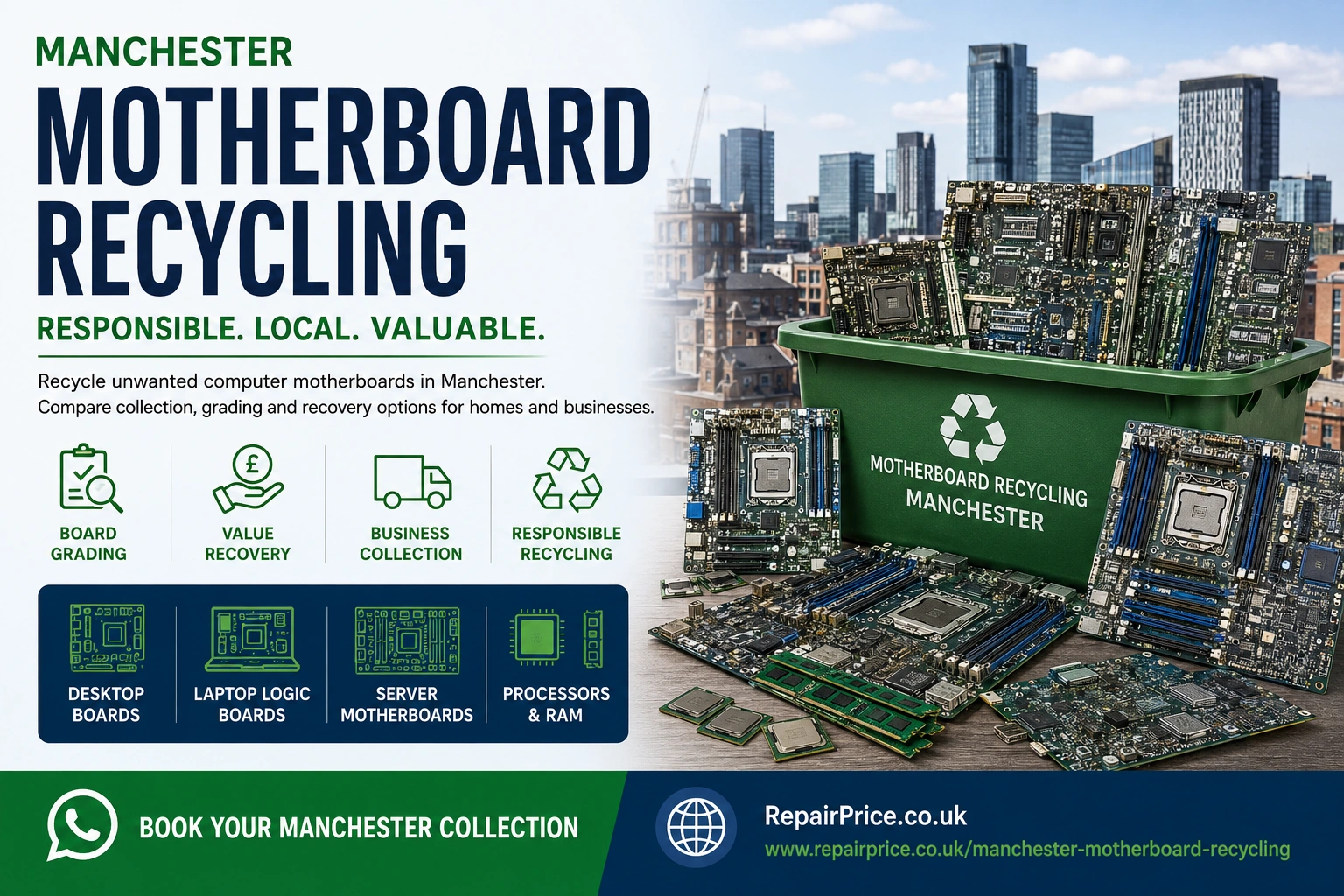
Manchester Motherboard Recycling and Value Guide
Old motherboards can take up valuable storage space, but they may also contain reusable components and recoverable materials. Whether you have one computer board at home or a commercial batch produced during an IT upgrade, choosing a responsible recycling route can help you clear unwanted equipment while giving suitable boards another useful purpose.
This Manchester guide to motherboard recycling and value explains what affects a board’s potential worth, how different motherboard types are assessed and what you should do before arranging a collection. If you already know what you have, you can also compare motherboard recycling options across Manchester.
Book Your Motherboard Recycling Collection from Manchester WhatsApp
Why recycle unwanted motherboards?
A motherboard is the main circuit board inside a desktop computer, laptop, server or other electronic system. It connects the processor, memory, storage, power supply and expansion hardware. Once the equipment becomes obsolete or uneconomical to repair, the motherboard should not simply be placed in general waste.
Boards can contain metals, connectors, processors, chips and other components that may be suitable for reuse or material recovery. Separating them from mixed rubbish allows a recycler to inspect, grade and process the equipment more effectively. Recycling also gives businesses a clearer route for managing redundant IT equipment instead of allowing it to accumulate in storerooms.
For a wider range of unwanted electrical items, explore responsible electronics recycling services in Manchester. Households and organisations clearing several kinds of equipment can also review Manchester collection routes for reusable and recyclable devices.
Are old motherboards worth money?
Some motherboards may have resale, refurbishment or recycling value, but not every board will produce a payment. The amount depends on the type of board, its age, condition, specification, attached components, quantity and current demand. A recent working gaming motherboard, for example, may be assessed differently from a damaged board removed from an obsolete office computer.
Complete boards with identifiable model numbers are generally easier to evaluate. Their sockets, chipsets and compatibility can be checked against current demand. Older boards may still be useful to repair specialists looking for discontinued parts, while damaged or incomplete items may be graded mainly according to their recoverable material content.
To understand how those factors could affect your return, visit the page covering motherboard recycling prices and grading in Manchester. A proper quotation should be based on the actual equipment rather than an unsupported fixed figure.
What determines motherboard recycling value?
| Valuation factor | Why it matters | Helpful preparation |
|---|---|---|
| Board type | Desktop, laptop, server and specialist industrial boards can have different component densities and levels of demand. | Separate boards into recognisable categories where possible. |
| Age and specification | Recent or sought-after platforms may have reuse value, while obsolete boards may be assessed for component or material recovery. | Record the manufacturer, model number, socket and chipset if known. |
| Working condition | A tested working board may have more reuse potential than an untested or visibly damaged item. | State honestly whether the board works, is faulty or has not been tested. |
| Attached components | Processors, memory, heatsinks and expansion cards may require separate assessment. | List any components still attached rather than assuming they are included in the board price. |
| Quantity | Larger, consistently sorted batches may be easier to grade and collect efficiently. | Provide an approximate board count or total weight. |
| Physical damage | Corrosion, burns, broken sockets and missing sections can reduce reuse opportunities. | Mention damage and supply clear details when requesting a quotation. |
Motherboards accepted for recycling
Recycling enquiries can cover boards removed from desktop computers, laptops, servers, workstations, point-of-sale systems and other electronic equipment. Some collections may also include backplanes, controller boards, expansion cards and associated computer hardware. Acceptance and valuation can vary, so items should be described accurately before collection.
- Desktop PC motherboards
- Laptop and notebook mainboards
- Server and workstation boards
- Gaming computer motherboards
- Industrial computer boards
- Controller and interface boards
- Boards with processors or memory attached
- Faulty, obsolete or untested computer boards
If your items are primarily smartphone logic boards rather than computer motherboards, the more relevant route may be specialist mobile phone board recycling in Manchester. Mixed circuit boards from electronic devices can instead be assessed through Manchester circuit board recovery and recycling services.
Reuse, component recovery or material recycling
Not every motherboard should immediately be reduced to raw materials. A board may first be inspected to determine whether it is suitable for reuse, repair or parts recovery. This approach can preserve more of the item’s practical value and may keep compatible hardware available for maintaining older systems.
Working boards with clear model details may be candidates for reuse. Faulty boards can sometimes provide connectors, sockets, chips or other parts for repair work. Items that are unsuitable for either route may then move into an appropriate material-recovery process.
For equipment that may still contain serviceable parts, learn more about recovering useful components from Manchester computer boards. This service is particularly relevant when boards are obsolete but contain parts that may help repair existing systems.
How to prepare motherboards for collection
Good preparation can make identification, handling and grading easier. Start by separating loose motherboards from complete computers and unrelated waste. Avoid snapping boards or removing chips purely to reduce their size, as unnecessary damage can reduce their reuse potential and make sorting more difficult.
Store boards in dry, sturdy containers and avoid exposure to water. If several specifications are present, group similar boards together and label the containers. Businesses should prepare an inventory showing estimated quantities, equipment origins and whether processors, memory or storage devices remain attached.
- Count the boards or estimate the total quantity.
- Separate desktop, laptop, server and specialist boards.
- Record model numbers where they remain visible.
- Identify boards that are working, faulty or untested.
- List processors, memory and expansion cards separately.
- Package the boards to prevent breakage during handling.
- Request a collection or recycling quotation.
When the items are bulky, numerous or difficult to transport, you can enquire about collection for unwanted motherboards across Manchester. Providing accurate quantities and collection details at the start can help determine the most suitable next step.
Data security and motherboard recycling
A motherboard is not normally the main storage location for personal documents, customer records or business files. However, complete computers and servers may still contain hard drives, solid-state drives, memory cards or other storage media. These items should be identified before the equipment leaves your control.
Removing a motherboard does not automatically erase information stored elsewhere in the computer. Businesses should follow their internal data-handling procedures and clearly disclose any data-bearing equipment included in a recycling batch. If you are uncertain, treat the device as though it may contain information until the storage media has been checked.
Motherboard recycling for Manchester businesses
Offices, repair shops, schools, IT departments, charities and managed service providers can produce larger quantities of redundant motherboards during upgrades, repairs and equipment clearances. A planned recycling service can help these organisations avoid mixing electronic equipment with general waste and reduce the space occupied by outdated stock.
Commercial enquiries should include the approximate number of boards, the type of equipment, the collection postcode and any access restrictions. It is also useful to state whether the batch contains complete computers, loose components, storage devices or mixed electronic equipment.
Organisations planning an office clearance or recurring disposal arrangement can review business motherboard recycling solutions in Manchester. Separating boards by type before collection can support more efficient assessment and help identify items with possible reuse value.
Local motherboard recycling around Greater Manchester
Collection and recycling needs vary between households, repair businesses and commercial premises. Local landing pages provide a more relevant route for enquiries from different parts of Greater Manchester.
- Arrange motherboard recycling and collection in Dukinfield.
- Find responsible recycling options for old motherboards in Oldham.
- Request help with computer motherboard recycling in Eccles.
- Explore local motherboard recovery services serving Droylsden.
- Compare Didsbury recycling routes for unwanted computer boards.
- Enquire about motherboard collection and valuation in Sale.
Common mistakes that can reduce recycling value
One common mistake is placing every type of electronic board into a single mixed container. Although mixed loads may still be recyclable, separating computer motherboards from power boards, mobile logic boards and low-grade peripheral boards can make identification easier.
Another mistake is assuming that every old motherboard has a high precious-metal value. Online prices may refer to a particular grade, quantity or market condition and may not apply to an individual household board. Similarly, a rare model is not automatically valuable unless there is genuine demand and the board is in a condition that supports reuse.
Boards should not be burned, chemically stripped or dismantled using unsafe methods. These actions can create hazards, damage recoverable components and remove the information needed to identify the equipment. Keeping the board complete and describing it accurately is usually the best starting point.
Choosing the right recycling route
| What you have | Suggested route |
|---|---|
| A working, identifiable motherboard | Request an assessment that considers potential reuse as well as recycling. |
| A faulty or untested computer board | Ask whether component recovery or material recycling is most suitable. |
| A commercial batch of loose boards | Provide quantities, categories and collection information for a business quotation. |
| Complete computers containing storage drives | Identify data-bearing media before arranging equipment recycling. |
| Mixed electronic circuit boards | Use a broader circuit board recycling assessment. |
Request a Manchester motherboard recycling quotation
Before requesting a quote, gather a few useful details: your Manchester collection postcode, the estimated quantity, the types of motherboards, their condition and whether other computer components are included. Photographs or model lists may also help explain the batch, although the final assessment may still depend on inspection and grading.
A clear enquiry gives the recycling service enough information to discuss collection, reuse possibilities and potential value. It also helps avoid confusion between motherboard pricing, complete-computer disposal and mixed electronic waste recycling.
Quote from Manchester Recycling Services
Frequently asked questions
Can I recycle a single motherboard in Manchester?
Yes, you can enquire about recycling a single board, although collection availability and potential payment can depend on the item, location and service requirements. Include the model and condition when asking for options.
Should I remove the processor and RAM first?
That depends on whether you want the attached components assessed separately. If processors or memory modules remain installed, mention them in your enquiry. Avoid forcing components out if you are unfamiliar with the release mechanisms.
Do broken motherboards still have recycling value?
A broken board may still contain recoverable materials or reusable parts, but damage can reduce its potential resale or refurbishment value. The board type, completeness, quantity and grade all influence the assessment.
Can businesses arrange recurring collections?
Businesses producing regular quantities of redundant boards can enquire about scheduled or repeat collections. Provide expected volumes and frequency so the service requirement can be evaluated properly.
Are laptop motherboards accepted?
Laptop mainboards may be considered alongside desktop and server boards. Keep them separate where possible because their construction, components and grading can differ from full-size desktop motherboards.
What if I have complete computers rather than loose boards?
Complete equipment may require a broader IT or electronics recycling service. Make sure any data-bearing storage devices are identified and describe the computers accurately when requesting a quotation.
Turn unused motherboards into a responsible recycling opportunity
Unwanted motherboards do not need to remain forgotten in cupboards, workshops or business storerooms. By identifying the equipment, protecting it from damage and choosing the right recycling route, you can make it easier to recover reusable components and recyclable materials.
Start with the main Manchester motherboard recycling and valuation service, or select the relevant collection, pricing, recovery, business or local page above. A detailed enquiry is the best way to find out whether your boards may be suitable for reuse, component recovery or responsible material recycling.