

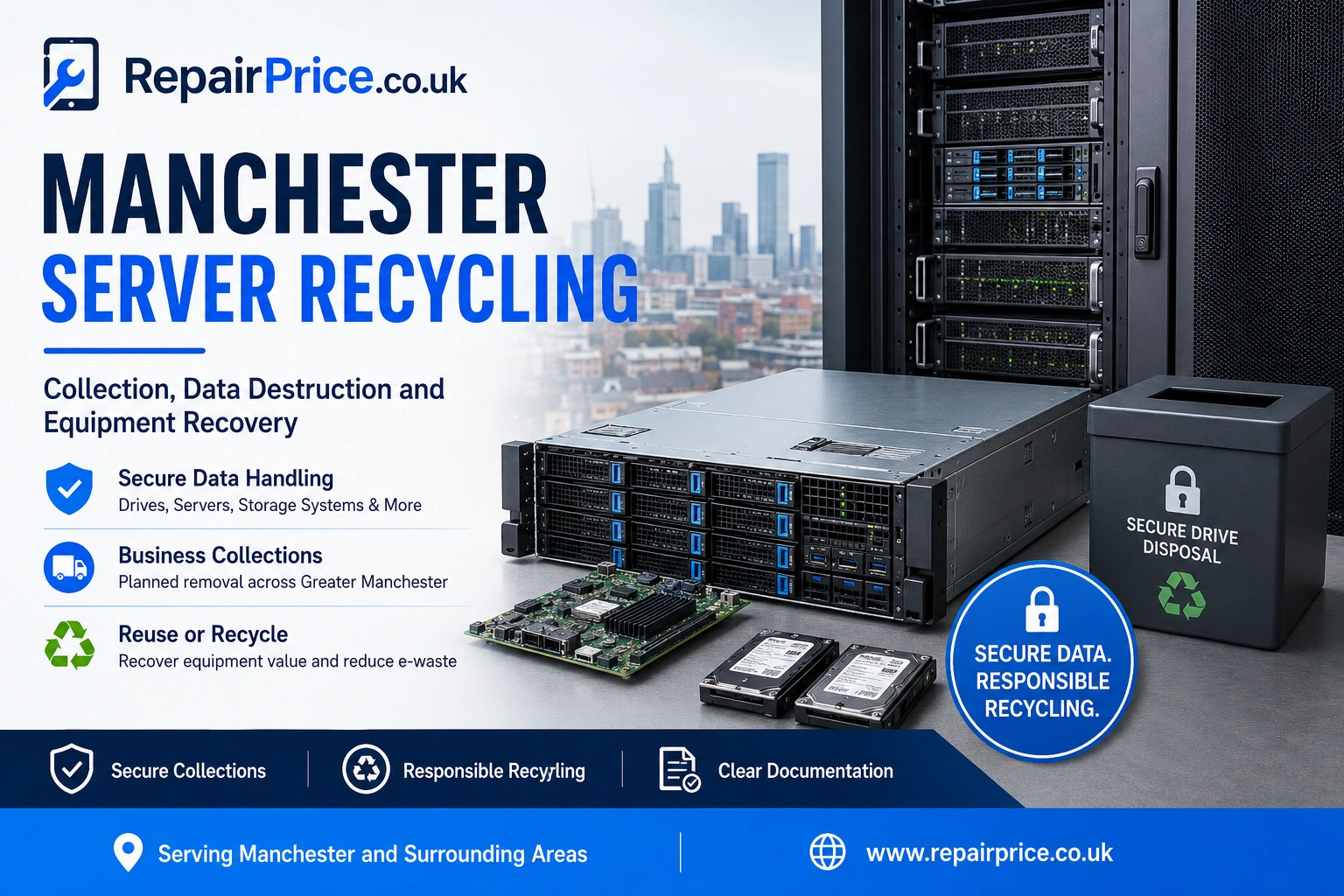
Manchester Server Recycling and Data Destruction Guide
Decommissioned servers can contain reusable components, valuable circuit boards and highly sensitive business information. Leaving this equipment in a storeroom creates security, compliance and space-management problems, while disposing of it through an unsuitable waste stream can waste recoverable materials. This Manchester server recycling and data destruction guide explains how to prepare redundant equipment, protect stored information and choose an appropriate recycling route.
If your business is planning an infrastructure upgrade, office clearance or data-centre shutdown, explore our server recycling options available across Manchester. You can compare suitable services for individual rack servers, mixed IT loads and larger collections involving cabinets, switches, storage arrays and associated equipment.
Book Your Server Recycling Collection from Manchester on WhatsApp
Why responsible server disposal matters
A retired server is not simply scrap metal. Depending on its specification, it may contain hard disk drives, solid-state drives, memory modules, processors, power supplies, network cards, RAID controllers, batteries and high-grade printed circuit boards. Some parts may remain suitable for reuse, while others can be separated for material recovery.
The storage devices are particularly important. Even when a server no longer starts, its drives may still contain customer records, employee information, financial documents, intellectual property, access credentials or archived communications. Deleting folders or formatting a drive does not necessarily make that information irretrievable. Organisations should therefore plan data sanitisation and physical recycling as connected stages of the same disposal project.
Specialist recycling also helps keep recoverable metals and electronic components out of general waste. Businesses with a broader range of obsolete devices can review commercial electronics recovery services in Manchester, while households and organisations outside a server-specific project can start with the wider electronics recycling information and options.
What server equipment can be assessed?
Recycling requirements vary between a single small-business server and a complete data-centre clearance. A collection may include tower servers, rack-mounted units, blade systems, storage appliances, network switches, uninterruptible power supplies, rails, cabinets and loose components. Providing an inventory in advance helps the recycling provider plan vehicle space, lifting arrangements and the correct downstream processing route.
| Equipment type | Important checks | Possible next step |
|---|---|---|
| Rack and tower servers | Record make, model, condition and installed storage | Assess for reuse, parts recovery or recycling |
| Hard drives and SSDs | Identify data sensitivity and required destruction method | Sanitise, shred or otherwise securely destroy |
| Memory and processors | Check specification, age and working condition | Prioritise reuse or component recovery where practical |
| Network and storage equipment | Check for saved configurations and removable media | Clear data before equipment leaves the site |
| Racks, rails and metal enclosures | Confirm dimensions, weight and access restrictions | Arrange suitable dismantling and collection |
| UPS units and batteries | Declare battery type, condition and approximate weight | Use an appropriate specialist processing route |
Data destruction should be planned before collection
The right destruction method depends on the storage technology, the sensitivity of the information and the organisation’s internal policies. Software-based sanitisation may be appropriate for functioning drives intended for reuse. Damaged, obsolete or especially sensitive drives may require physical destruction. The agreed method should be documented before any equipment changes custody.
For a focused assessment, businesses can arrange secure data destruction for retired Manchester servers. Before booking, explain whether the project contains HDDs, SSDs, removable media, encrypted drives or mixed storage formats. SSDs store information differently from traditional magnetic drives, so the processing method should match the media involved.
Ask the provider what records can be supplied after completion. Depending on the agreed service, useful documentation may include an asset list, collection record, serial-number schedule or destruction confirmation. Never assume that a standard recycling collection automatically includes data destruction; confirm the service scope in writing.
How a Manchester server collection usually works
Start by producing a simple equipment inventory. Record quantities, equipment types, approximate weights, installed drives and any unusual items such as large cabinets or battery systems. Photographs can also help a provider understand the volume and access requirements, although sensitive asset labels should be handled in line with your organisation’s security procedures.
Next, review access to the collection point. Important details include floor level, lift availability, loading restrictions, parking, narrow corridors and whether server racks must be dismantled. Sharing this information early reduces the likelihood of delays or unsuitable vehicle arrangements.
Businesses that need equipment removed can enquire about planned collection of redundant servers in Manchester. Keep high-risk storage media in a controlled area until handover and make sure an authorised member of staff is available to verify the equipment leaving the premises.
Can redundant servers have recycling value?
Some server loads may have recoverable value, but this should not be assumed from the original purchase price. Valuation can be influenced by age, specification, working condition, completeness, quantity, component demand, transport requirements and the amount of processing needed. Newer working hardware may be more suitable for reuse, while older units may be assessed mainly for components and material content.
Processors, memory modules and certain enterprise components may affect a quotation. However, missing parts, damaged boards, obsolete specifications or significant collection costs may reduce the amount available. For a clearer explanation of these factors, see the guide to Manchester server recycling prices and valuation criteria.
Do not remove components purely because they appear valuable without considering data security and the remaining equipment. An incomplete server may be harder to identify, test or remarket. It is usually better to provide an accurate inventory and request an assessment of the whole load.
Request a Quote from Manchester Server Recycling Services
Reuse, recovery and recycling explained
Reuse generally offers the greatest opportunity to preserve the value already invested in manufacturing equipment. A complete working server may be assessed for continued use, refurbishment or parts harvesting. Reusable components can include memory, processors, network adapters, power supplies and drive caddies, subject to condition and demand.
When reuse is unsuitable, equipment can move into component recovery and material separation. Circuit boards require specialist handling because they combine metals, fibreglass, resins and electronic components. Organisations with loose server boards or mixed high-grade electronic assemblies can compare circuit-board recovery routes in Manchester.
Standalone mainboards from servers, workstations and computers may also need separate grading. The Manchester motherboard recycling and recovery service provides a more relevant route for organisations holding removed boards rather than complete server units.
Planning a data-centre clearance
A data-centre project can involve much more than removing servers. There may be storage arrays, switches, cabling, rails, cabinets, PDUs, UPS equipment and large quantities of drives. These projects benefit from a phased plan covering asset identification, system shutdown, data handling, dismantling, removal and final reporting.
Before work begins, identify which assets are owned, leased or subject to support agreements. Separate equipment that is being redeployed from items approved for disposal. Asset tags, serial numbers and drive references should be reconciled before removal so that reusable equipment is not mistakenly recycled.
For larger infrastructure projects, review data-centre equipment recycling across Manchester. Sharing rack counts, equipment lists, site rules and target dates at the quotation stage can help establish a realistic collection plan.
Preparing servers for responsible disposal
Preparation reduces delays and helps protect information throughout the handover process. Disconnect and label the equipment that has been approved for removal. Separate servers from assets that remain operational, and avoid leaving loose drives in unmarked boxes. If drives have been removed, record which server or system they came from whenever the information is available.
Remove any media that is not included in the destruction agreement, such as backup tapes, USB devices or memory cards. Check management modules, network appliances and storage controllers for saved configurations or credentials. If your IT team performs sanitisation internally, retain the relevant logs and confirm whether the recycling provider needs additional evidence.
Do not dismantle heavy racks or battery equipment unless competent staff have the necessary tools and safety procedures. Instead, disclose the size, location and condition of these items when requesting a collection.
Server recycling coverage around Manchester
Collection requirements differ across Greater Manchester. City-centre premises may have loading and time restrictions, while business parks and industrial sites may offer easier vehicle access. Organisations west of the city can explore server disposal and collection options in Eccles.
For equipment held east of Manchester, compare responsible server recycling services serving Droylsden. Businesses in the south of the city can find server and storage-equipment recycling near Didsbury.
Organisations in Trafford can review commercial server collection services in Sale, while companies north of the city can consider server recycling arrangements for Middleton workplaces. For sites towards Tameside, see secure server disposal options available in Denton.
Questions to ask a recycling provider
Before accepting a quotation, confirm exactly what is included. Ask whether collection, labour, dismantling, data destruction, asset recording and final documentation are priced separately or as one service. Clarify whether the quotation depends on equipment condition, quantities or the final weight collected.
You should also establish how data-bearing devices will be controlled after collection and whether functioning equipment may be considered for reuse. If your organisation requires a specific audit trail, describe that requirement before booking rather than after the equipment has been processed.
Frequently asked questions
Can one redundant server be collected?
Single-server collections may be possible, but availability and cost can depend on location, access, equipment weight and whether data destruction is required. Providing the full specification helps the service assess the most practical option.
Should hard drives be removed before recycling?
Drives can be removed when this forms part of your security policy, but they must still enter an appropriate sanitisation or destruction process. If drives remain installed, identify them clearly and confirm that data destruction is included in the booked service.
Does formatting a drive destroy its data?
Formatting alone should not automatically be treated as secure data destruction. The appropriate method depends on the storage media and the sensitivity of the information. Use a documented process that matches your organisation’s security requirements.
Can damaged servers still be recycled?
Yes. Equipment that is unsuitable for reuse may still contain recoverable components and recyclable materials. Tell the provider about fire, liquid, impact or battery damage before collection so the equipment can be handled appropriately.
Can racks and networking equipment be collected with servers?
They may be accepted as part of a wider project when declared in advance. Include cabinet dimensions, approximate weights, floor access and details of switches, storage appliances, UPS units or batteries in your enquiry.
Arrange server recycling in Manchester
A well-managed disposal project should connect secure data handling, clear asset records and responsible material recovery. Begin with an inventory, decide how every data-bearing device will be treated and provide accurate access information when requesting a quotation.
Return to this Manchester server recycling and secure data disposal guide when preparing your internal checklist, then use the relevant collection, destruction, pricing or data-centre service page to discuss the next stage. Acting before obsolete equipment accumulates can help free valuable space while keeping security and recycling responsibilities under control.