

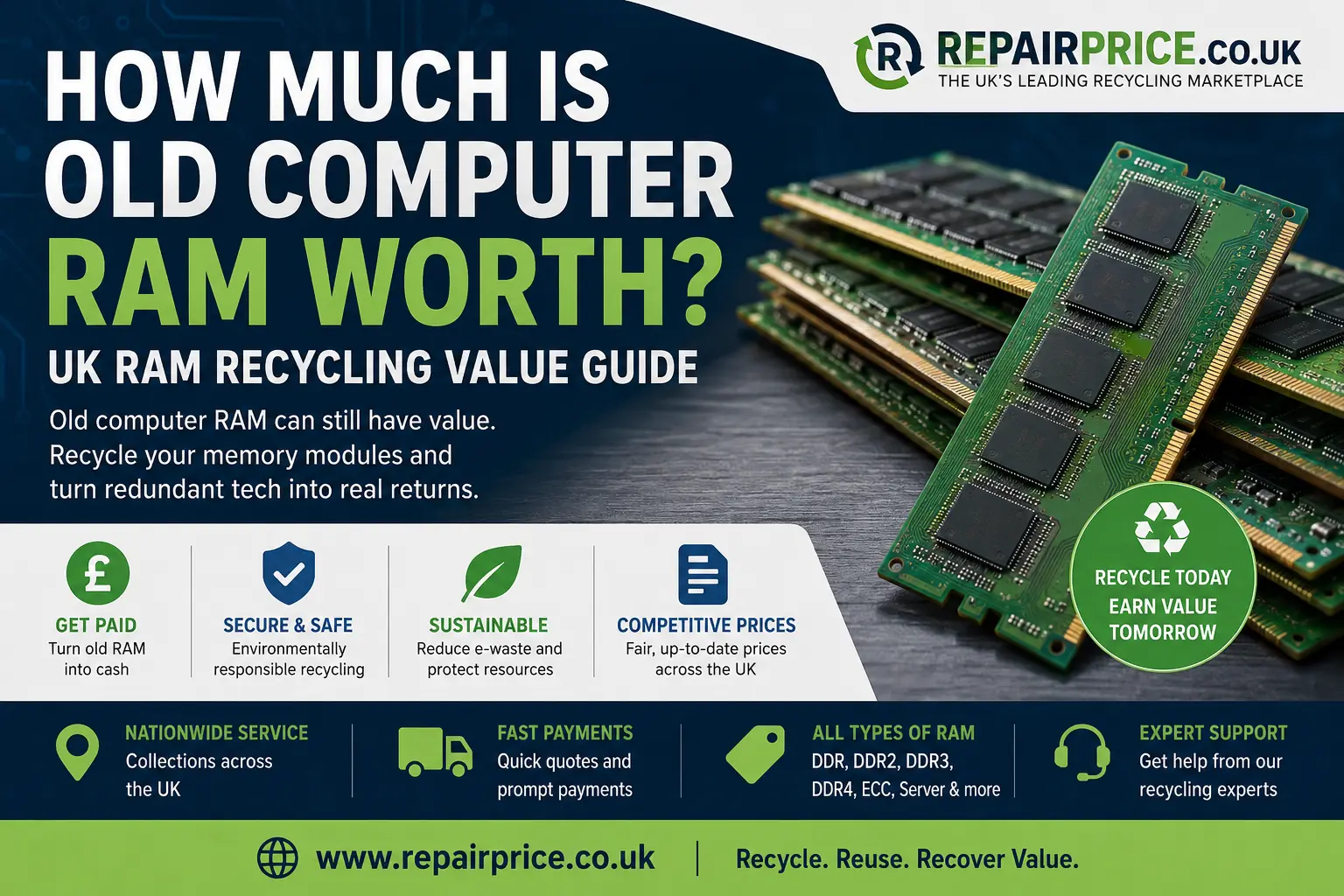
How Much Is Old Computer RAM Worth? UK RAM Recycling Value Guide
Old computer RAM can still have value long after the computer, laptop or server it came from has reached the end of its useful life. Memory modules contain reusable electronic components, circuit-board material and recoverable metals, making them an important category of electronic scrap.
Whether you have a few memory sticks from a home computer or bulk RAM from an IT equipment clearance, the value can depend on memory type, condition, age, quantity and current recycling markets.
Get a RAM Recycling Quote on WhatsApp
Is Old Computer RAM Actually Worth Money?
Yes. Many types of old computer RAM can have either reuse or recycling value. However, there is no single price that applies to every memory module.
A relatively recent working DDR4 or DDR5 module may have a second-hand market, while older, damaged or untested memory may be more appropriate for specialist material recovery.
RAM modules consist of printed circuit-board material, memory chips, contacts and other electronic components. Their construction means they should not automatically be treated as ordinary waste.
For current values, visit our scrap memory RAM recycling prices page before deciding whether to reuse, sell or recycle your modules.
What Determines the Value of Scrap RAM?
The amount offered for unwanted memory can depend on several factors. These include the RAM generation, module type, age, physical condition, quantity available and whether the memory still has a practical reuse market.
Working modules may be worth more as reusable components. Obsolete or failed memory can instead be assessed according to its electronic recycling grade and recoverable material content.
Quantity can also influence the assessment. A few individual modules are different from kilograms of sorted RAM generated by a repair business, data centre, IT department or commercial equipment clearance.
If you are dismantling complete computers, processors may have a separate value. Compare them using our CPU and IC recycling prices.
Working RAM Versus Scrap RAM
Before treating old memory as scrap, determine whether it still works. Reusable RAM can sometimes be sold or used to extend the life of an older computer. Memory that is damaged, obsolete or uneconomical to reuse can enter an electronics recycling stream instead.
This distinction matters because reuse and material recovery are different routes. Reusing a functional component can extend its useful life, while recycling focuses on recovering materials from equipment that has reached the end of practical use.
If you are processing complete computers, separate memory from other components where practical. Motherboards can be checked against our motherboard recycling price information, while mixed boards can be compared through our UK circuit board price guide.
What Types of Computer RAM Can Be Recycled?
Many generations and formats of memory can potentially enter an electronics recycling stream. These can include SDRAM, DDR, DDR2, DDR3, DDR4, DDR5, laptop SO-DIMMs, server RAM, registered memory and ECC modules.
Industrial computers and specialist electronic equipment may also contain removable memory modules. If you cannot identify the RAM yourself, labels on the module can often provide the manufacturer, capacity, speed and part number.
Keeping different types of memory clean, dry and separated from general waste can make the material easier to inspect and classify.
Why Do Recyclers Want Old RAM?
Computer memory is a compact electronic component containing circuit-board material, chips, contacts and other materials that may be recoverable through specialist recycling processes.
The gold-coloured contacts visible on many RAM modules are one reason people associate memory with precious-metal recovery. However, the colour of the contacts alone does not determine the value of a module.
Actual recycling economics depend on the complete material composition, processing costs, quantity and prevailing recovery markets. For a broader explanation, see our UK electronic waste price guide.
Should You Remove RAM Before Recycling a Computer?
When a computer is already being professionally dismantled for recycling, separating the memory can make sense because RAM can be assessed independently from the rest of the machine.
The CPU, motherboard and other populated circuit boards may also fall into separate recycling categories. This is especially relevant for repair companies, IT departments and organisations decommissioning multiple computers or servers.
If you have complete electrical or computer equipment rather than separated components, visit our electronics recycling service for information about recycling unwanted equipment.
How to Prepare Old RAM for Recycling
Keep RAM modules separate from steel computer cases, cables, hard drives, batteries and general waste. For larger quantities, grouping similar memory types together can make inspection easier.
Do not burn, grind, chemically process or deliberately break memory modules to try to recover metals yourself. Electronic scrap should be processed using suitable professional recycling methods.
If your load also contains phone boards, separate them and check our mobile board recycling prices. Server equipment can produce additional grades covered by our server back panel recycling guide.
RAM Recycling for Businesses
IT departments, computer repair companies, schools, offices, data centres and refurbishment businesses can accumulate substantial quantities of memory during upgrades and equipment replacement programmes.
Separating RAM instead of mixing it with general electronic waste can make the material easier to describe and assess. CPUs, motherboards and populated circuit boards can also be separated into their appropriate categories.
If your clearance contains larger electronic boards, use our printed PCB recycling prices page for additional guidance.
Local RAM Recycling Across the UK
RepairPrice provides information for households, repair businesses and organisations looking to recycle computer memory and related electronic components in different UK locations.
Wakefield RAM Recycling
Computer upgrades and business IT clearances in Wakefield can generate reusable or recyclable memory. See our Wakefield RAM recycling information.
Quote from Wakefield Repair shops
Halifax RAM Recycling
Old desktop, laptop and server memory in Halifax can be separated from mixed electronics for easier assessment. Explore RAM recycling in Halifax.
Quote from Halifax Repair shops
Derby RAM Recycling
Businesses and households replacing computers in Derby can separate unwanted memory before recycling. Visit our Derby computer RAM recycling page.
Quote from Derby Repair shops
Coventry RAM Recycling
Memory recovered during equipment upgrades in Coventry may still have reuse or recycling potential. Read our Coventry scrap memory guide.
Quote from Coventry Repair shops
Leeds RAM Recycling
Leeds households, businesses and repair shops can separate old computer memory for specialist recycling. Explore our Leeds RAM recycling options.
Quote from Leeds Repair shops
Bradford RAM Recycling
RAM generated through repairs, upgrades and computer clearances in Bradford can be kept separate for recycling. See our Bradford memory recycling information.
Quote from Bradford Repair shops
RAM, Motherboards, CPUs and Circuit Boards
RAM is only one potentially recyclable component inside an old computer. Motherboards, processors, expansion cards and other populated circuit boards can also belong to specialist electronic recycling categories.
For mixed electronic boards, check our scrap circuit board price information. Motherboards can be compared through our UK motherboard price page, while processors have their own CPU and IC recycling valuation guide.
Populated printed boards from computers and other electronics can also be assessed using our printed PCB recycling guide.
How Much Is a Kilogram of Scrap RAM Worth?
There is no permanent price per kilogram that applies to every type of RAM. Recycling values can change according to the type and quality of material, market conditions, processing requirements and quantity available.
A price seen online should therefore not automatically be treated as a guaranteed purchase price. For current information, use our latest RAM recycling price guide.
For larger quantities, provide clear photographs, an approximate weight and information about whether the material consists of desktop, laptop or server memory.
What Other Computer Components May Be Worth Recycling?
When dismantling redundant computers, RAM should not be considered in isolation. Processors, motherboards, mobile boards, server boards and other PCBs may have their own recycling classifications.
Separating these categories can help prevent higher-grade material from becoming mixed with lower-value electronics. It can also make commercial IT recycling loads easier to inspect.
For more detailed information about one of the largest computer circuit boards, read our motherboard recycling price guide.
Sell, Reuse or Recycle Old Computer RAM?
The best route depends on the condition and specification of the memory. Recent, tested and working RAM may still have a resale or reuse market. Older modules with limited demand may be more appropriate for recycling.
Damaged or failed memory should not simply be placed in ordinary household or commercial waste. Appropriate electronics recycling gives the material an opportunity to enter a specialist recovery stream.
If you are unsure, identify the memory specification first. Check the labels for capacity, memory generation and manufacturer information, then compare the potential reuse route with current recycling options.
Why E-Waste Values Change
Electronic scrap prices are not fixed indefinitely. Recycling markets can be affected by commodity prices, demand for recovered materials, refining costs and the composition of the electronic material being processed.
RAM, processors and motherboards do not necessarily move in value at exactly the same rate because each category has a different material composition.
Our electronic waste value guide provides a wider overview of pricing across different categories of unwanted electronics.
How to Get Your RAM Assessed
Start with an accurate description of what you have. State the approximate number of memory modules, whether they came from desktops, laptops or servers and whether they are known to be working.
For bulk material, provide an approximate weight. Photographs should clearly show the modules and should ideally be taken after RAM has been separated from processors, motherboards and other electronic components.
Good sorting and clear information can make an initial recycling assessment much easier.
Explore Related Electronic Recycling Prices
If your computer clearance contains more than RAM, compare the individual recycling categories rather than assuming every electronic component has the same value.
Check circuit board recycling values, review motherboard recycling prices, compare CPU and integrated circuit values, or explore printed PCB recycling prices.
For complete equipment and mixed electronics, visit the RepairPrice electronics recycling section.
Find Out What Your Old Computer RAM Is Worth
Old desktop memory, laptop RAM and server modules should not automatically be treated as worthless computer waste. Depending on their specification and condition, they may have reuse potential or recycling value.
Start with our scrap RAM recycling prices page to understand the current recycling category for your material.
If you are clearing complete computers, separate RAM, CPUs, motherboards and other circuit boards where practical. Correct sorting can make electronic scrap easier to identify, assess and direct towards the appropriate recycling stream.