

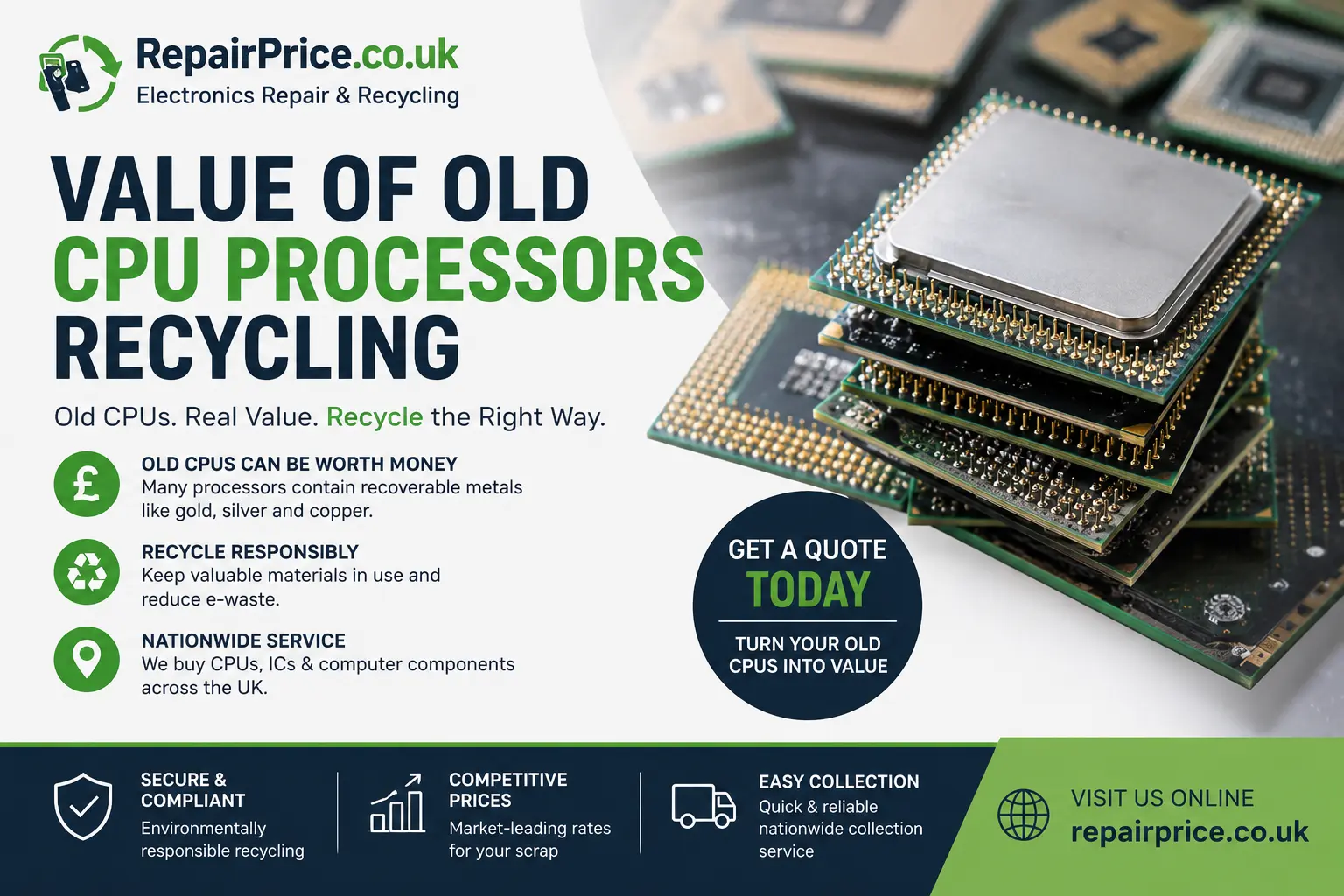
Value Of Old CPU Processors Recycling: What Are Old CPUs Worth in the UK?
Old computer processors can have more recycling value than their small size suggests. CPUs and integrated circuits may contain recoverable metals including gold, silver, copper and other materials used in electronic manufacturing. However, the value of an old processor depends heavily on its age, construction, processor type, quantity and the recycling grade offered by a specialist buyer.
If you have old desktop processors, server CPUs, ceramic processors, gold-cap CPUs, integrated circuits or mixed computer components, understanding how processors are graded can help you avoid selling potentially valuable electronic scrap as low-grade general waste.
RepairPrice helps UK households, computer repair businesses, IT companies and organisations compare recycling routes for unwanted electronics. For current processor categories and recycling information, start with our latest scrap CPU and IC recycling price guide.
Why Can Old CPU Processors Have Recycling Value?
A processor contains far more than silicon. Depending on its design and generation, it can also contain copper conductors, plated contacts, bonding wires, pins and small quantities of precious metals. Manufacturers historically used gold because it conducts electricity well and resists corrosion, particularly around contacts, pins and internal connections.
This does not mean every CPU contains a large amount of gold. Modern processors generally use materials more efficiently than many older components, while certain vintage ceramic processors can attract considerably more interest from specialist recyclers and collectors.
The most important factor is therefore correct identification. Throwing processors into a mixed box of low-grade electrical scrap can result in valuable material being priced at the wrong grade. Separating processors, memory, motherboards and circuit boards before requesting a quotation can make the recycling process much clearer.
What Types of Old CPUs Can Be Recycled?
Most computer processors can enter an electronics recycling stream, although their monetary value varies significantly. Common recyclable categories include modern desktop CPUs, laptop processors, server processors, ceramic CPUs, fibre processors, pinless CPUs, processors with gold-coloured pins and assorted integrated circuits removed from computer equipment.
Some older ceramic processors are particularly interesting because their manufacturing methods can result in a higher precious-metal content compared with many modern plastic or fibre CPUs. Early Intel, AMD, Motorola, IBM and similar processor families may therefore require specialist grading rather than being valued as ordinary electronic scrap.
If you are dismantling complete computers, keep the other components separated too. Our motherboard recycling value guide explains how complete boards are assessed, while the UK scrap RAM recycling price page covers memory modules that may also contain gold-plated contacts.
How Much Are Old CPU Processors Worth?
There is no single price that applies to every processor. CPU recycling prices can change according to processor grade, precious-metal markets, recycling demand, quantity and the buyer processing the material. A box containing mixed modern CPUs may therefore receive a very different valuation from a batch of older ceramic or server processors.
Rather than looking only at the processor's original retail price, recyclers concentrate on recoverable material. A CPU that originally cost hundreds of pounds is not automatically worth more as scrap than a much older processor. In some cases an obsolete processor built using older manufacturing techniques can have greater specialist recycling interest.
For current grading information, compare your processors against our CPU and integrated circuit scrap price categories before combining them with other electronic waste.
Old Ceramic CPUs and Gold-Pin Processors
Ceramic processors are among the CPU categories most frequently associated with precious-metal recovery. These processors can often be recognised by their ceramic body, visible pins and, on some models, a gold-coloured cap or plated areas.
Not every ceramic CPU should be assumed to have the same value. Processor manufacturer, model, production period, construction and condition all matter. Removing parts unnecessarily can also make grading harder. When possible, keep processors intact and photograph both sides before requesting a recycling quotation.
Processors with gold-coloured pins should also be kept separate from low-grade circuit boards. Specialist recyclers can evaluate the complete processor rather than simply estimating the value from its visible gold colour.
Server CPUs and Data Centre Processor Recycling
Businesses replacing servers can accumulate substantial quantities of CPUs alongside memory, motherboards, backplanes, network cards and other high-grade electronics. Keeping these categories separated may make commercial recycling considerably easier.
Server processors can differ from ordinary desktop CPUs in size, construction and generation. Large quantities can also make collection or commercial recycling arrangements more practical.
If you are clearing server equipment, do not overlook other components. Our server back panel recycling price information covers another category frequently produced during server dismantling.
CPU Recycling in London
Businesses and individuals disposing of processors in the capital can explore CPU recycling options for London electronics. Large office upgrades, IT refresh projects and computer repair operations can all generate processors that should be separated from ordinary commercial waste.
CPU Recycling in Bristol
For processors generated by computer businesses, organisations and households in the South West, our Bristol processor and CPU recycling service page provides a route into specialist electronics recycling.
CPU Recycling in Manchester
Companies upgrading computers or servers across Greater Manchester can use our Manchester scrap processor recycling information to find suitable routes for unwanted CPUs and related electronic components.
CPU Recycling in Sheffield
Old processors produced by IT companies, repair shops and organisations in South Yorkshire can be directed through our Sheffield CPU and IC recycling page rather than entering mixed electrical waste.
CPU Recycling in Bradford
West Yorkshire businesses and residents can find local guidance through our Bradford old CPU recycling service, particularly when processors are being recovered alongside motherboards, RAM and other computer components.
CPU Recycling in Leeds
If your processors are located around Leeds, visit our Leeds computer processor recycling page for information about recycling old CPUs and related electronic scrap.
Should CPUs Be Removed Before Recycling a Computer?
If equipment is already being professionally dismantled, separating CPUs can make grading easier. However, there is little benefit in damaging a working computer purely to remove components without first considering whether the complete machine has reuse value.
Reuse should normally be considered before material recovery. A functional computer can have considerably greater value as usable equipment than the combined scrap value of its components. Recycling becomes particularly relevant when equipment is obsolete, damaged, beyond economical repair or unsuitable for reuse.
When a complete machine has reached the end of its useful life, its processor, motherboard, memory and circuit boards can then be directed into appropriate recycling streams.
CPU Recycling Versus General E-Waste Recycling
General electronic waste can contain everything from cables and power supplies to computers, phones and household electrical equipment. Specialist CPU recycling narrows the material into a specific high-grade electronics category.
If you have a mixed electrical clearance rather than processors alone, use our UK e-waste price and material guide to understand how different types of electronic scrap may be assessed.
For a broader route covering unwanted electronics, our UK electronics recycling service can help you move from individual processor grading into a wider recycling solution.
Other Valuable Components Found With CPUs
Processors rarely arrive at a recycler on their own. Computer dismantling can also produce RAM modules, motherboards, printed circuit boards, mobile boards and server components. Separating these categories can make quotations clearer and help prevent higher-grade electronics from disappearing into mixed low-value scrap.
For assorted boards, see our scrap circuit board price comparison guide. If you are processing complete computer boards, our dedicated scrap motherboard recovery page explains how motherboard grades can differ.
Businesses handling bare or populated PCBs can also review our printed circuit board recycling price guide, while organisations processing phone components can check the mobile phone board recycling value page.
Memory should be separated as well. Our RAM module precious-metal recycling guide explains why gold-finger memory and other RAM grades should not automatically be mixed with lower-grade computer scrap.
How to Prepare Old CPUs for a Recycling Quote
Start by separating processors from other components. Where possible, divide ceramic CPUs, modern fibre CPUs, server processors and loose IC chips into separate groups. Avoid removing pins, cutting processors apart or attempting to recover precious metals yourself.
Next, record the approximate quantity or weight. For smaller batches, clear photographs showing both sides of several representative processors may help with initial identification. Larger commercial batches may benefit from being sorted into containers according to processor type.
Do not clean processors using chemicals or burn components to expose metals. Professional electronics recyclers use controlled processing methods designed to separate recoverable materials while managing hazardous substances appropriately.
Why You Should Not Try to Extract Gold From CPUs at Home
Online videos sometimes make processor gold recovery appear straightforward, but precious-metal refining can involve corrosive chemicals, harmful fumes and contaminated waste. The visible gold on a processor also represents only part of the material that may require professional recovery.
For most individuals and businesses, selling processors to an appropriate electronics recycler is safer and more practical than attempting chemical recovery. It also allows other metals and materials within the component to enter established recycling processes.
Can Old CPU Processors Be Reused Instead?
Before recycling, check whether an older processor still has resale or collector demand. Some discontinued CPUs are wanted for repairing vintage computers, upgrading older systems or collecting historically significant hardware.
A working processor with an identifiable model number may therefore be worth more as a reusable component than as scrap. Recycling is generally more appropriate for damaged, untested, heavily obsolete or bulk processors where resale is impractical.
RAM, Motherboards and CPUs Should Work as One Recycling Silo
Computer recycling becomes more efficient when related material categories connect logically. CPUs link naturally with motherboards because processors are usually recovered from them. Motherboards link to RAM because memory modules occupy dedicated board slots. All three categories then connect into broader printed circuit board and e-waste recycling.
If you are researching memory after sorting processors, read our related guide explaining how much old computer RAM may be worth for recycling. It provides the next step for evaluating another commonly recovered computer component.
Recycling CPUs From Business IT Clearances
Office closures, server upgrades, data centre projects, repair businesses and IT asset replacement programmes can generate processors in much larger quantities than household recycling. In these situations, sorting before collection can be particularly useful.
Keep CPUs, memory, motherboards, server boards and other high-grade electronic components separate where practical. Provide an approximate quantity, photographs and collection location when requesting a commercial quote. This information gives a recycler a much better starting point than simply describing the material as mixed computer scrap.
Businesses with several types of redundant electronics can combine processor recycling with broader commercial electronics recycling through RepairPrice, helping route reusable equipment and recyclable components appropriately.
What Affects the Scrap Value of a CPU?
The main variables include processor generation, construction material, ceramic or fibre packaging, pin type, precious-metal content, manufacturer, quantity, condition and current recycling-market demand. Precious-metal prices can also influence what specialist processors are worth.
This is why old CPUs should be graded rather than assigned one universal price. A handful of ordinary modern processors and a large batch of older ceramic CPUs are fundamentally different recycling propositions.
The easiest way to establish a realistic value is to identify the material first and then compare it against the current categories shown on our scrap CPU and IC recycling prices page.
Get a Quote for Old CPU Processor Recycling
If you have unwanted CPUs, IC chips, motherboards, RAM, server components or mixed electronic boards, do not automatically dispose of them as general waste. Separate the material where practical, identify what you have and obtain a specialist recycling quotation.
RepairPrice connects processor recycling with the wider electronics recovery chain, helping users move from identifying CPU value to recycling motherboards, memory, circuit boards, server components and complete electronic equipment.
Whether you have a handful of processors from old household computers or larger volumes generated through IT upgrades, correct sorting is the first step towards obtaining a more meaningful recycling valuation and keeping reusable metals and electronic materials within the recycling system.