

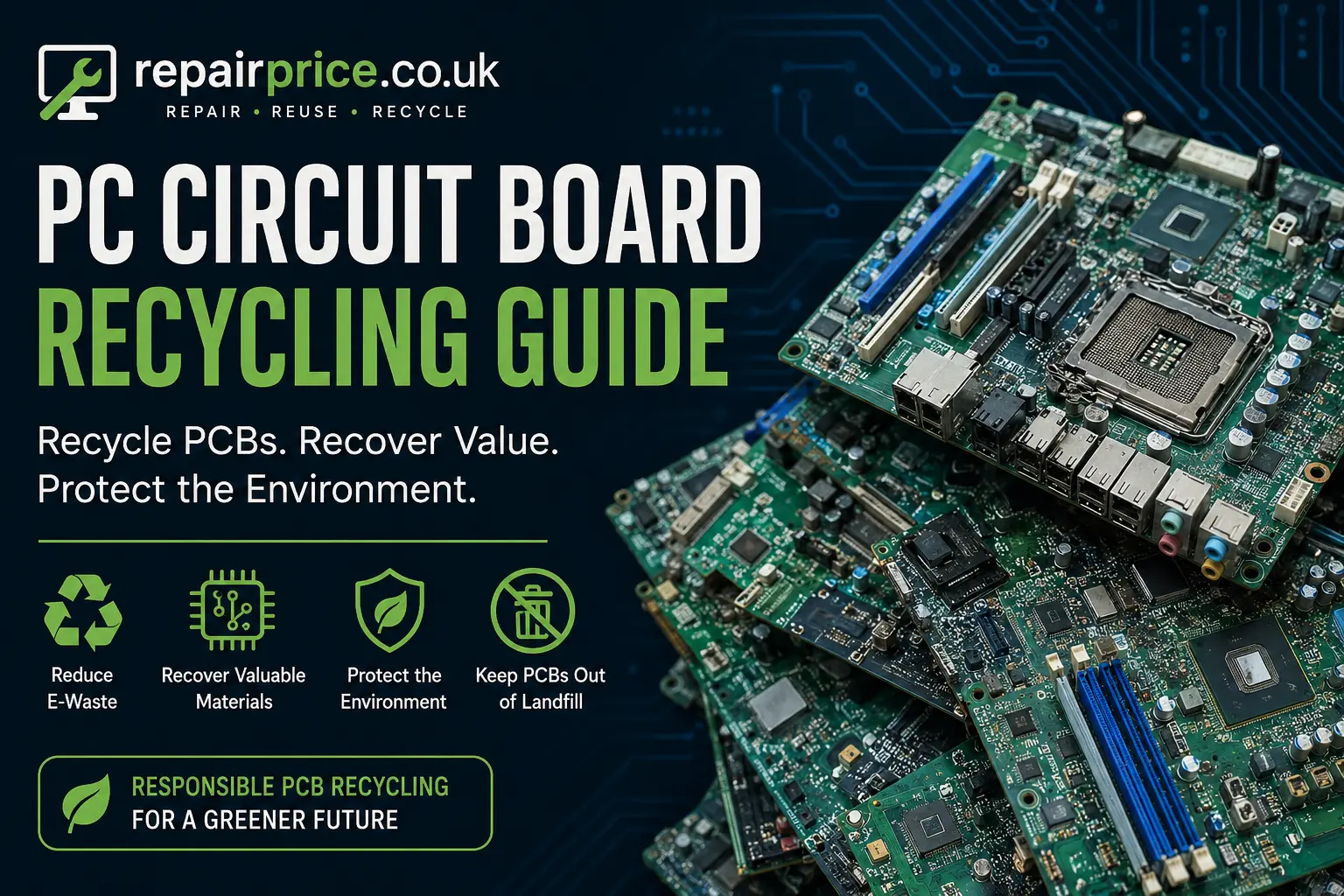
PC Circuit Board Recycling Guide: How to Recycle Computer Motherboards and PCBs Responsibly
Old desktop computers, workstations and business PCs contain circuit boards that should not be placed in household rubbish or mixed general waste. Motherboards, network cards, graphics cards, memory modules, power supply boards and other printed circuit boards can contain reusable components and recoverable metals. Correct PC circuit board recycling helps prevent electronic waste from reaching landfill while allowing suitable materials to be separated, processed and returned to the manufacturing supply chain.
This guide explains what PC circuit boards are, why they can have recycling value, how they are graded and what to do before arranging collection. RepairPrice helps households, repair businesses, schools, offices and organisations find suitable routes for recycling unwanted computer equipment and loose circuit boards across the UK.
Arrange PC Circuit Board Recycling by WhatsApp
What Is a PC Circuit Board?
A PC circuit board is a printed circuit board used inside a desktop computer, workstation or computer-based system. The largest and most recognisable board is the motherboard, which connects the processor, memory, storage devices, power supply and expansion components. A single computer may also contain several smaller boards that perform specialist tasks.
Common examples include graphics cards, sound cards, network interface cards, wireless cards, RAID controller cards, USB expansion boards and storage controller boards. Businesses may also have server boards, backplanes and specialist industrial computer boards that require separate identification and grading.
For a service focused specifically on desktop and workstation boards, visit our PC circuit board recycling service. This supporting service page explains how loose motherboards, computer cards and related PCB material can be submitted for recycling.
Why PC Circuit Boards Should Be Recycled
Computer circuit boards are made from a combination of fibreglass, resin, copper tracks, solder, connectors, chips and other electronic components. Some boards may contain small quantities of valuable metals, but the amount and recoverability depend on the board type, component density, age and condition.
Recycling allows specialist processors to separate useful materials from waste fractions. It can also reduce the unnecessary disposal of copper-bearing material, connectors and electronic components. Where suitable, certain components may be tested for reuse before the remaining board is processed as electronic waste.
Our main circuit board recycling hub provides an overview of the different PCB categories accepted through specialist recycling routes. It is a useful starting point when you have a mixed collection containing boards from computers, laptops, servers, televisions and other devices.
Which Computer Boards Can Be Recycled?
A wide range of computer-related circuit boards may be suitable for recycling. These can include desktop motherboards, workstation boards, server motherboards, memory modules, processor cards, graphics cards, sound cards, modem cards, network cards, controller cards and damaged expansion boards.
Loose boards are generally easier to inspect and sort than complete computers. However, complete or partially dismantled equipment may still be accepted through an appropriate device recycling service. Before sending material, separate computer circuit boards from batteries, cooling fans, metal cases, plastic panels and storage drives whenever it is safe and practical to do so.
Computer expansion components can sometimes be graded separately from main motherboards. Read our expansion card recycling information if your batch contains graphics cards, network cards, sound cards, controller cards or similar plug-in boards.
How PC Circuit Boards Are Graded
PCB grading is based on more than the physical size of the board. Recyclers may consider the number of integrated circuits, the type of connectors, processor sockets, edge contacts, memory slots and the overall component density. Boards with large areas of empty fibreglass may be graded differently from densely populated computer motherboards.
Older boards can look valuable because of their size, but age alone does not guarantee a higher grade. Modern server and telecommunications boards may also contain dense components and specialist connectors. Each batch should be assessed according to its actual composition rather than appearance alone.
Do not remove processors, memory, gold-coloured contacts or connectors unless you understand how the material will be graded. Removing components can reduce the value of the remaining board or create several low-volume categories that are harder to process. Keeping items organised and asking for guidance before dismantling can produce a clearer recycling assessment.
PC Motherboards and Laptop Circuit Boards
Desktop motherboards are usually larger than laptop boards and contain replaceable processors, memory slots and expansion card connectors. Laptop boards are more compact and may have processors, memory or graphics components soldered directly to the board.
If you are recycling portable computer boards, use our dedicated laptop motherboard recycling service. You can also read the laptop circuit board recycling guide for more information about identifying laptop logic boards, removing batteries and preparing damaged portable computers for responsible recycling.
Complete unwanted laptops may be more suitable for our laptop recycling service. This provides a route for recycling the complete device rather than separating only the motherboard.
Hard Drives and Storage Circuit Boards
Hard disk drives contain small controller boards attached to the underside of the metal drive casing. These boards control the drive motor, data interface and internal operation. They should not automatically be mixed with full-size PC motherboards because their size, construction and grading can be different.
Businesses must also consider data security before disposing of storage devices. Removing the controller board does not necessarily erase information stored on the internal platters. Drives containing confidential data should be handled under an appropriate data destruction process.
For controller boards that have already been separated from storage devices, visit our hard-drive PCB recycling page. Keep whole drives separate from loose boards so the correct recycling and data-handling route can be selected.
Server Boards, Backplanes and Business Computer Equipment
Servers and enterprise computers may contain larger motherboards, multiple processors, memory riser cards, storage controllers, network adapters and rear connection boards. These items can be more complex than standard household PCs and should be sorted carefully.
Server backplanes and rear walls connect storage drives, power modules or communication components. Where these have been removed from decommissioned servers, our server rear-wall recycling service can help identify an appropriate recycling category.
Organisations clearing offices, data rooms or IT storage areas may benefit from separating complete equipment, reusable parts, data-bearing devices and loose PCB material. Our business PCB recycling guide explains how companies can plan larger electronic clearances and organise different waste streams more efficiently.
Should You Repair a Computer Before Recycling It?
Recycling should not always be the first option. A computer with a failed power supply, damaged charging socket, faulty graphics card or storage problem may still be economical to repair. Extending the life of usable equipment can reduce electronic waste and may provide better value than immediate replacement.
For desktop computers, laptops and workstations, compare local options through our computer and laptop repair service. A professional diagnosis can help determine whether the motherboard is genuinely faulty or whether another replaceable component is causing the problem.
Residents and businesses in West Yorkshire can also explore laptop repair options in Bradford or request prices from laptop repair shops serving Leeds. If repair is not practical, the device can then be directed towards an appropriate recycling service.
Computer Boards Found in Games Consoles and Televisions
Games consoles and smart televisions also contain main boards, power boards, interface boards and storage-related components. These should not automatically be classified as PC motherboards because their construction and material composition may differ.
A faulty console may only require an HDMI port, cooling system, storage device or power supply repair. Before dismantling the unit, compare specialist options through our games console repair service. Customers in West Yorkshire can also find console repair services around Halifax.
When a console is beyond economical repair, our console recycling service provides a route for the complete device. Keeping the console intact may be preferable when you are unsure how to remove internal boards safely.
Televisions can contain separate main boards, timing controller boards, power supply boards and input boards. Compare potential repair options through our television repair quotation service before deciding whether to dismantle or recycle the set.
How to Prepare PC Circuit Boards for Recycling
Begin by identifying whether you have complete computers, loose motherboards, expansion cards, storage drives or mixed electronic parts. Place different material categories into separate boxes or clearly labelled containers. This makes inspection easier and helps prevent small components from being lost during transport.
Remove lithium batteries where it is safe to do so, including coin-cell motherboard batteries and batteries from complete portable devices. Do not puncture, crush or bend batteries. Damaged or swollen batteries require careful handling and should be disclosed before collection.
Keep boards dry and avoid storing them outdoors. Water, mud and heavy contamination can affect handling and grading. Use sturdy packaging to protect exposed components and prevent boards from moving freely inside the container.
Do not burn boards, use chemicals to strip components or attempt to recover metals at home. Informal processing can release hazardous fumes, create contaminated waste and damage material that could otherwise enter a controlled recycling process.
Data Protection Before Computer Recycling
Most standard motherboards do not retain the same type of personal information as hard drives or solid-state drives. However, complete computers can contain storage devices, embedded memory and removable media. Always inspect equipment before it leaves your possession.
Remove hard drives, solid-state drives, memory cards and USB devices if they are not included in an approved data destruction service. Businesses should maintain a clear record of which devices have been wiped, destroyed, reused or recycled.
Where equipment contains confidential customer, employee or commercial information, use a documented process rather than assuming that dismantling the computer has removed the data risk. Storage devices should remain identifiable until sanitisation or destruction has been completed.
Recycling Complete PCs and Mixed Electronic Equipment
You do not need to dismantle every computer before requesting recycling support. Complete PCs, laptops, consoles and mixed electronic equipment may be more suitable for a general device recycling route, particularly when the quantity is small or the equipment is difficult to disassemble.
Visit the electronic device recycling hub to explore recycling options for complete devices. Separating reusable equipment from damaged material can help ensure that working devices are not unnecessarily processed as scrap.
When submitting a mixed collection, provide an accurate description of the quantity, device types, condition and whether circuit boards have already been removed. Photographs, estimated weights and box counts can also help the recycler understand what is included before collection is arranged.
Understanding Expansion Card Recycling
Expansion cards are installed in desktop computers and servers to add graphics, networking, sound, storage or communication functions. They may have edge connectors, cooling systems, memory chips and large processors. Because their construction differs from standard motherboards, separating them can improve sorting accuracy.
Our detailed expansion card recycling guide explains how to recognise common computer cards, when to keep cooling assemblies attached and how to prepare larger quantities for assessment.
Working graphics cards and network cards may still have reuse value. Test or professionally assess newer components before treating them as scrap. Reuse can extend the life of existing computers and may deliver a better environmental outcome than immediate material recovery.
Who Can Use a PC Circuit Board Recycling Service?
PC board recycling can be suitable for private individuals, computer repair shops, IT support companies, schools, colleges, charities, offices, warehouses, manufacturers and data-centre operators. The correct service will depend on the quantity and type of equipment available.
A household may have one old motherboard and several computer cards, while a business may have boxes of boards collected during upgrades. Repair shops may also accumulate damaged motherboards that cannot be economically repaired. Providing clear details allows the material to be directed towards the most suitable processing route.
For larger commercial quantities, keep an inventory of board categories, approximate weights and collection locations. Avoid combining PCBs with cables, batteries, metal cases and general rubbish unless the collection service has confirmed that mixed equipment is accepted.
Request a PC Circuit Board Recycling Assessment
RepairPrice can help you move from unwanted computer hardware to an appropriate repair, reuse or recycling option. Start by identifying the equipment, separating data-bearing devices and estimating the number of boards or complete computers available.
When contacting us, explain whether the material comes from household computers, repair operations, office upgrades, server decommissioning or another source. Include your location, approximate quantity and whether collection is required. Clear information helps reduce delays and supports a more accurate response.
Request a PC Board Recycling Quote
Frequently Asked Questions About PC Circuit Board Recycling
Can old PC motherboards be recycled?
Yes. Old desktop and workstation motherboards can be processed through specialist circuit board recycling services. Their grade and recycling route depend on their construction, component density, condition and quantity.
Should I remove the processor and memory first?
Not always. Some recyclers prefer processors, memory modules and motherboards to be separated, while others may assess the complete board. Ask for guidance before removing components because dismantling can change the grade of the remaining material.
Can I recycle a complete desktop computer?
Yes. Complete computers can often be accepted through a device recycling service. This may be more suitable than removing the motherboard yourself, especially when the computer contains a power supply, storage drive and other components requiring separate handling.
Does removing the hard drive controller board erase my data?
No. Removing the external controller board does not reliably destroy information stored on the internal platters. The complete storage device should be securely erased, physically destroyed through an approved process or handled by a professional data destruction service.
Can damaged or broken computer boards still be recycled?
Many damaged boards can still be recycled, although contamination, fire damage, missing components or excessive corrosion may affect classification. Describe the condition accurately when requesting an assessment.
Are PC circuit boards valuable?
Some boards contain recoverable metals and reusable components, but value varies considerably. The final assessment depends on board type, grade, quantity, market conditions and processing costs. Large size or gold-coloured parts do not automatically mean a board has a high recycling value.
Choose Repair, Reuse or Responsible Recycling
Computer equipment should be assessed before disposal. A repairable PC may continue operating after a relatively simple component replacement. Reusable parts can support refurbished systems, while non-repairable circuit boards can be sent through a controlled recycling process.
By separating motherboards, expansion cards, hard-drive boards, server components and complete devices, you can make recycling more efficient and reduce the risk of valuable electronic material being mixed with general waste. Use the specialist pages linked throughout this guide to select the service that best matches your equipment.
Whether you have one unwanted desktop computer or a commercial quantity of PC boards, provide accurate information and keep the material clean, dry and safely packaged. RepairPrice can help connect your enquiry with relevant repair and recycling options so that unwanted computer hardware is handled more responsibly.