

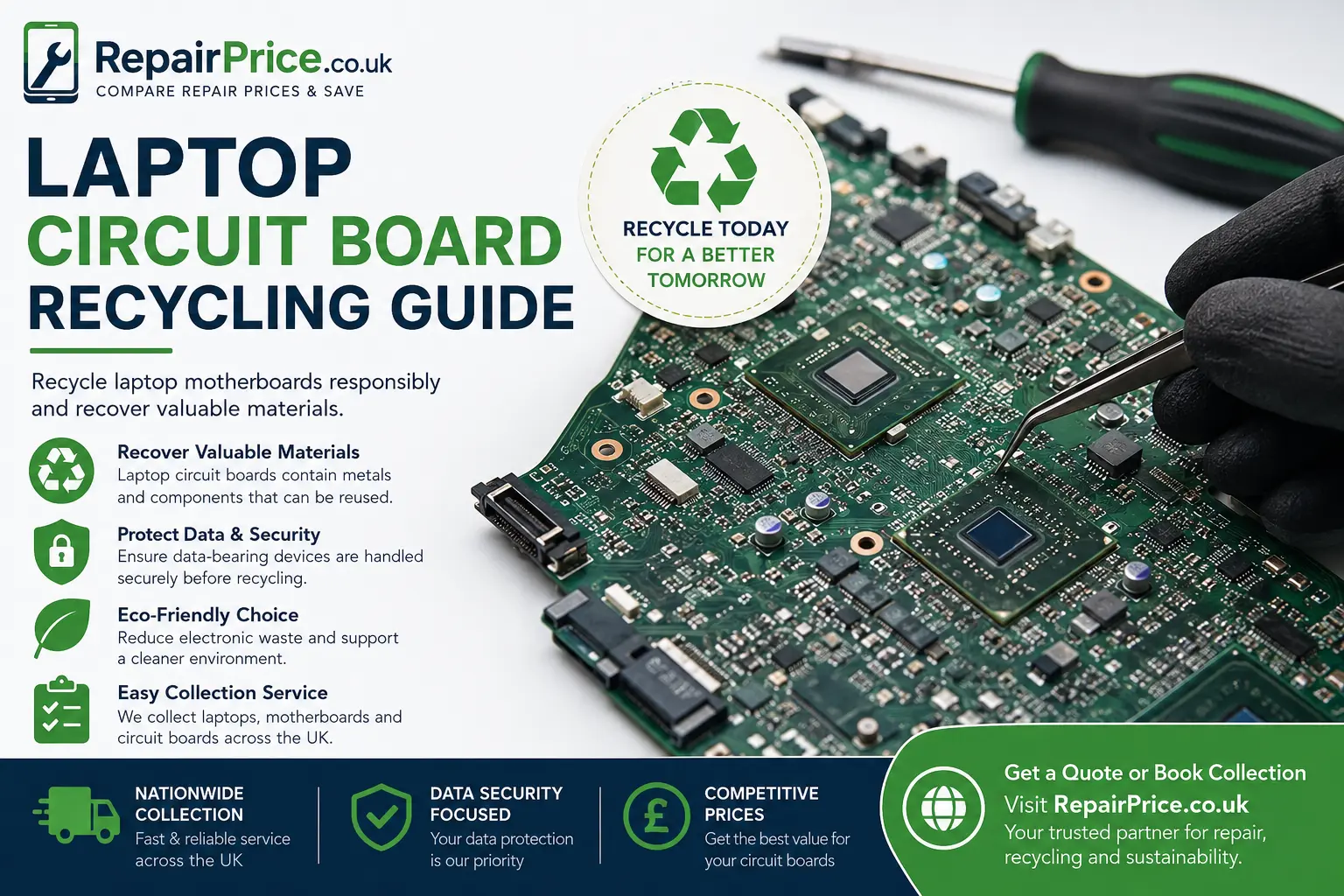
Laptop Circuit Board Recycling Guide: Recover Value and Recycle Laptop Motherboards Responsibly
Laptop circuit boards contain a complex mixture of metals, electronic components and reusable materials. When a laptop reaches the end of its working life, its motherboard should not be placed in general household or commercial waste. Specialist laptop circuit board recycling helps recover useful materials while reducing the environmental and data-security risks associated with unwanted electronic equipment.
This guide explains what laptop circuit boards are, why they can have recycling value, how professional recycling works and when repairing a laptop may be more appropriate than dismantling it. It also shows households, repair shops, schools and businesses how to arrange a responsible recycling route for old laptops, motherboards and related computer components.
Book Your UK Laptop Circuit Board Recycling Collection on WhatsApp
What Is a Laptop Circuit Board?
The main circuit board inside a laptop is commonly called the motherboard, mainboard or logic board. It connects essential components such as the processor, memory, storage drive, charging system, display output, keyboard, trackpad, cooling fan and wireless hardware. Some laptops have additional smaller boards for charging ports, USB connections, audio controls or power buttons.
Unlike a simple piece of metal or plastic, a laptop motherboard contains many different materials bonded together. These may include copper tracks, solder, aluminium, steel, fibreglass, integrated circuits, connectors and small quantities of precious or valuable metals. The exact composition varies according to the laptop’s brand, model, age and board specification.
Because these materials are difficult to separate safely without specialist equipment, unwanted boards should be sent through an established circuit board recycling service. This gives the components a controlled route into sorting, processing and material recovery rather than allowing them to enter landfill or an unsuitable waste stream.
Why Laptop Motherboards Should Be Recycled
Discarded laptop circuit boards may still contain recoverable metals and reusable components. Recycling supports the circular economy by returning some of these materials to manufacturing and refining processes. It can also reduce demand for extracting new raw materials and help prevent electronic components from being handled as ordinary rubbish.
Laptop boards are especially important because they are densely populated with chips, sockets and connectors. Although an individual board may not appear valuable, larger quantities collected from repair businesses, IT departments, schools, offices and technology refurbishment companies can represent a worthwhile recyclable material stream.
Specialist recyclers can assess boards according to their type, condition, generation and component density. For a service focused specifically on this category, visit the dedicated laptop motherboard recycling page.
What Parts of a Laptop Can Be Recycled?
A complete laptop contains more than its main circuit board. Depending on its condition, different parts may be repaired, reused, refurbished or separated for recycling. Common recyclable laptop components include:
- Main laptop motherboards and logic boards
- Charging-port and power-control circuit boards
- Memory modules and processor components
- Solid-state drives and hard disk drives
- Wireless network cards and expansion modules
- Display panels, cables and screen-control boards
- Cooling fans, heat sinks and metal frames
- Keyboards, speakers and trackpad assemblies
- Lithium-ion laptop batteries
- Plastic casings, screws and structural components
These items should not automatically be mixed together. Batteries, storage devices, displays and circuit boards can require different handling methods. Separating components correctly can make the recycling process more efficient and help ensure that sensitive or hazardous items are managed appropriately.
How Laptop Circuit Board Recycling Works
The recycling process normally begins with collection or delivery to an appropriate facility. Boards may be received individually, as part of dismantled laptops or within a larger batch of redundant IT equipment. The recycler may inspect the material to identify board types, remove unsuitable items and determine the most appropriate processing route.
1. Collection and Initial Assessment
The first stage is to identify what equipment is being recycled and whether it contains complete laptops, loose motherboards, storage devices, batteries or mixed electrical components. Clear information about the quantity and condition of the equipment can help the recycling provider plan collection and handling.
2. Data-Bearing Components Are Separated
The motherboard itself can sometimes hold firmware settings or embedded storage, but most personal and business files are stored on the laptop’s hard drive or solid-state drive. These storage devices should be removed and processed using an appropriate data-erasure or destruction procedure before the remaining laptop components are recycled.
Businesses recycling storage-related electronics can also review the specialist information about hard-drive controller board recycling. This is particularly relevant when dismantling failed drives or processing mixed computer hardware.
3. Boards Are Sorted by Category
Not every circuit board has the same material composition. Laptop motherboards may be sorted separately from desktop computer boards, low-grade power boards, peripheral boards and other electronic assemblies. The quantity of integrated circuits, connectors and recoverable metal can influence the board’s recycling classification.
Desktop computers and workstations often contain different board formats. Organisations handling a combination of laptops and tower computers can use the computer mainboard recycling service for relevant desktop PC components.
4. Reusable Parts May Be Recovered
Where practical, working components can be identified for reuse or refurbishment. This may include memory, processors, wireless cards, cooling assemblies or complete boards that can be used in compatible devices. Reuse can extend the working life of existing electronics and may be preferable to immediate material processing.
5. Materials Are Processed and Recovered
Boards that cannot be reused are prepared for specialist processing. Industrial recovery methods can separate metals and other materials from the board structure. The exact treatment depends on the recycler, available technology and the classification of the material. These processes should be completed by experienced operators using suitable environmental and safety controls.
Are Laptop Circuit Boards Valuable?
Laptop motherboards can have recycling value, but their value is not fixed. It may depend on the board’s age, size, component density, grade, condition and current material markets. A modern board with many integrated circuits may be assessed differently from a damaged charging board or a low-component peripheral board.
The quantity supplied also matters. A single damaged motherboard may have limited standalone value after collection and processing costs are considered. Larger, consistently sorted batches can be more practical for commercial assessment. Repair shops, recyclers, universities, schools and businesses replacing fleets of laptops may therefore benefit from keeping suitable boards separated from low-grade electronic waste.
Some densely populated computer boards may be grouped within higher-value recycling categories. To understand how board quality can affect handling and classification, read about higher-grade Class 3 circuit board recycling.
Repair the Laptop or Recycle the Board?
A faulty laptop does not always need to be recycled. Problems that appear to involve the motherboard may actually be caused by the charging socket, battery, memory, storage drive, cooling system, display cable or operating system. Obtaining a diagnosis can prevent a repairable device from being dismantled unnecessarily.
Professional laptop repair quotations can help determine whether the device is economically repairable. Repair may be worthwhile when the laptop is relatively modern, the fault is isolated, replacement parts are available and the expected repair cost is reasonable compared with buying a replacement.
Recycling may be the more suitable option when the motherboard is severely damaged, multiple major components have failed, parts are unavailable or the cost of repair is close to the value of a replacement device. The age, specification, battery condition and software compatibility of the laptop should also be considered.
For a broader explanation of dismantling, material separation and recovery, see the guide covering how old laptops move through the recycling process.
Recycling Complete Laptops
Many households and organisations do not have the tools or technical knowledge to remove a motherboard safely. In these situations, recycling the complete laptop may be the simplest option. A complete-device recycler can determine which parts are suitable for reuse, which components require data handling and which materials should be separated.
The dedicated old laptop recycling service is suitable for laptops that are obsolete, beyond economical repair or no longer required. Complete units may include broken screens, failed keyboards, damaged casings, worn batteries or non-working motherboards.
Users with several types of unwanted electronics can also start from the main electronic device recycling hub. Keeping complete devices separate from loose circuit boards can help the collection provider understand what equipment is available and which recycling route is required.
Business and Bulk Laptop Recycling
Businesses frequently replace laptops in batches when equipment reaches the end of a support contract, no longer meets performance requirements or cannot run necessary software securely. These upgrades can produce a mixture of working devices, repairable units, damaged laptops, storage drives and loose motherboards.
Before collection, organisations should create an inventory of the equipment, identify devices that may contain confidential information and confirm how data will be erased or destroyed. Laptops should be stored securely while awaiting collection, especially when storage drives remain installed.
IT departments and asset managers can learn more about preparing workplace equipment through the business IT equipment recycling guide. Planning the process carefully can improve traceability, reduce unnecessary disposal and identify devices that may still be suitable for repair or refurbishment.
Recycling Expansion Cards and Additional Laptop Boards
Some laptops, docking stations and specialist portable workstations contain removable cards or secondary circuit boards. These can include wireless cards, graphics modules, interface boards, controller cards and docking-station electronics. They may need to be separated from the main motherboard during sorting.
Loose computer cards and compatible modules can be directed to an expansion and interface card recycling service. Separating these boards from batteries, cables, plastics and general scrap can make identification and processing easier.
What About Tablets and Mobile Devices?
Laptops are often collected alongside tablets and mobile phones, but these devices have different construction methods and component sizes. Tablet logic boards are normally smaller and more tightly integrated, while smartphones may contain compact multi-layer boards with soldered components.
A tablet that is still potentially usable should first be assessed through a tablet fault and repair comparison service. When a tablet has reached the end of its life, the tablet recycling collection page provides a more appropriate route for the complete device.
Similarly, damaged smartphones may still be repairable despite a broken screen, charging fault or weak battery. Users can compare options through the mobile phone repair service before deciding whether recycling is necessary.
Laptop Circuit Board Recycling in West Yorkshire
RepairPrice helps users compare relevant repair and recycling options across the UK, including services connected with West Yorkshire. Local support can be useful when users want to diagnose a laptop before recycling it or need advice about dealing with a failed motherboard.
Customers in Bradford can explore laptop repair options from Bradford-area specialists. Those based in Leeds can review Leeds laptop repair quote services, while users elsewhere in the region can find Halifax laptop fault assessment options.
Obtaining a repair opinion before recycling can be especially useful for business-class laptops, gaming laptops, premium ultrabooks and models that contain valuable or difficult-to-replace components.
How to Prepare Laptop Circuit Boards for Collection
Correct preparation helps protect the boards, prevents contamination and makes the collection easier to assess. Loose motherboards should be handled carefully because sharp edges, broken connectors and damaged components can create hazards.
- Keep laptop boards dry and protected from rain or moisture.
- Do not mix circuit boards with food waste, liquids or general rubbish.
- Remove batteries and store them separately where safe to do so.
- Keep hard drives and solid-state drives separate when data handling is required.
- Avoid deliberately breaking, cutting or burning circuit boards.
- Use sturdy containers for loose boards and prevent unnecessary movement.
- Separate laptop motherboards from cables, chargers and plastic casings where practical.
- Provide an approximate quantity or weight when requesting a collection.
Boards should never be burned or treated with chemicals to recover metals. Informal recovery methods can release hazardous fumes, create contaminated waste and expose people to unnecessary health risks. Material recovery should be left to appropriately equipped recycling specialists.
Understanding Hard-Drive Board Recycling
A laptop hard drive contains a small controller board attached to the drive enclosure. This board manages communication, power and movement of the internal drive components. Although it is a circuit board, it should not automatically be removed before the data on the drive has been addressed.
Removing the controller board does not reliably erase the data stored on the drive platters or memory chips. The storage device must undergo a suitable erasure or destruction process. The detailed hard-drive PCB recycling guide explains how these controller boards differ from laptop motherboards and why data security remains important.
Environmental Benefits of Responsible Laptop Recycling
Responsible recycling helps keep electronic equipment within a managed recovery system. Recovering copper, aluminium, steel and other materials can reduce the amount of waste sent for disposal and support the production of new goods using secondary materials.
Recycling also helps address the rapid turnover of computers. Laptops may be replaced because of physical damage, weak batteries, unsupported software or changing workplace requirements even when some internal parts remain usable. A combined repair, reuse and recycling approach can capture more value from each device.
The best environmental outcome is often to keep a safe and functional laptop in use for longer. When this is not possible, reusable parts should be recovered where practical, data-bearing components should be secured and the remaining circuit boards should enter a specialist recycling process.
Who Can Use a Laptop Motherboard Recycling Service?
Laptop circuit board recycling can be suitable for individuals and organisations with either small or bulk quantities. Typical users include:
- Independent laptop and computer repair shops
- IT support and managed-service providers
- Schools, colleges and universities
- Offices replacing staff laptops
- Retailers and electronics refurbishment companies
- Charities and community technology projects
- Property-clearance and facilities-management businesses
- Households with old or dismantled laptops
The most appropriate collection method may depend on the quantity, location, equipment condition and whether complete laptops or loose boards are being supplied. Providing accurate details at the enquiry stage can help the service provider recommend a suitable route.
Request a Laptop Circuit Board Recycling Quote
Before submitting an enquiry, prepare a brief description of the material. Include the number of laptops or circuit boards, whether the devices are complete, whether batteries and storage drives remain installed, your collection location and any data-security requirements.
Clear information helps distinguish a laptop motherboard collection from a mixed electronic-waste enquiry. It can also make it easier to identify whether any devices should first be considered for repair, reuse or refurbishment.
Request a Laptop Circuit Board Recycling Quote
Frequently Asked Questions About Laptop Circuit Board Recycling
Can a broken laptop motherboard be recycled?
Yes. A motherboard does not need to be working to enter a specialist recycling process. Burnt, cracked, corroded or otherwise damaged boards may still contain recoverable materials, although contamination or severe physical damage can affect how they are classified.
Should I remove the laptop battery first?
Lithium-ion batteries generally require separate handling. Remove the battery only when it is safe and practical to do so. Do not force, puncture or bend a swollen or damaged battery. Tell the recycling provider when a battery remains installed or appears unsafe.
Does recycling a laptop motherboard erase my files?
Not necessarily. Most user files are stored on the hard drive or solid-state drive rather than the main motherboard. Storage devices should be securely erased or physically destroyed according to the sensitivity of the information before recycling.
Can one laptop circuit board be collected?
Collection availability can depend on location, quantity and the type of material. A single board may be suitable for delivery or inclusion with other recyclable equipment, while larger commercial quantities may justify a dedicated collection.
Can laptop circuit boards be mixed with desktop PC boards?
They may be accepted within the same collection, but separating them can help with grading and assessment. Laptop boards, desktop motherboards, storage-controller boards and expansion cards can have different structures and recycling classifications.
Should I repair my laptop before recycling it?
A repair assessment is worthwhile when the laptop is relatively recent, has useful specifications or may have a simple fault. Recycling is more appropriate when the device is obsolete, severely damaged or uneconomical to repair.
Choose a Responsible Route for Unwanted Laptop Boards
Laptop circuit boards should be treated as valuable electronic material rather than ordinary waste. A responsible process begins by checking whether the laptop can be repaired or reused, securing any data-bearing components and separating batteries or other items that require specialist handling.
When repair is no longer practical, professional laptop circuit board recycling can recover materials from motherboards, controller boards and related computer components. Whether you have one failed laptop or a commercial batch of redundant equipment, providing clear details about the quantity and condition will help identify the most suitable recycling route.
RepairPrice connects repair, reuse and recycling information so that users can make a more informed decision about unwanted technology. Start with the relevant recycling service, describe the equipment accurately and ensure that personal or business data is dealt with before the laptop leaves your control.