

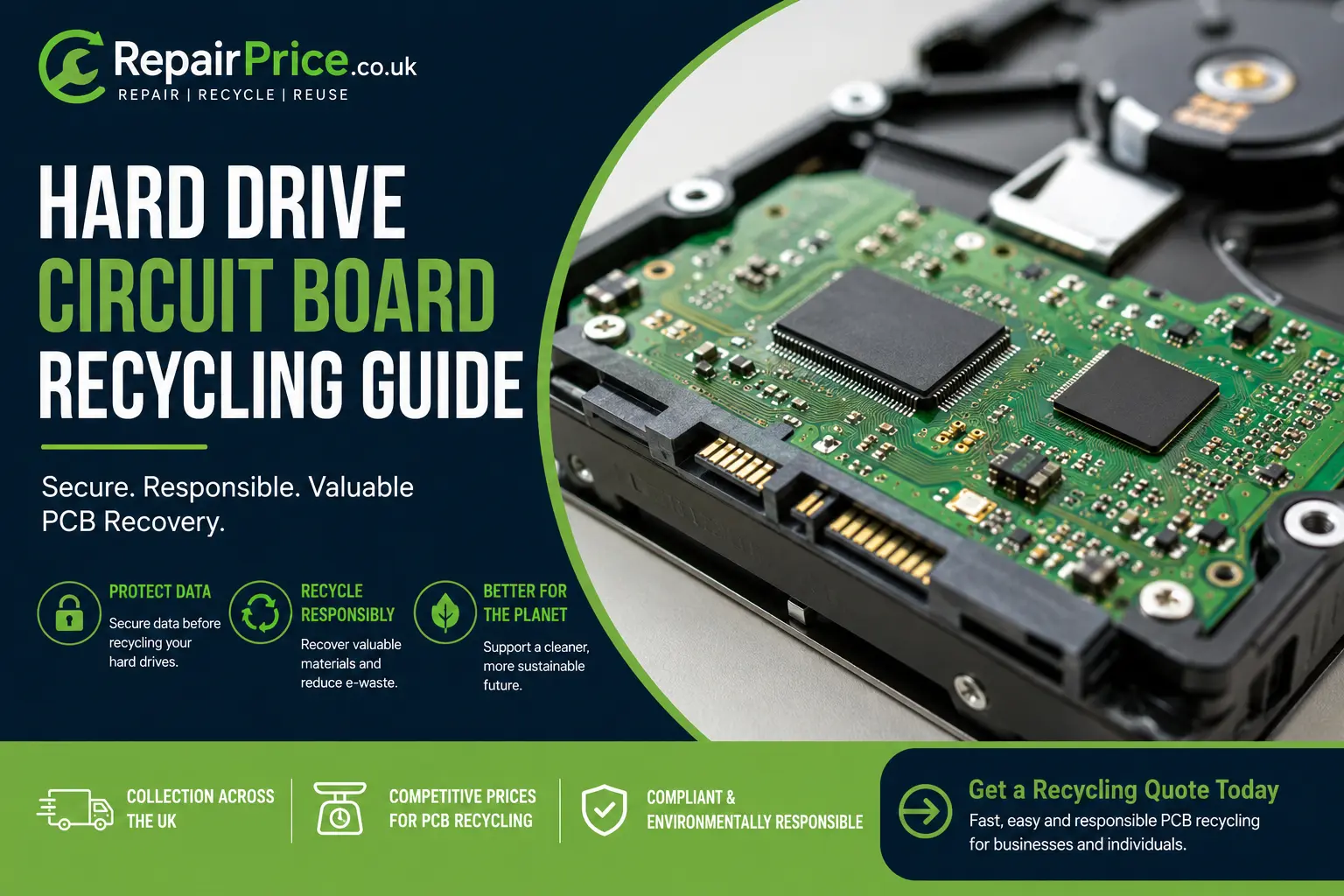
Hard Drive Circuit Board Recycling Guide: Secure, Responsible and Valuable PCB Recovery
Old, damaged and obsolete hard drives should not be placed in general waste or stored indefinitely in cupboards, server rooms and office storage areas. Every hard disk drive contains an electronic circuit board that controls communication, power delivery, motor operation and data transfer. These printed circuit boards can contain copper, gold-plated contacts, integrated circuits and other recoverable materials that may be suitable for specialist recycling.
This hard drive circuit board recycling guide explains how hard drive PCBs are identified, why secure data handling remains important, what happens during the recycling process and how households, repair shops, IT departments and businesses can arrange responsible collection. RepairPrice.co.uk helps connect customers with appropriate repair and recycling services, making it easier to decide whether equipment should be repaired, reused, dismantled or recycled.
For dedicated information about accepted boards, preparation requirements and collection options, visit our specialist hard drive PCB recycling service.
Book Your Hard Drive PCB Recycling Collection via WhatsApp
What Is a Hard Drive Circuit Board?
A hard drive circuit board, sometimes called a hard disk PCB, controller board or logic board, is normally attached to the underside of a hard disk drive. It controls many of the drive’s electronic functions and enables the storage device to communicate with a desktop computer, laptop, server, external enclosure or specialist industrial system.
The PCB may include a controller chip, motor driver, memory components, power-management circuitry, interface connectors and firmware-related components. Depending on the age, model and manufacturer of the drive, the board may use SATA, SAS, IDE or another connection standard.
Although a single hard drive board is relatively small, large quantities collected from computers, servers, data centres, repair businesses and IT replacement projects can create a significant stream of electronic material. Specialist processing allows useful metals and components to be separated while reducing the volume of electronic waste sent to landfill.
Why Hard Drive PCBs Should Be Recycled Separately
Hard drive boards should be handled as electronic waste rather than mixed with ordinary household or commercial rubbish. Printed circuit boards are made from several different materials, including fibreglass, resin, solder, copper tracks, connectors, chips and small quantities of precious or specialist metals.
Separating these boards from general waste supports more effective material recovery. It also prevents reusable metals from being lost and reduces the risk of unsuitable electronic components entering uncontrolled waste streams.
Hard drive PCBs are often collected with other high-grade electronic boards. Businesses with mixed circuit board quantities can explore our main UK circuit board recycling service for guidance on sorting, collection and broader PCB recycling options.
Does Removing the PCB Destroy the Data?
Removing the circuit board does not automatically destroy the data stored on a hard disk drive. In traditional mechanical drives, information is normally stored magnetically on internal platters. The external PCB controls the drive, but the stored information may remain recoverable from the internal media under certain circumstances.
This distinction is especially important for businesses, schools, healthcare organisations, professional offices and households disposing of drives that previously held personal, financial or confidential information. Recycling the PCB and securely destroying the stored data are related but separate processes.
Before sending complete hard drives for recycling, consider whether the data has been securely erased, overwritten or physically destroyed using a suitable method. Our guide to protecting data before electronic recycling explains why deleting files or formatting a drive may not always be sufficient.
Can a Faulty Hard Drive Be Repaired Before Recycling?
Some hard drives fail because of an electronic fault rather than damage to the platters or internal mechanical components. Symptoms may include a drive that does not power on, is not detected by a computer, has visible damage around the power connector or stopped working after a surge.
Replacing a hard drive PCB is not always a simple plug-and-play repair. Modern drives may store model-specific calibration information or firmware data on the board. A replacement controller may need specialist component transfer or programming before it can communicate correctly with the original drive.
Where important files are involved, avoid repeatedly powering a damaged drive or attempting unverified board swaps. A professional assessment may provide a better chance of recovering the data. If the faulty drive came from a notebook computer, compare options through our laptop repair quotation service.
Customers dealing with storage problems in other devices can also explore mobile phone repair support or request assistance through our tablet repair comparison service. Repairing a usable device can extend its working life and delay unnecessary replacement.
Which Hard Drive Circuit Boards Can Be Recycled?
Recycling services may accept boards removed from desktop hard drives, laptop hard drives, enterprise storage devices, servers, network storage systems, CCTV recorders, external hard drive enclosures and older computer equipment. Acceptance can depend on quantity, condition, contamination and how the boards have been separated.
Boards should generally be kept dry and free from excessive dirt, oil, batteries and unrelated waste. Where possible, separate bare hard drive PCBs from metal drive casings, plastic caddies, cables and complete computer assemblies. Correct sorting can make identification and processing more efficient.
Businesses dismantling laptops may also generate motherboard material. Our laptop motherboard and PCB recovery page provides information for this related category.
Desktop towers and workstation upgrades can produce additional board grades, including motherboards, controller boards and internal cards. These materials may be handled through our computer circuit board recycling service.
How Hard Drive Circuit Board Recycling Works
The recycling journey normally begins with collection, delivery or postal submission, depending on the quantity and service arrangement. The materials are then inspected so that hard drive PCBs can be separated from complete drives, low-grade electronic items and other circuit board categories.
After sorting, the boards may be weighed and grouped according to their composition and recoverable content. They can then be transferred to an appropriate specialist processor. Processing methods vary, but the objective is to separate useful materials from the fibreglass, resin and other non-metallic parts of the board.
Mechanical treatment may reduce the boards into smaller pieces before different materials are separated. Specialist recovery processes can then target copper and other metals. The exact route depends on the processing facility, board grade and applicable environmental controls.
Server decommissioning projects frequently produce hard drives alongside backplanes, rear walls and other data-centre boards. Organisations managing this type of equipment can review our server backplane and rear-wall recycling options.
Are Hard Drive PCBs Considered High-Grade Circuit Boards?
The value and grade of a circuit board depend on its design, component density, connector type, age and recoverable material content. Hard drive PCBs are compact and often contain several integrated circuits, plated contacts and copper-rich tracks, but not every board has the same recycling value.
Boards should not be assessed only by their colour, size or number of visible chips. Professional grading considers the full composition of the material and the cost of processing it. Mixing hard drive boards with metal casings, cables or low-grade waste can also affect how a batch is classified.
For an overview of another recognised circuit board category, see our information about Class 3 circuit board recovery.
Hard Drive Recycling for Businesses and IT Departments
Businesses often accumulate hard drives during computer upgrades, server replacements, office relocations, equipment audits and data-centre decommissioning. Keeping large quantities of redundant drives on-site can consume storage space and increase the risk of devices being misplaced or handled without a clear data-security process.
A planned recycling project should identify the equipment, record where it came from, separate reusable devices from failed units and establish how confidential data will be treated. Hard drive PCBs can then be separated for material recovery where appropriate, while the remaining aluminium casing, magnets and other components can enter suitable recycling streams.
Our business IT equipment recycling guide provides additional advice for organisations managing computers, storage devices, phones and other workplace electronics.
Companies replacing complete notebooks can use our laptop recycling and collection service rather than dismantling every device internally. This can be more practical when equipment includes batteries, screens, casings, storage drives and multiple circuit boards.
Should You Recycle the Complete Hard Drive or Only the PCB?
The best option depends on what material you have and whether the drive contains sensitive data. Repair shops and dismantlers may already have bare controller boards separated from damaged drives. In this situation, sending the PCB as a sorted circuit board category may be appropriate.
Households and offices are more likely to have complete hard drives. These should not be dismantled without considering data security, sharp metal edges and the correct route for the remaining materials. Complete devices may be easier to manage through a broader electronic recycling arrangement.
For mixed devices, chargers, computers and accessories, start with our electronic device recycling hub. It explains the available routes for unwanted technology and helps users move from storage or disposal towards responsible reuse and recycling.
Recycling Hard Drives Removed from Laptops
Laptop hard drives are commonly removed during storage upgrades, fault diagnosis or replacement with solid-state drives. Before recycling the old drive, check whether it still contains files that need to be transferred or securely erased.
If the laptop remains functional, repairing or upgrading it may be more environmentally responsible than replacing the entire machine. A new storage drive, battery, keyboard or charging port can sometimes return an otherwise useful computer to service.
Customers in West Yorkshire can compare local support through our Leeds laptop repair shop network, find suitable providers through our Wakefield laptop repair comparison page, or request quotations from Huddersfield laptop repair specialists.
When a device has reached the end of its practical life, its hard drive, motherboard, memory, battery and metal casing should enter appropriate recycling channels. Our guide to recycling laptop circuit boards explains how other internal laptop electronics can be recovered.
Can Hard Drives from Phones and Tablets Be Recycled?
Phones and tablets do not normally contain removable mechanical hard disk drives. They generally use flash-storage chips mounted directly onto a main circuit board. However, these devices still contain valuable electronic components and should be recycled through a suitable device-specific service.
Unwanted handsets can be submitted through our mobile phone recycling service. Recycling the complete handset helps direct its battery, casing, screen, circuit board and internal metals into more appropriate recovery routes.
Before recycling a phone or tablet, sign out of accounts, remove SIM and memory cards where applicable, back up important information and complete a secure factory reset. Devices that remain economically repairable may have greater value when restored and reused instead of dismantled immediately.
Preparing Hard Drive Circuit Boards for Collection
Before arranging recycling, count or estimate the number of boards and confirm whether they are bare PCBs or still attached to complete hard drives. Keep boards dry and place them in a secure container that prevents pieces from being lost during handling.
Do not mix hard drive boards with loose batteries, liquids, heavily contaminated equipment or general waste. If you have several electronic categories, separate them into clearly labelled containers. This can reduce sorting time and make it easier to identify laptop boards, PC motherboards, server boards and hard drive controllers.
For commercial quantities, provide clear information about the approximate weight, location, type of equipment and whether loading assistance may be required. Photographs are not included in this page, but they may be requested separately to help assess a mixed batch before collection.
Why Choose a Specialist Recycling Route?
A specialist route is designed to handle circuit boards as a distinct electronic material rather than treating them as ordinary scrap. Correct identification helps ensure that recoverable metals are directed towards appropriate processing and that unsuitable items are removed before treatment.
Using a clear recycling process also supports better record keeping for businesses. Organisations may need internal evidence showing how redundant IT equipment was handled, particularly when data-bearing devices or workplace electronics are involved.
RepairPrice.co.uk helps users find practical routes for both repair and recycling. This supports a simple hierarchy: continue using equipment where possible, repair faults when sensible, reuse working devices and recycle materials responsibly when equipment has genuinely reached the end of its useful life.
Request Help with Hard Drive PCB Recycling
Whether you have a small collection of bare hard drive boards or a larger batch from computers, servers and business IT equipment, provide as much detail as possible when making an enquiry. Include the approximate quantity, condition, collection location and whether the boards are separated from the drive casings.
Customers with mixed electronic equipment can also mention laptops, desktop computers, phones, tablets, server hardware and other circuit boards in the same enquiry. The available route may differ according to the type, volume and condition of the material.
Request a Hard Drive PCB Recycling Quote
Frequently Asked Questions About Hard Drive Circuit Board Recycling
Can I recycle a hard drive PCB without the rest of the drive?
Yes, bare hard drive circuit boards may be suitable for specialist PCB recycling. Keep them separate from metal casings, batteries, cables and unrelated electronic waste, and provide an approximate quantity when requesting collection or delivery information.
Does recycling a hard drive board erase the stored data?
No. Removing or recycling the controller board does not necessarily destroy information stored on the drive’s internal platters. Secure data erasure or physical media destruction should be considered separately before the complete drive leaves your control.
Are broken or burnt hard drive boards accepted?
Some damaged boards may still be recyclable, but acceptance depends on their condition and whether they are contaminated. Describe any fire, liquid or chemical damage when making an enquiry so the material can be assessed correctly.
Can businesses arrange collection for large quantities?
Collection may be available for suitable commercial quantities, depending on the location, board type, total weight and access requirements. Businesses should provide an inventory or reasonable estimate when requesting an assessment.
Should working hard drives be recycled?
A working drive may be suitable for secure reuse if it remains reliable and all previous data has been properly removed. However, drives with uncertain condition, obsolete capacity or security concerns may be better directed towards secure destruction and material recycling.
Can complete laptops be collected with hard drives?
Complete laptops may be handled through a device recycling route. This allows the battery, display, casing, motherboard, storage device and other components to be assessed without requiring the owner to dismantle the equipment.
Recycle Hard Drive Circuit Boards Responsibly
Hard drive PCBs are small but important components within the electronic waste stream. They contain recoverable materials, should not be discarded with general rubbish and require careful handling when attached to data-bearing storage devices.
Before recycling, decide whether the drive can be repaired, whether its data must be recovered and how confidential information will be securely destroyed. Separate bare circuit boards where appropriate, keep materials dry and provide accurate quantity details when arranging a service.
By choosing repair, reuse and responsible recycling in the correct order, households and businesses can reduce electronic waste, protect sensitive information and return valuable materials to the recycling chain.