

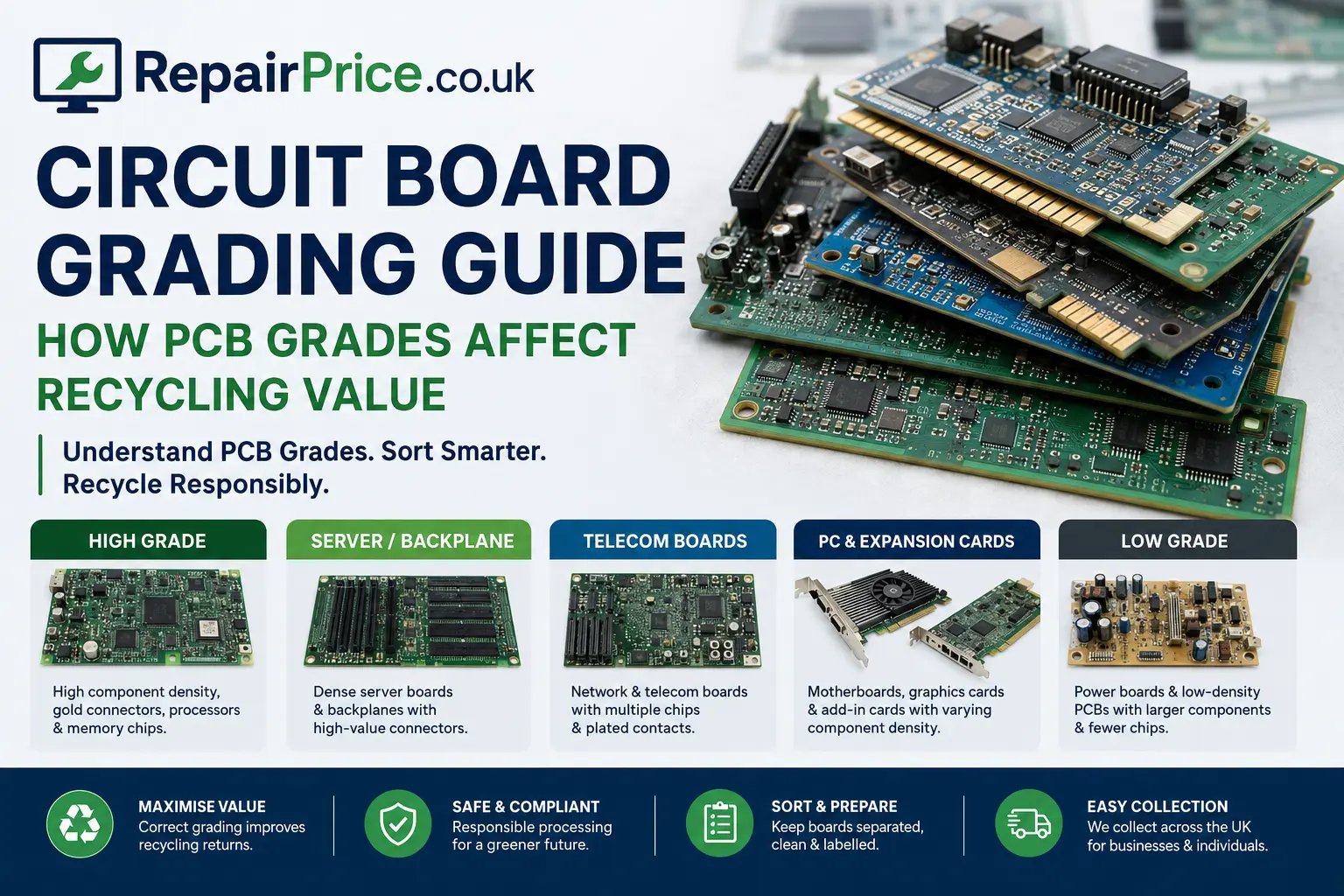
Circuit Board Grading Guide: How PCB Grades Affect Recycling Value
Circuit board grading is the process of sorting printed circuit boards according to their component density, precious-metal content, construction, age and original application. The grade assigned to a circuit board can significantly affect its recycling value because not every board contains the same quantity or concentration of recoverable materials.
A server board packed with processors, gold-plated connectors and high-value integrated circuits will normally be classified differently from a basic power board containing transformers, capacitors and only a small number of chips. Understanding these differences can help businesses, repair shops, IT departments, recycling companies and individual sellers avoid mixing valuable circuit boards with lower-grade electronic material.
This guide explains how circuit boards are commonly graded, which features recycling specialists examine and how to prepare your boards before requesting a collection or valuation. RepairPrice.co.uk can help you find an appropriate recycling route for circuit boards and unwanted electronic equipment across the UK.
Book Your UK Circuit Board Recycling Collection on WhatsApp
What Is Circuit Board Grading?
Circuit board grading is a commercial sorting method used to group PCBs with broadly similar recycling characteristics. Although grading terminology can vary between recyclers, buyers and processing facilities, boards are generally assessed according to the concentration of valuable components and the likely cost of recovering their materials.
The grading process helps recyclers determine whether a batch should be processed as a high-value material, combined with a wider category or treated as low-grade electronic scrap. Accurate separation can improve the efficiency of downstream processing and may lead to a more appropriate valuation than supplying every type of board in one mixed container.
Organisations managing regular quantities of electronic waste can explore the main circuit board recycling service to understand how different PCB categories may be collected and processed. This is particularly useful for repair centres, telecoms businesses, data centres, manufacturers and IT asset managers producing repeat volumes.
Why Circuit Board Grades Are Important
Circuit boards contain a mixture of metals, fibreglass, resins, plastics and electronic components. Depending on the board type, recoverable materials may include copper, aluminium, tin, silver, gold, palladium and other metals. However, the presence of these materials does not mean that every circuit board has the same recycling value.
High-grade boards may contain dense rows of integrated circuits, processors, memory modules, gold fingers and plated connectors. Lower-grade boards may contain fewer chips and a higher proportion of bulky components, steel, plastic or low-value substrate material. The potential return must also be balanced against labour, transport, separation and specialist processing costs.
For a deeper explanation of the metals that may be present, read the guide to valuable materials found inside circuit boards. It explains why visually similar PCBs can have very different material compositions.
What Determines a Circuit Board Grade?
A recycler will usually consider several characteristics rather than relying on board colour or size alone. The most important factors often include component density, connector type, chip quantity, board application and contamination levels.
Component Density
Boards with a high concentration of processors, integrated circuits, memory chips and plated connectors are generally more attractive for specialist recovery. A densely populated board may contain a greater concentration of recoverable material per kilogram than a large board carrying only a few basic components.
Gold-Plated Contacts and Connectors
Gold fingers, edge connectors, processor sockets and certain telecoms contacts can influence grading. These features do not automatically make a board high grade, but their quantity, thickness and distribution may contribute to the overall assessment.
Board Origin and Application
The equipment from which a board was removed provides useful information. Server, telecommunications, computer, industrial-control and networking boards are often evaluated differently from household appliance, television power-supply or basic peripheral boards.
Age and Technology
Older circuit boards sometimes contain larger components or different plating levels than modern compact designs. However, age alone is not a reliable indicator of value. Some older boards are highly desirable, while others contain substantial quantities of low-value material.
Contamination and Damage
Excess dirt, oil, moisture, batteries, steel frames, heat sinks, plastic cases and attached cables can reduce the quality of a batch. Clean, correctly separated boards are easier to inspect and may require less preparation before processing.
Common Circuit Board Grading Categories
There is no single universal grading system used by every recycling company. Buyers may use terms such as high grade, medium grade, low grade, telecom grade, server grade or Class 3. The following categories provide a practical overview of how boards are often separated.
High-Grade Circuit Boards
High-grade boards usually contain a dense concentration of valuable electronic components. Examples may include selected server boards, telecom boards, processor boards, networking boards and certain industrial-control PCBs. Features can include numerous integrated circuits, gold-plated connectors, processor sockets and high component density.
Businesses handling dense electronic boards can review the dedicated Class 3 circuit board recycling option. Classification should still be confirmed by a recycler because not every populated board will meet the same commercial specification.
Server and Backplane Boards
Server backplanes, rear walls and associated infrastructure boards may contain multiple high-quality connectors and complex electronic layouts. Their construction can differ substantially from ordinary desktop computer boards, so they should be kept in a separate category where possible.
Data centres, IT departments and server-maintenance companies can learn more about recycling server rear-wall and backplane boards. Separating these boards from steel cases, fans and power supplies makes identification easier.
Telecommunications Circuit Boards
Telecom boards can come from exchanges, network cabinets, switching systems, communication hardware and specialist infrastructure. Some are densely populated and contain numerous plated contacts, while others may have a lower concentration of recoverable material.
Companies replacing communications equipment can use the telecom PCB recycling service to identify a suitable route for obsolete boards and associated electronic hardware.
Computer and PC Circuit Boards
Desktop computers can produce several PCB categories, including motherboards, graphics cards, memory modules, network cards, sound cards, controller boards and power-supply boards. These parts should not automatically be treated as one grade because their component concentration varies significantly.
Computer motherboards and related materials can be directed through the PC circuit board recycling pathway. Removing batteries, large steel brackets and unrelated plastic components can make the material easier to assess.
Expansion Cards
Graphics cards, network cards, sound cards, controller cards and other add-in boards are commonly grouped as expansion cards. Some include gold-plated edge contacts and dense chip arrangements, while simpler cards may carry only a small number of components.
Organisations with separated computer add-in boards can review the expansion card recycling service for guidance on suitable material types.
Low-Grade Circuit Boards
Low-grade boards often have fewer integrated circuits and a higher proportion of transformers, relays, large capacitors, coils, steel or plastic. Examples may include some power-supply boards, appliance controls, basic monitor boards and certain television PCBs.
Low grade does not mean that a board cannot be recycled. It means that the recoverable material concentration and processing economics differ from more densely populated circuit boards. Mixing low-grade boards into a high-grade batch may reduce the overall classification offered by a buyer.
How to Identify a Potentially Higher-Grade Board
A visual check can help with initial sorting, although a professional recycler should make the final classification. Look for a high number of integrated circuits, processors, memory chips, gold fingers, plated sockets and closely arranged components. Boards from enterprise servers, telecommunications systems and specialist computing equipment may deserve separate inspection.
Do not grade a board solely by weight. A heavy power board containing transformers and heat sinks may have less recoverable precious-metal content than a lighter but densely populated communications board. Board colour is also unreliable because green, blue, red, black and brown substrates can all appear across different grades.
How to Sort Circuit Boards Before Recycling
Good preparation can make a collection more efficient and reduce uncertainty during valuation. Begin by separating boards according to the equipment they came from. Keep server boards, telecom boards, computer motherboards, expansion cards and low-density power boards in different boxes or containers.
Remove loose batteries where it is safe to do so, as batteries require a separate recycling route and can create a fire risk if damaged. Avoid breaking, burning, grinding or chemically treating circuit boards. These methods can expose people and the environment to hazardous substances and may also destroy the commercial value of the material.
Keep the boards dry and protected from rain. Use strong containers that can support the weight without splitting. Label each container clearly and record the approximate quantity or weight. For larger commercial loads, photographs of each category may help a recycling provider understand the material before arranging collection.
Should Components Be Removed Before Recycling?
In most cases, circuit boards should be supplied intact unless a recycling company has specifically requested component removal. Removing processors, heat sinks, batteries or steel brackets may sometimes help with separation, but indiscriminate dismantling can damage valuable parts and create unnecessary labour.
Businesses should ask for grading instructions before processing a large batch. A recycler may prefer certain boards to remain complete because their original configuration helps identify the category. Other materials, such as batteries or oversized metal frames, may need to be separated for safety and accurate weighing.
Repair, Reuse or Recycle the Equipment First?
Before dismantling working or repairable equipment, consider whether extending its useful life is practical. Repair may be more appropriate when a device has a replaceable fault and remains suitable for continued use. Reuse can preserve more of the energy and resources already invested in manufacturing the product.
For faulty computers, compare options through the national laptop repair quotation service. Mobile devices with screen, battery or charging faults may still be economical to restore through phone repair specialists. Televisions with power, backlight or main-board faults can be assessed using the TV repair comparison service.
West Yorkshire customers can also explore local options, including laptop repair services around Leeds, mobile phone repair quotes in Halifax and television repair providers serving Wakefield.
When equipment is beyond economical repair, obsolete, incomplete or unsuitable for reuse, responsible recycling can recover useful materials and divert electronic waste from disposal.
Recycling Complete Devices Containing Circuit Boards
You do not always need to dismantle equipment before arranging recycling. Complete laptops, phones and other electronic devices may be accepted through a device-recycling route. Keeping an item complete can also support reuse, refurbishment, parts harvesting and secure data-handling procedures before material recovery begins.
The main electronic device recycling hub provides routes for several common equipment categories. Organisations replacing business computers can explore responsible laptop recycling, while unwanted handsets can be directed through the mobile phone recycling service.
Before recycling equipment that stores personal or commercial information, ensure that data is securely erased or destroyed using a process appropriate to the device and your organisation’s responsibilities. Simply deleting files or performing a basic reset may not be sufficient for every situation.
How Circuit Boards Are Processed After Collection
After collection, boards may be checked, weighed and separated into appropriate categories. Depending on the facility and material type, processing can involve manual dismantling, mechanical size reduction, magnetic separation, density separation and specialist metallurgical recovery.
The aim is to separate useful metals and other recyclable fractions while managing hazardous or non-recoverable materials responsibly. The exact process depends on board composition, available technology and the requirements of downstream refiners.
For a step-by-step overview, visit the article explaining what happens to circuit boards during recycling. Commercial organisations can also read the business guide to managing PCB recycling for practical advice on storage, auditing and arranging collections.
Common Circuit Board Grading Mistakes
One of the most common mistakes is assuming every motherboard is high grade. Motherboards vary by device type, manufacturer, age and component density. A desktop motherboard, laptop motherboard, server board and television main board may all receive different classifications.
Another mistake is mixing circuit boards with batteries, hard drives, steel cases, cables and general waste. Mixed loads require additional sorting and may be valued differently from clearly separated material. Burning components or using chemicals to expose metals is dangerous and should never be used as a preparation method.
Sellers should also avoid relying on photographs alone for a guaranteed valuation. Images can help with an initial assessment, but final grading may depend on physical inspection, verified weight, contamination levels and the consistency of the full batch.
Can Mixed Circuit Boards Still Be Recycled?
Mixed circuit boards can often be recycled, but they may need to be sorted before a final category or price can be confirmed. A mixed load containing high-density server boards, household power boards and computer expansion cards is unlikely to be treated as a single premium grade.
Separating obvious categories before collection can save processing time and make the contents clearer. For substantial quantities, provide an inventory describing the source equipment, approximate board types, total weight, storage conditions and whether any batteries or complete devices are included.
Who Can Benefit from PCB Grading?
Circuit board grading is particularly useful for IT departments, data centres, telecoms companies, electronics manufacturers, repair shops, schools, universities, local authorities, refurbishment businesses and waste-management providers. These organisations may generate enough material for accurate sorting to improve traceability and collection efficiency.
Repair businesses can also use grading to keep reusable components separate from recycling stock. A working expansion card, processor or server component may have a reuse value that is greater than its raw-material value. Testing and reuse should therefore be considered before components enter the recycling stream.
Information to Provide When Requesting a PCB Recycling Quote
When contacting a recycling provider, explain what types of boards you have, where they came from and whether they have already been sorted. Include an approximate weight, number of containers, collection postcode and clear photographs showing the front and back of representative boards.
You should also mention whether the load contains complete computers, phones, televisions, batteries, hard drives, cables or metal frames. Accurate information helps the provider determine whether the material requires a specialist collection, additional packaging or separate handling.
Request a Circuit Board Recycling Quote
Choose the Right Route for Your Circuit Boards
Circuit board grading is not simply a matter of labelling boards as good or bad. It is a practical method of identifying material with different component densities, recovery potential and processing requirements. Keeping server boards, telecom boards, computer boards, expansion cards and low-density power boards separate can make recycling more organised and transparent.
Where equipment is still usable, prioritise repair, refurbishment or component reuse. When devices and circuit boards have reached the end of their practical life, use a specialist recycling route that can assess the material, manage data-bearing equipment and direct recoverable resources into suitable processing streams.
RepairPrice.co.uk helps UK households and organisations compare repair options and find relevant recycling services. Whether you have a small quantity of computer boards or a larger commercial batch from an IT upgrade, providing clear information and separating obvious board categories is the best starting point for an efficient collection.