

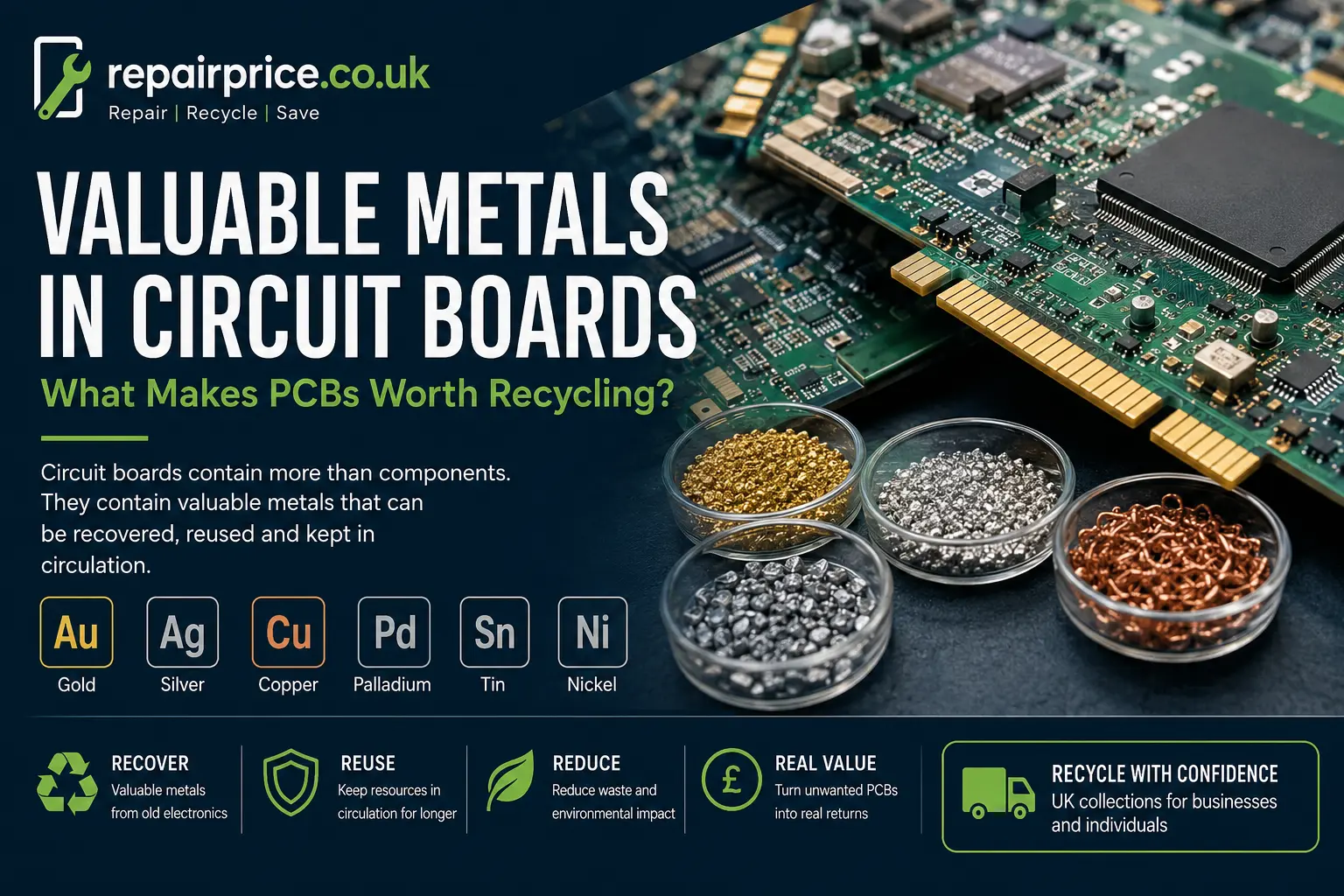
Valuable Metals in Circuit Boards: What Makes PCBs Worth Recycling?
Printed circuit boards are found inside almost every modern electronic device, from mobile phones and laptops to games consoles, telecommunications equipment and industrial servers. Although a circuit board may look like a mixture of plastic, glass fibre and small electronic components, it can also contain recoverable metals with commercial and environmental value.
Gold, silver, copper, palladium, tin and other metals may be present in different quantities depending on the board’s age, purpose, component density and original manufacturing specification. This does not mean every circuit board is highly valuable. However, when boards are correctly identified, separated and processed in suitable volumes, they can become an important source of secondary raw materials.
This guide explains which valuable metals are commonly found in circuit boards, why some PCB grades are worth more than others, how professional recycling works and what businesses or householders should do with unwanted electronic equipment.
Arrange a UK Circuit Board Recycling Collection on WhatsApp
Why Do Circuit Boards Contain Valuable Metals?
Circuit boards must transfer electrical signals reliably while resisting corrosion, heat and repeated use. Manufacturers therefore use metals that provide good electrical conductivity, mechanical strength and long-term performance. Copper is widely used for conductive tracks, while gold may be applied to connectors and contact points because it conducts electricity efficiently and does not corrode easily.
Other metals are used within solder, processors, capacitors, pins, relays and specialist electronic components. The exact composition varies considerably. A basic board from a household appliance may contain fewer valuable components than a densely populated telecommunications board or a server-related PCB.
Recovering these resources through professional printed circuit board recycling services helps keep useful materials in circulation and reduces the need to rely entirely on newly mined metals.
Gold in Printed Circuit Boards
Gold is one of the best-known precious metals associated with electronic waste. It may be found on connector fingers, contact surfaces, processor pins and other areas where dependable conductivity is required. Gold is highly resistant to oxidation, making it suitable for components that must maintain a stable electrical connection over time.
The amount of gold within an individual circuit board is usually small. The recoverable value becomes more meaningful when larger quantities of suitable boards are collected and processed together. High-density boards from certain servers, telecom systems, computing equipment and older electronics may contain more gold-bearing components than low-grade household boards.
Gold-coloured material should not automatically be assumed to be solid gold. Many contacts use extremely thin plating, and some yellow components may contain little or no recoverable precious metal. Accurate grading is therefore more dependable than judging a board by colour alone.
Silver in Electronic Components
Silver has excellent electrical and thermal conductivity. It may appear in switches, contacts, solder, conductive pastes and selected components mounted on a circuit board. As with gold, the quantity present in one device may be limited, but collected electronic material can contribute to a wider recovery stream.
Silver-bearing components should be processed by authorised specialists rather than dismantled with uncontrolled heat or chemicals. Informal recovery can release harmful substances, damage reusable materials and create unnecessary safety risks.
Copper: The Most Abundant Valuable Metal in Many PCBs
Copper is often the most significant recoverable metal by weight in a circuit board. It forms the conductive tracks that connect components and may also be present in coils, transformers, wiring, heat sinks and internal layers.
Multilayer circuit boards can contain copper between layers of resin and glass fibre. Although copper usually has a lower value per kilogram than precious metals, its greater quantity makes it an important part of the recycling process.
Recovering copper from old electronics can reduce waste and return usable metal to manufacturing supply chains. Businesses replacing computers, communications equipment or other technology should therefore avoid placing circuit boards in general waste.
Palladium and Other Platinum-Group Metals
Palladium can be found in selected capacitors, connectors and specialist electronic components. It is part of the platinum-group metals and may contribute to the value of certain high-grade boards. However, palladium content differs widely between devices, manufacturing periods and component types.
Older components may use different material formulations from newer alternatives. This is one reason why the age of a circuit board alone cannot determine its grade. Component density, board function, connector type and equipment category must also be considered.
Tin, Nickel, Aluminium and Other Recoverable Materials
Tin is commonly associated with solder used to attach components to circuit boards. Nickel may be present beneath surface plating or within connectors, while aluminium can appear in heat sinks, housings and selected components. Zinc, iron and other metals may also form part of the overall material mixture.
These metals may not attract the same attention as gold or palladium, but responsible recycling is based on recovering as much usable material as practical. The process also separates non-metal fractions that may require specialist handling.
Which Circuit Boards Are Usually the Most Valuable?
Circuit boards are commonly grouped into grades according to their component density, construction and likely recoverable metal content. High-grade boards often have numerous integrated circuits, processors, gold-plated connectors or specialist components. Lower-grade boards may have fewer components, larger areas of plain board material and lower concentrations of valuable metals.
High-grade Class 3 circuit board recycling may be relevant for densely populated PCBs from advanced computing, communications or specialist electronic systems.
Mobile devices can contain compact boards with densely packed components. A specialist mobile phone PCB recovery service can help separate these boards from batteries, screens, housings and other phone materials.
Large server and data-centre equipment may contain backplanes, rear walls and other substantial electronic assemblies. Organisations clearing infrastructure can use server rear-wall and backplane recycling to manage these materials separately.
Boards from telephone exchanges, networking systems and communication hardware may also have distinct layouts and components. These can be directed through telecommunications circuit board recycling.
Computer expansion cards, including graphics, sound, network and controller cards, should be removed from obsolete systems where practical. A dedicated computer expansion card recycling route can help keep these boards within an appropriate recovery stream.
Why Visual Inspection Is Not Enough
A board covered with components may appear valuable, but not every component contains precious metal. Likewise, a board with fewer visible parts may contain internal copper layers or specialist contacts that affect its grade.
Professional assessment considers factors such as the board’s origin, connector type, processor content, component density, ceramic components, internal layering and contamination. Batteries, steel housings, plastic parts, large transformers and other attachments may need to be removed or classified separately.
For a more detailed explanation of PCB categories, read the circuit board grading and identification guide.
How Valuable Metals Are Recovered from Circuit Boards
Professional PCB recycling normally begins with collection, sorting and grading. Boards may then be dismantled or processed to separate metals from resins, glass fibre and other materials. Industrial recovery can involve controlled mechanical separation, thermal treatment, smelting, refining or specialist metallurgical processes.
The exact route depends on the board type, volume, contamination level and recycling facility. The objective is to concentrate recoverable metals while safely managing materials that should not be released into the environment.
To understand the wider process from collection to material separation, visit the guide explaining how circuit boards are professionally recycled.
Why You Should Not Extract Metals at Home
Online videos sometimes show people burning circuit boards or using strong acids to attempt precious-metal recovery. These methods can produce toxic fumes, corrosive waste and contaminated residues. They can also cause serious injury and may breach waste, environmental or chemical-handling requirements.
Home extraction is rarely efficient because the quantity of precious metal in a small batch is often much lower than expected. Valuable materials can be lost through poor separation, while hazardous by-products may be created without a safe disposal route.
The safer option is to keep circuit boards intact, store them securely and arrange collection or delivery through an established recycling service.
Repair, Reuse or Recycle the Whole Device?
A valuable circuit board does not automatically mean the whole device should be dismantled. A working or repairable product may provide greater environmental and financial value through continued use. Repair should therefore be considered before recycling, particularly when a fault is limited to a screen, charging port, battery, fan, storage drive or replaceable component.
Owners of damaged handsets can compare options through the UK mobile phone repair quotation service. Laptop owners can explore suitable specialists through the laptop repair comparison page, while faulty gaming systems can be submitted through the games console repair quote service.
When repair is uneconomical, the device is obsolete or important parts are missing, recycling becomes the practical next step.
Recycling Complete Devices Before Separating the PCB
Complete electronic products contain more than circuit boards. They may include batteries, displays, storage devices, cables, plastics, steel frames, aluminium parts and personal data. Each material may require a different handling process.
The main electronic device recycling service provides a starting point for unwanted technology that has not yet been dismantled.
Old smartphones can be directed to a dedicated mobile phone recycling solution, while redundant notebooks and business computers can be assessed through the laptop recycling collection service.
Keeping complete devices separate from loose PCBs can make identification easier and help ensure that batteries, data-bearing components and hazardous parts are managed correctly.
Business Circuit Board Recycling
Businesses may generate circuit board waste during IT upgrades, telecom replacements, repair operations, manufacturing, data-centre decommissioning or equipment maintenance. Mixed electronic waste should be inventoried where possible before collection.
Useful information can include the estimated weight, number of boxes or pallets, type of equipment, whether the boards are loose or still installed and whether any batteries are included. Clear photographs can also help a recycling provider understand the likely material grade.
Boards should be stored in strong containers and protected from rain. Different categories should not be mixed unnecessarily, particularly when high-grade computer or telecom boards could be combined with low-grade appliance boards.
Businesses should also consider data security. Circuit boards may be accompanied by hard drives, solid-state drives, memory cards or embedded storage. These data-bearing items should be identified before the equipment leaves the premises.
Circuit Board Recycling in West Yorkshire
Householders, repair businesses and organisations across West Yorkshire may have devices that should be repaired before recycling. For example, businesses can compare nearby options through Bradford laptop repair specialists, while handset owners can request prices from phone repair shops serving Leeds.
Faulty gaming systems in the Huddersfield area can also be submitted through the Huddersfield console repair quotation page. If the equipment cannot be restored economically, it can then be redirected into an appropriate device or PCB recycling stream.
Environmental Benefits of Recovering Metals from PCBs
Discarded circuit boards contain materials that required energy, mining, manufacturing and transportation to produce. Sending them to general waste can lose valuable resources and increase the risk of inappropriate disposal.
Responsible recycling supports resource efficiency by recovering metals for future use. It can also reduce pressure on primary extraction and help businesses manage electronic waste through a more controlled route.
The value of PCB recycling is therefore not based solely on the market price of gold or copper. It also comes from reducing waste, managing hazardous components correctly and returning useful materials to the economy. The article on why responsible PCB recycling is important explores these benefits in greater detail.
How to Prepare Circuit Boards for Collection
Keep boards dry and place them in durable boxes, crates or suitable containers. Avoid mixing them with food waste, liquids, broken glass or unrelated rubbish. Batteries should not be hidden inside boxes of loose PCBs because damaged lithium batteries can create a fire risk.
Where practical, separate high-density computer, server and telecom boards from low-grade power-supply or appliance boards. Do not cut, burn, crush or chemically treat the boards before collection. Intact material is generally safer to transport and easier to assess.
Prepare a basic description of the material, including its source, approximate quantity and collection location. For larger commercial loads, photographs and estimated weights can help with the initial enquiry.
Request a Circuit Board Recycling Quote
If you have unwanted circuit boards, obsolete electronics, server components, telecom equipment or dismantled computer hardware, submit the details for assessment. Include the type of boards, approximate volume, condition and your UK collection area. Suitable material can then be directed to an appropriate recycling route rather than being placed in general waste.
Request a UK Circuit Board Recycling Quote
Frequently Asked Questions About Valuable Metals in Circuit Boards
Do all circuit boards contain gold?
Many circuit boards contain small amounts of gold plating or gold-bearing components, but the quantity varies significantly. Some low-grade boards may contain very little recoverable gold, while selected computer, server and telecom boards may contain more valuable contacts and components.
Are old circuit boards always worth more?
Not necessarily. Some older boards contain components with higher precious-metal concentrations, but age alone does not determine value. The equipment type, board grade, component density and condition are also important.
What is the most common valuable metal in a PCB?
Copper is often the most abundant recoverable metal by weight because it is used throughout conductive tracks and internal layers. Precious metals such as gold, silver and palladium are usually present in much smaller quantities.
Can damaged circuit boards still be recycled?
Yes. Burnt, broken or incomplete boards may still contain recoverable materials, although contamination and missing components can affect their classification. They should still be kept out of general waste and assessed by a suitable recycler.
Should components be removed before recycling?
Most people should leave the components attached unless specifically instructed otherwise. Removing parts without the right equipment can damage the material, create sharp fragments and make grading more difficult.
Can a single circuit board be recycled?
Small quantities may be accepted depending on the recycling route, but collection services are often more practical for larger volumes. Householders with one complete device may find it easier to use a device recycling service rather than dismantling the PCB.
Are circuit boards hazardous waste?
The classification can depend on the board, attached components and applicable waste requirements. Circuit boards should therefore be handled through an authorised electronic waste route rather than placed in ordinary household or commercial bins.
Turn Unwanted Electronics into Recoverable Resources
The metals inside circuit boards are present because electronic equipment requires reliable, conductive and corrosion-resistant materials. Gold, silver, copper, palladium, tin and other metals can all contribute to a board’s recycling potential, but accurate grading and professional processing are essential.
Before dismantling a device, consider whether repair or reuse is possible. When the product has reached the end of its useful life, separate it from general waste and choose the correct recycling route. Responsible circuit board recycling can protect valuable resources, reduce avoidable disposal and support a more circular approach to electronics across the UK.