

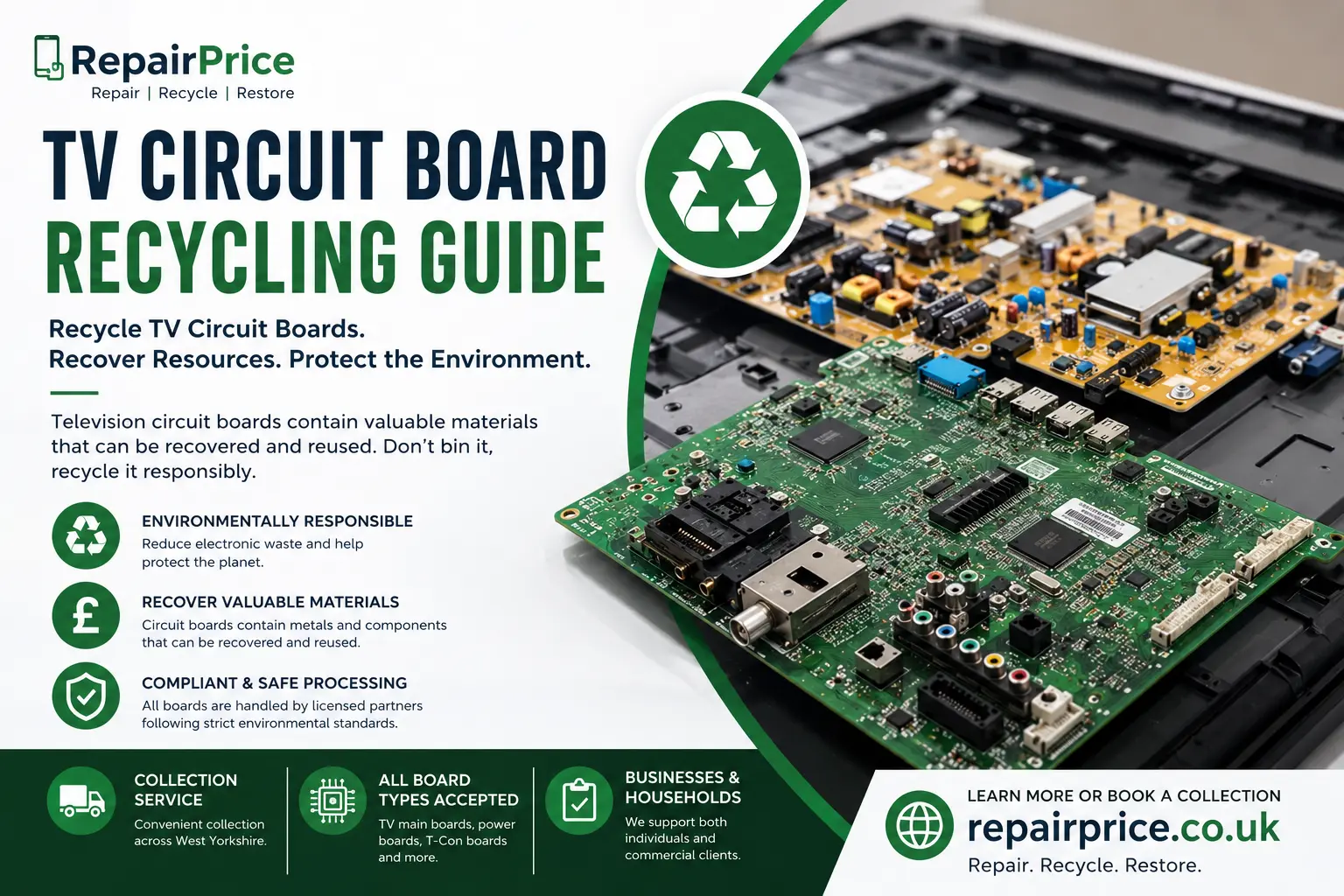
TV Circuit Board Recycling Guide: How to Recycle Television PCBs Responsibly
Televisions contain complex electronic components that should not be placed in household rubbish or sent directly to landfill. One of the most important components inside a television is the printed circuit board, commonly called a PCB. These boards control the television’s power, picture processing, sound, connectivity and smart features. When a television reaches the end of its useful life, responsible TV circuit board recycling can help recover reusable materials while reducing unnecessary electronic waste.
This guide explains what television circuit boards are, which boards may be found inside modern televisions, why they should be recycled professionally and how households, repair businesses, landlords, offices and commercial organisations can arrange suitable recycling services. It also explains when repairing a television may be more economical than dismantling it for recycling.
Arrange TV Circuit Board Recycling by WhatsApp
Have unwanted television circuit boards, damaged TVs or electronic equipment ready for recycling? Contact RepairPrice to discuss the type of equipment, approximate quantity and collection location. Providing clear details can help determine whether your items are suitable for collection, specialist processing or another recycling route.
Arrange TV PCB Recycling in West Yorkshire by WhatsApp
What Is a TV Circuit Board?
A television circuit board is a rigid electronic board that connects and supports processors, capacitors, resistors, integrated circuits, transformers, connectors and other components. Conductive pathways allow electrical signals to travel between these components so the television can operate correctly.
Depending on the television’s age, design and technology, it may contain several separate circuit boards. An LED, LCD, OLED or smart television may include a main board, power supply board, timing control board, inverter board, Wi-Fi module and smaller control boards. Older televisions may use different components, but they still contain materials that need appropriate handling.
Businesses or individuals with mixed television boards can learn more about the dedicated TV circuit board recycling service. This supporting service page is designed for enquiries involving loose boards, dismantled television electronics and other suitable TV-related PCB material.
Common Circuit Boards Found Inside Televisions
The exact internal layout of a television varies between manufacturers and models. However, most modern televisions contain several recognisable board types.
TV Main Board
The main board acts as the central control system. It processes video and audio signals, manages HDMI ports, controls software functions and connects smart television features. Main boards frequently contain processors, memory chips, ports and communications components.
A faulty main board can cause symptoms such as missing sound, no picture, repeated restarting, unresponsive HDMI ports or smart applications that fail to load. Before discarding the television, read the guide to diagnosing and repairing TV main-board faults to understand whether professional repair may still be worthwhile.
Power Supply Board
The power supply board converts incoming electricity into the voltages required by the television’s internal components. It may contain transformers, capacitors, heat sinks, fuses and other power-management components. These boards must be handled carefully because some components can retain an electrical charge after the television has been unplugged.
Timing Control Board
The timing control board, often called the T-Con board, helps manage the signals sent to the display panel. A fault can lead to vertical lines, distorted images, half-screen problems, flickering or a completely blank display.
Inverter and Backlight Control Boards
Some televisions contain inverter boards or LED backlight control circuits. These components regulate the lighting system behind the display. A television may appear to have no picture when the real problem is a failed backlight circuit rather than a damaged screen.
Wireless and Input Modules
Smart televisions may also contain Wi-Fi modules, Bluetooth components, infrared sensor boards, side-button boards and input assemblies. Although these boards are smaller, they should still enter an appropriate electronic recycling stream rather than general waste.
Why TV Circuit Boards Should Be Recycled
Television circuit boards combine metals, plastics, fibreglass, solder and electronic components. Professional recycling can help separate and process some of these materials. The exact recovery value varies according to the board type, component density, condition, age, quantity and current recycling requirements.
Sending boards through a specialist recycling route supports more responsible resource use. Recoverable materials can be diverted from landfill, while unsuitable or hazardous fractions can be handled through controlled waste-processing systems.
For a broader explanation of collection, sorting and material recovery, visit the main UK circuit board recycling service. Organisations managing different categories of electronic boards can use this page as the starting point for a mixed-PCB recycling enquiry.
You can also read about the wider environmental and commercial reasons behind responsible processing in the guide explaining why printed circuit board recycling matters.
Should You Repair or Recycle the Television?
A faulty television does not always need to be recycled immediately. Many common problems are caused by replaceable boards, damaged ports, failed power components, backlight faults or software issues. Repair may extend the television’s life and avoid the environmental impact of replacing an otherwise usable device.
Repair may be suitable when the display panel is intact, the television is reasonably modern, replacement components are available and the estimated repair cost is sensible compared with the cost of a replacement television. A professional diagnosis can help identify whether the fault is limited to one circuit board or involves the display panel itself.
Start by comparing options through the main television repair quote service. Users in West Yorkshire can also explore local quotation pages for TV repair services serving Bradford, television repair options across Leeds and Huddersfield television repair specialists.
For help identifying likely faults before requesting a quotation, review the guide to common television problems and warning signs. If repair is impractical, the complete television or its dismantled circuit boards can then be directed towards a suitable recycling service.
Request a Quote Before Recycling a Repairable TV
If the television may still be economical to repair, request quotations before arranging disposal. Describe the brand, model, screen size and symptoms as accurately as possible. Mention whether the television powers on, produces sound, displays an image or shows visible lines and flickering.
Compare Quotes from West Yorkshire TV Repair Shops
What Happens During TV PCB Recycling?
The recycling process depends on whether the material arrives as complete televisions, separated circuit boards or a mixed load of electronic components. A responsible process may include inspection, sorting, dismantling, board classification and transfer to an authorised processing facility.
1. Initial Assessment
The recycler or collection service may ask what items are available, how many units or boards are included and whether the material has already been dismantled. Photographs, model details and approximate weights may help with the initial assessment.
2. Safe Collection or Delivery
Suitable material may be collected or delivered according to the service area and quantity. Circuit boards should be stored securely and kept dry. Complete televisions should be protected from breakage, particularly when damaged screens or loose components are present.
3. Sorting by Board Type
Television boards may be separated from other PCB categories because their component mix and processing requirements can differ. Main boards, power boards and smaller modules may also be sorted into different groups.
4. Component and Material Recovery
Boards may undergo mechanical or specialist processing to separate metals and other materials. Some reusable components may be recovered for testing or refurbishment, while non-reusable material is directed towards an appropriate recycling or disposal route.
5. Processing of Remaining Equipment
If the complete television is supplied, the casing, cables, speakers, display assembly and other parts may need separate processing. Not every component follows the same recycling route, which is why complete televisions should be handled through a service equipped for electronic waste.
How TV Boards Compare with Other PCB Categories
Not all circuit boards have the same component density, construction or potential recycling value. Television boards are commonly mixed-grade boards containing processors, ports, capacitors, power components and connectors. Their classification depends on the specific board rather than the device name alone.
Some compact, component-rich electronics may be handled as Class 3 circuit board recycling material. By comparison, motherboard and desktop hardware enquiries may be better directed to the computer PCB recycling service.
Boards removed from routers, switches, network equipment and communications systems can be assessed through the telecommunications circuit board recycling page. Graphics cards, sound cards, network cards and similar plug-in components may instead fall under electronic expansion-card recycling.
Separating board categories before collection can make the assessment process easier. However, users who are unsure should avoid guessing. Provide clear photographs and a description so the material can be reviewed before collection or delivery.
Can Complete Televisions Be Recycled?
Complete televisions can often be accepted through an appropriate electronic recycling route, although acceptance conditions may vary. A complete television includes more than circuit boards, so the display, casing, wiring, speakers, stands and power components may require separate treatment.
The general electronic device recycling hub provides a useful starting point for households and organisations with complete or mixed electrical equipment. It can also help users identify related recycling routes for other unwanted devices.
Never dismantle a television unless you have suitable technical knowledge, tools and safety procedures. Power boards can contain charged capacitors, broken screens can create sharp fragments and some older display technologies may present additional hazards. Professional dismantling is the safer option for most users.
Recycling Other Equipment with Television Circuit Boards
Homes, repair shops, schools, offices, landlords and IT departments often accumulate more than one type of unwanted electronic device. Combining compatible equipment into a planned collection may be more convenient than arranging separate disposal for each item.
Old games systems and controllers can be directed to the games console recycling service. Unwanted notebooks, business computers and damaged portable PCs can be reviewed through the laptop recycling collection page.
Before recycling equipment that may still be repairable, compare potential repair costs. Faulty games systems can be submitted through the console repair comparison service, while damaged portable computers can be assessed through the laptop repair quotation page.
This repair-first approach can help keep usable devices in service. Equipment that is unsafe, severely damaged, obsolete or uneconomical to repair can then be moved into a suitable recycling stream.
TV Circuit Board Recycling for Repair Shops and Businesses
Television repair businesses may accumulate faulty main boards, power boards, T-Con boards, cracked televisions and parts-only units. Keeping these items indefinitely consumes storage space and can make workshop organisation more difficult.
A planned recycling arrangement can help repair businesses separate reusable components from genuine waste. Boards that may be suitable for refurbishment should be labelled and stored separately from damaged, burnt, corroded or incomplete boards intended for recycling.
Commercial customers should prepare an inventory where possible. Include the approximate number of complete televisions, loose boards, mixed electronics and any other equipment. Businesses should also retain relevant waste-transfer or collection documentation where required for their own compliance procedures.
Preparing Television PCBs for Collection
Correct preparation can reduce handling risks and make it easier to assess the material. Follow any specific instructions provided by the recycling service.
- Keep circuit boards dry and protected from rain.
- Store boards in strong boxes or suitable containers.
- Separate loose boards from broken glass and general rubbish.
- Do not intentionally break, crush or burn circuit boards.
- Keep batteries separate unless the recycler gives different instructions.
- Label boxes containing different board or equipment categories.
- Provide photographs when requesting an initial assessment.
- State whether the items are complete televisions or dismantled parts.
Does a TV Circuit Board Have Recycling Value?
Some television boards contain recoverable metals and reusable components, but this does not mean every board has a guaranteed payment value. The outcome depends on the board’s classification, weight, condition, component density, quantity and the cost of collection and processing.
A single low-grade board may have limited standalone value, particularly when collection is required. Larger quantities of sorted material may be more practical to assess. Mixed loads containing other suitable circuit boards may also be considered, depending on the recycling service.
Avoid removing components solely because they appear valuable. Incorrect dismantling can damage recoverable materials, create safety risks and reduce the efficiency of professional processing. Supplying complete boards is often the most practical approach unless the recycler specifically requests otherwise.
Why Televisions Should Not Be Placed in General Waste
Televisions are electronic products containing multiple materials that should be separated and processed appropriately. Placing a television or its circuit boards in general household rubbish can result in reusable resources being lost and unsuitable materials being sent to landfill or incineration.
Responsible recycling keeps electronic waste within a more controlled recovery system. It can also support legal and environmental responsibilities for businesses that generate electrical waste as part of their operations.
Households should use an appropriate local authority, retailer take-back or specialist recycling service. Businesses should ensure that the organisation handling their electronic waste follows applicable waste-management requirements.
Frequently Asked Questions About TV PCB Recycling
Can I recycle a television main board on its own?
Yes, loose television main boards may be suitable for specialist PCB recycling. Acceptance can depend on the condition, board type, quantity and collection location. Send photographs and approximate quantities when making an enquiry.
Can damaged or burnt television boards be recycled?
Some damaged boards may still be accepted, although severely burnt, contaminated or incomplete material may require separate assessment. Do not clean boards with chemicals or attempt to burn away non-metallic material.
Should I remove the circuit boards from my television?
Most householders should not dismantle televisions themselves. Internal power components may retain electrical charge, and broken display panels can create additional hazards. Ask whether the complete television can be accepted instead.
Is repairing a TV better than recycling it?
Repair is often preferable when it is safe, technically possible and economically reasonable. Extending the life of a television can reduce demand for replacement products. Recycling becomes the appropriate next step when repair is impossible or uneconomical.
Can businesses arrange collections for multiple televisions?
Businesses, landlords, schools and repair shops may be able to arrange collections for multiple units or batches of circuit boards. Provide an inventory, photographs, collection postcode and information about access or loading requirements.
Can other electrical equipment be included?
Other suitable electronic equipment may be considered as part of a mixed collection. List each device category separately so the service can confirm what can be accepted and whether any items need a different recycling route.
Arrange Responsible TV Circuit Board Recycling
TV circuit board recycling provides a responsible route for unwanted main boards, power boards, T-Con boards, control modules and other television electronics. Professional assessment helps determine whether the material should be reused, refurbished, processed for material recovery or handled through another authorised waste stream.
Before recycling a complete television, consider whether a professional repair could extend its working life. If the device is beyond economical repair, separate recycling services can help divert the television and its internal circuit boards from general waste.
To request an assessment, provide your location, the approximate quantity, whether the items are complete televisions or loose boards and clear photographs of the available material. RepairPrice can then help direct your enquiry towards a suitable repair, collection or recycling option.