

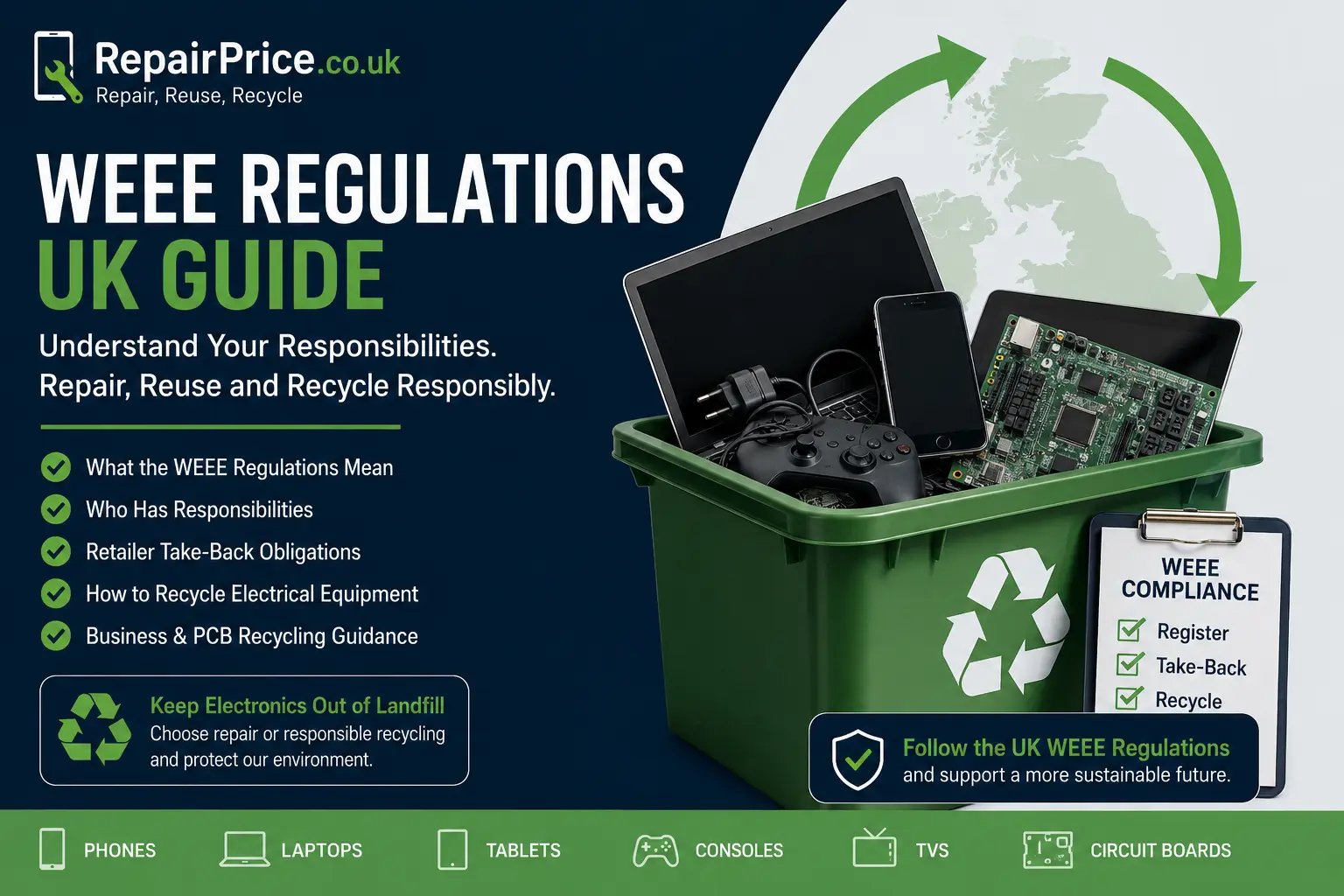
WEEE Regulations UK: A Practical Guide to Electrical Waste Recycling
Electrical equipment has become essential to everyday life, but every phone, laptop, television, tablet and games console eventually reaches the point where it is no longer wanted or economical to use. The Waste Electrical and Electronic Equipment Regulations, commonly known as the WEEE Regulations, were introduced to prevent these products from being routinely thrown into general waste, incinerated or sent to landfill.
This guide explains what the UK WEEE Regulations mean for households, businesses, electrical retailers and organisations disposing of unwanted technology. It also shows how repairing, reusing and responsibly recycling equipment can reduce environmental harm while recovering useful devices, components and materials.
RepairPrice.co.uk helps users explore repair options before replacing equipment and provides access to responsible recycling routes when a device has reached the end of its practical life. Start by visiting our electrical and electronic recycling hub to find an appropriate route for your unwanted equipment.
Arrange WEEE Recycling by WhatsApp
What Does WEEE Mean?
WEEE stands for Waste Electrical and Electronic Equipment. It generally covers discarded products that depend on electricity, batteries or electromagnetic fields to operate. Examples include mobile phones, computers, monitors, televisions, tablets, household appliances, networking equipment, power tools and entertainment systems.
An electrical product does not automatically become waste simply because its current owner no longer wants it. A working device may be suitable for continued use, resale, donation or refurbishment. A faulty product may also be repairable. Equipment usually enters the waste stream when it is discarded and no longer intended for direct use in its existing condition.
This distinction matters because reuse and repair can preserve more of the product’s original value than immediately dismantling it for raw materials. Before disposing of a faulty device, compare suitable services such as mobile phone fault diagnosis and repair, laptop repair quote comparison or television repair services.
Why Were the UK WEEE Regulations Introduced?
Electrical products can contain metals, plastics, circuit boards, batteries, screens, cables and other materials that require controlled handling. Placing them in a general waste bin can result in reusable resources being lost and potentially harmful components entering unsuitable waste streams.
The WEEE system is designed to encourage the collection, reuse, treatment, recovery and environmentally responsible disposal of electrical waste. It places responsibilities on organisations that manufacture, import, rebrand, distribute or sell electrical and electronic equipment in the UK.
For consumers, the most important message is straightforward: unwanted electrical equipment should not normally be placed in household rubbish. It should be assessed for repair or reuse and, where neither is practical, passed to an appropriate recycling service.
For a broader explanation of how discarded technology is processed, read our complete guide to electronic waste recycling. You can also learn why unsuitable disposal causes long-term problems in our article explaining why electrical equipment should stay out of landfill.
Who Has Responsibilities Under the WEEE Regulations?
The precise obligations depend on the role an organisation plays in the electrical equipment supply chain. Producers may include manufacturers selling equipment under their own brand, businesses importing electrical products commercially into the UK, organisations rebranding equipment and certain overseas sellers supplying UK customers directly.
Electrical equipment producers generally need to register annually. Businesses placing larger quantities of qualifying equipment onto the UK market may need to join a producer compliance scheme, while qualifying small producers may be able to register directly with the appropriate environmental regulator.
Distributors and retailers also have responsibilities. Depending on their circumstances, they may need to provide or participate in an eligible take-back arrangement, explain the service to customers and retain relevant records. These duties can apply whether products are sold in a physical shop, online, by mail order or over the telephone.
Companies clearing offices, shops, schools, warehouses or other commercial premises must also consider their wider waste duty of care. Business equipment should be stored safely, transferred through an appropriate route and supported by the records required for the type of waste movement involved.
What Are Retailer Take-Back Obligations?
Retailers selling electrical and electronic equipment may need to offer customers a free way to return qualifying old equipment. A common example is like-for-like take-back when a customer purchases a replacement product. The returned item does not necessarily have to be the same brand, but it should perform a similar function to the new product being supplied.
Certain larger retail sites must also accept very small items of WEEE from household customers without requiring a new purchase. Very small WEEE generally refers to electrical items measuring less than 25 centimetres on their longest side. The exact duties affecting a retailer depend on its operation, sales area, turnover and any eligible take-back scheme membership.
Consumers should ask the retailer about its recycling arrangements before purchasing replacement equipment. However, retailer take-back is not the only available route. Local collection services, household recycling facilities and specialist recycling providers may also accept electrical products.
What Does the Crossed-Out Wheelie Bin Symbol Mean?
Many electrical products display a crossed-out wheelie bin symbol. This marking indicates that the product should not be discarded with ordinary household waste. It should be collected separately so that it can be considered for reuse, repaired where appropriate or processed through a suitable electrical recycling route.
The symbol may appear on the product, its packaging or accompanying documentation. Consumers should treat it as a reminder to keep the item out of general rubbish and identify a dedicated electrical waste service.
Should You Repair or Recycle an Electrical Device?
The best environmental and financial decision is not always immediate recycling. A product with a replaceable battery, damaged charging port, faulty screen, failed power supply or software problem may still have considerable usable life remaining.
Repair may be worthwhile when the equipment is relatively modern, replacement parts are available, stored data is valuable or the cost is reasonable compared with buying an equivalent new product. Repairing a device also avoids discarding working components simply because one part has failed.
Recycling may be the more practical route when a product is severely damaged, obsolete, unsafe, uneconomical to repair or missing essential parts. Devices that cannot be restored may still contain circuit boards, metals and components that can enter specialist recovery processes.
Mobile devices that cannot be repaired can be directed to our end-of-life phone recycling service. Unwanted portable computers can be assessed through responsible laptop recycling options, while damaged or outdated tablets can be submitted through our tablet reuse and recycling route.
How Should Households Dispose of WEEE?
Households should begin by checking whether the product still works. A functioning device may be suitable for reuse by another person. Faulty equipment should be assessed to establish whether a sensible repair is available before it is treated as waste.
When recycling is the right decision, remove personal belongings and accessories that are not being submitted. Back up important files and sign out of relevant accounts where possible. Phones, tablets, laptops, consoles and smart devices may contain photographs, passwords, saved payment information or business records, so data security should be considered before transfer.
Do not dismantle lithium batteries, puncture damaged cells or attempt to remove components unless you have the correct training and equipment. Tell the receiving service if a battery is swollen, leaking, overheating or physically damaged so the item can be handled appropriately.
Old games systems, controllers and associated hardware can be submitted through our games console recycling pathway. Keeping these products separate from ordinary rubbish helps protect potentially reusable hardware and valuable internal materials.
WEEE Compliance for Businesses and Organisations
Business electrical waste may include desktop computers, laptops, monitors, servers, telecommunications systems, printers, phones, networking hardware and audiovisual equipment. A small office clearance can generate many devices containing confidential information and a mixture of reusable, repairable and non-repairable assets.
Before arranging collection, create an inventory of the equipment. Record the asset type, quantity, condition and whether it may contain sensitive data. Separating working equipment from damaged items can make reuse opportunities easier to identify and reduce unnecessary destruction.
Businesses should check that the organisation transporting and receiving their waste is suitable for the activity being undertaken. Relevant transfer records should be retained, and equipment containing confidential information should follow an appropriate data-erasure or destruction process.
Our business IT equipment recycling guide explains how to plan an organised clearance, separate assets and reduce the risks associated with disposing of workplace technology.
Why Circuit Boards Need Specialist Recycling
Circuit boards are present in almost every modern electronic product. They connect processors, memory, power components, communication modules and other essential parts. When equipment reaches the end of its life, these boards should not be mixed indiscriminately with ordinary waste.
Specialist circuit-board recycling can help separate reusable components and recover materials from equipment that is no longer suitable for repair. Organisations with mixed boards can begin at our printed circuit board recycling centre.
Boards removed from desktop computers and associated hardware can be directed to our PC motherboard and circuit-board recycling service. Businesses replacing routers, communication hardware or network infrastructure can also explore telecommunications PCB recycling solutions.
Equipment should not be dismantled solely to obtain circuit boards unless this can be done safely and lawfully. In many cases, it is preferable to submit the complete device so its condition can be assessed and reusable parts are not accidentally destroyed.
Electrical Repair and Recycling Across West Yorkshire
RepairPrice.co.uk connects users with relevant repair and recycling routes across West Yorkshire. Local access can make it easier to compare whether a device should be restored, reused or transferred for recycling.
Customers with damaged smartphones can explore Bradford phone repair quote options. Businesses and households with faulty portable computers can compare laptop repair services serving Leeds.
Televisions showing picture, power, sound or main-board faults can be assessed through Halifax television repair specialists. Console owners can find support through Wakefield games console repair services, while tablet users can request help from Huddersfield tablet repair providers.
Obtaining a repair quotation before recycling can prevent usable equipment from entering the waste stream prematurely. When repair is not viable, the device can then be directed towards the most suitable recycling category.
Compare West Yorkshire Repair Quotes Before Recycling
Common WEEE Recycling Mistakes to Avoid
One of the most common mistakes is placing small electrical products in a general household bin. Chargers, cables, mobile phones, computer accessories and small gadgets may appear insignificant individually, but they still belong in an appropriate electrical collection stream.
Another mistake is disposing of a complete device without checking whether it can be repaired. A failed battery, broken socket or damaged screen does not always mean the entire product has reached the end of its useful life.
Businesses may also create unnecessary risk by allowing unrecorded equipment to leave their premises. Without an inventory or transfer documentation, it can be difficult to confirm what was collected, where it went and how data-bearing devices were handled.
Removing circuit boards, batteries or other components without suitable knowledge can create safety issues and reduce reuse opportunities. Damaged batteries are particularly important because crushing, puncturing or short-circuiting them can create a fire risk.
A Simple WEEE Decision Process
First, determine whether the electrical item still works and could be reused. Second, obtain a repair assessment if the fault may be economical to resolve. Third, remove or securely manage personal and business data. Fourth, identify the correct collection route for the equipment type. Finally, retain appropriate records when the disposal is being completed by a business or organisation.
This process supports the main purpose of the WEEE Regulations by prioritising continued use where practical and ensuring that genuinely unwanted equipment is collected separately for suitable treatment.
Arrange Responsible Electrical Recycling
Following the WEEE Regulations does not need to be complicated. The essential approach is to keep electrical products out of general waste, assess whether they can be repaired or reused and choose a responsible recycling route when they have reached the end of their useful life.
RepairPrice.co.uk provides dedicated routes for phones, tablets, laptops, consoles and circuit boards, helping households and businesses separate equipment more effectively. Starting with the correct device category can improve collection planning and make it easier to identify equipment that may still have reuse or component value.
Visit our UK technology recycling service directory to choose the appropriate recycling route, or request a repair quotation when you are uncertain whether a device should be repaired or recycled.
This article provides general information about electrical waste and should not be treated as formal legal or regulatory advice. Businesses with producer, distributor, waste-carrier or treatment obligations should review current government guidance and obtain specialist compliance advice where required.