

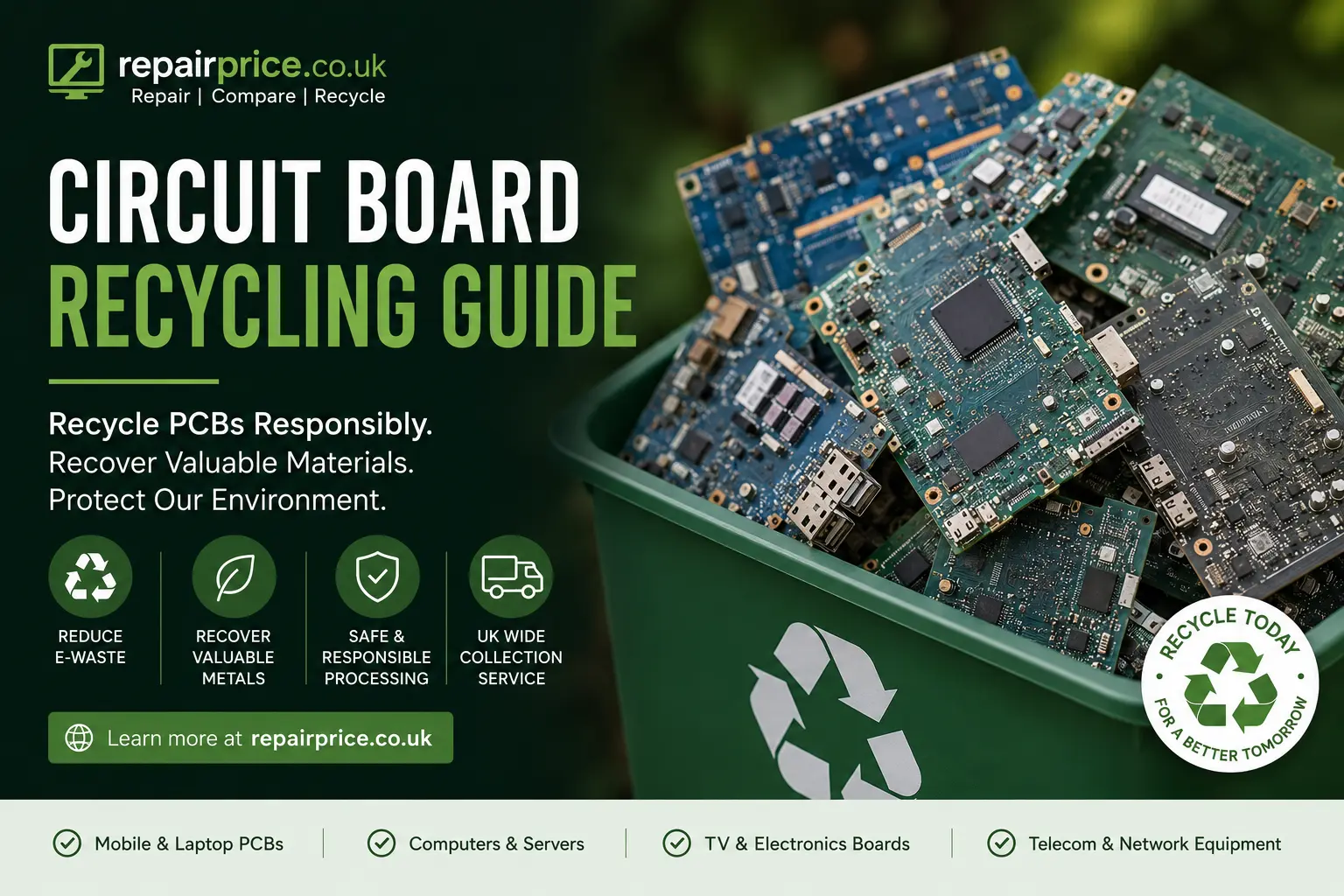
Circuit Board Recycling Guide: How to Recycle PCBs Responsibly in the UK
Printed circuit boards are found inside almost every modern electronic device, from mobile phones and laptops to televisions, computers, routers and telecommunications equipment. When these products become damaged, obsolete or unsuitable for reuse, their circuit boards should not be placed in household bins or sent directly to landfill. Responsible circuit board recycling helps recover useful materials, reduces electronic waste and ensures that hazardous components are handled through an appropriate recycling process.
This circuit board recycling guide explains what printed circuit boards contain, why they require specialist treatment, which devices can be recycled and how households, repair businesses, offices, schools and other organisations can arrange responsible disposal. It also explains when repairing a device may be more suitable than recycling it and how RepairPrice can help you compare repair services or find a recycling route for unwanted electronics.
Arrange a UK Circuit Board Recycling Collection on WhatsApp
What Is a Printed Circuit Board?
A printed circuit board, commonly shortened to PCB, is the internal platform that connects and controls many of the electronic components inside a device. It may contain processors, memory chips, capacitors, resistors, connectors, switches and other components that allow the product to operate correctly.
Circuit boards vary considerably in size, design and material composition. A small board from a mobile phone is very different from a motherboard removed from a desktop computer or a control board taken from a television. Some boards contain relatively high concentrations of recoverable metals, while others contain more plastic, fibreglass and lower-value components.
Because circuit boards are complex mixtures of materials, they should be processed by organisations with suitable equipment and established recycling procedures. The main UK circuit board recycling service provides further information about recycling PCBs from domestic, commercial and specialist electronic equipment.
Why Circuit Boards Should Be Recycled
Discarded circuit boards contribute to the growing electronic waste stream. When old electronics are thrown away without proper treatment, useful materials are lost and potentially harmful substances may be released into the environment. Recycling keeps suitable materials in circulation and reduces dependence on extracting new raw materials.
Many PCBs contain copper and smaller quantities of metals such as aluminium, tin, silver, gold and palladium. The concentration and value of these materials depend on the age, type and grade of the circuit board. Specialist facilities separate components and process the remaining board material so that recoverable resources can be returned to manufacturing supply chains.
For a closer look at the environmental and commercial reasons for responsible processing, read why responsible PCB recycling matters. You can also explore which valuable metals may be present in circuit boards and why different PCB grades can have different recycling values.
Which Circuit Boards Can Be Recycled?
A wide variety of printed circuit boards can enter a specialist recycling stream. These may come from personal electronics, household appliances, office technology, communications equipment, industrial systems and repair workshops. Whether a board can be accepted may depend on its condition, quantity, source and whether it is still attached to other components.
Mobile Phone Circuit Boards
Mobile phones contain compact, component-dense circuit boards that control communication, storage, charging, cameras and display functions. Damaged phones may still contain recyclable boards even when their screens, batteries or cases are no longer usable. The dedicated mobile phone circuit board recycling service explains how unwanted handset boards can be separated from the general waste stream.
If the phone is still complete, it may be better to begin with the responsible mobile phone recycling route. Complete devices may be assessed for reuse, parts recovery or material recycling before their circuit boards are processed.
Laptop Circuit Boards
Laptops contain motherboards, charging boards, power-management boards, memory modules and other electronic assemblies. A laptop motherboard may remain recyclable after a device suffers liquid damage, charging failure, overheating or severe physical damage. Learn more through the laptop motherboard and PCB recycling page.
Before dismantling a laptop for recycling, consider whether it could be repaired, refurbished or used for parts. The laptop repair quote comparison service can help you explore possible repair options. When repair is not economical, the laptop recycling service for unwanted computers provides a suitable next step.
Computer and PC Circuit Boards
Desktop computers can contain several recyclable boards, including the motherboard, graphics card, network card, sound card and storage controller. Business computers may also contain expansion cards and specialist boards that should be separated from ordinary office waste.
The desktop computer circuit board recycling service is suitable for people and organisations looking to recycle PC boards from obsolete systems, upgrades, office clearances or failed computers.
Television Circuit Boards
Modern televisions can include power supply boards, main boards, display-control boards, tuner boards and connectivity modules. These components should not be placed in general waste, particularly when several televisions are being cleared from a business, hospitality venue, school or rental property.
Information about processing these components is available through the television circuit board recycling service. A television that still has a usable screen or repairable fault may retain more value as a complete product, so it can also be worth checking the TV repair comparison service before arranging dismantling.
Telecommunications Circuit Boards
Routers, switches, telephone systems, network appliances, communications cabinets and other telecom equipment may contain multiple circuit boards. These boards can vary greatly in grade and may require secure handling when they come from business or infrastructure environments.
The telecommunications PCB recycling page provides a more focused route for boards recovered from networking and communications equipment.
How Are Circuit Boards Recycled?
The precise recycling process varies according to the type of board, the recycling facility and the materials being recovered. A typical process begins with collection, identification and sorting. Complete electronic devices may first be inspected to determine whether they can be repaired, refurbished or dismantled for reusable parts.
Once the circuit boards are separated, they may be grouped by type or grade. Batteries, large capacitors, heat sinks, cables and other attached components may need to be removed. The boards can then be mechanically processed to reduce their size and separate metal-bearing fractions from fibreglass, resin and other non-metal materials.
Further processing may use physical, thermal or chemical recovery methods, depending on the facility and the board composition. These procedures require controlled equipment and should not be attempted through burning, uncontrolled heating or chemical stripping at home. Improper processing can release dangerous fumes, create contaminated waste and expose people to hazardous substances.
For a step-by-step overview of the journey from discarded electronics to recovered materials, visit the guide explaining how printed circuit boards are recycled.
Should You Repair the Device Before Recycling It?
Recycling should not automatically be the first choice for every faulty device. Extending the usable life of a phone, laptop or television can reduce waste and preserve the energy and materials already used during manufacturing. A repair may be worthwhile when the device is relatively modern, the fault is limited and replacement would cost considerably more.
Phones with damaged screens, failing batteries or faulty charging ports may still be repairable. Before recycling a handset, compare possible options through the mobile phone repair quote service. Similarly, laptops with keyboard, screen, storage or charging faults may be suitable for repair rather than immediate recycling.
Televisions can also develop repairable problems such as backlight failure, power supply faults, software issues or damaged ports. However, recycling may be more appropriate when the screen is severely damaged, replacement parts are unavailable or the repair cost is disproportionate to the value of the television.
The best approach is usually to follow a simple hierarchy: reuse the device where possible, repair it when practical, recover working parts if the complete product cannot be saved and recycle the remaining materials responsibly.
Recycling Complete Devices Instead of Loose Circuit Boards
Many households and organisations do not have loose PCBs ready for collection. Instead, they have complete or partially dismantled electronics. In these cases, it is usually safer and more practical to use a complete-device recycling service rather than removing circuit boards without suitable tools or technical experience.
The main electronic device recycling hub connects users with recycling information for common consumer and business technology. It can help direct phones, laptops, tablets, consoles and other unwanted devices towards appropriate reuse or recycling routes.
Complete-device recycling also allows working components to be identified before materials are processed. Screens, memory, storage drives, cases, chargers and other parts may be suitable for reuse or refurbishment. This can preserve more value than immediately shredding or separating every component.
Circuit Board Recycling for Businesses and Repair Shops
Repair shops, IT departments, schools, offices, telecommunications businesses and electronics resellers can accumulate circuit boards over time. These may come from component replacements, damaged devices, upgrades, refurbishment work or equipment clearances.
Businesses should avoid mixing circuit boards with general rubbish. Keeping boards dry, securely stored and separated from batteries can make collection and sorting easier. It is also helpful to record the approximate quantity, type and source of the material before requesting a recycling service.
Organisations handling equipment that contains confidential information should consider data security before recycling. Storage drives, phones, computers and some embedded systems may retain information even after they stop working. Data-bearing equipment should be securely erased, physically destroyed where necessary or handled through a service that provides an appropriate data-destruction process.
When requesting a collection, provide clear details about whether the material consists of loose boards, complete devices, mixed electronics or palletised equipment. This helps the recycling provider assess transport requirements, potential handling charges and whether the material is suitable for collection.
Local Repair and Recycling Options in West Yorkshire
RepairPrice also helps users find relevant services across West Yorkshire. Laptop owners can explore laptop repair options available around Bradford before deciding whether a computer should be recycled.
People with damaged smartphones can compare phone repair services serving Leeds, while television owners can review TV repair choices in and around Halifax.
These location pages are useful when a device may still be economically repairable. Where repair is not possible, users can then move towards device recycling or specialist circuit board recovery instead of placing unwanted electronics in general waste.
How to Prepare Circuit Boards for Recycling
Preparation depends on whether you are recycling loose PCBs or complete electronic devices. Do not dismantle mains-powered equipment unless you have the necessary knowledge and tools. Televisions, power supplies and some industrial electronics may contain components that retain an electrical charge after the equipment has been disconnected.
Loose circuit boards should generally be kept clean and dry. Avoid placing them in containers with leaking batteries, liquids, food waste or general rubbish. Where possible, separate batteries and other hazardous components, but only when they can be removed safely.
For business quantities, count or weigh the boards and separate them into broad categories such as mobile phone boards, laptop motherboards, computer boards, television boards and telecom boards. Photographs and an approximate weight can help a recycling provider understand the material before collection.
Do not burn circuit boards, grind them without suitable extraction equipment or use acids to recover metals. Professional recovery processes are designed to control emissions, manage residues and protect workers from exposure.
What Determines the Value of Scrap Circuit Boards?
Not every circuit board has the same recycling value. Factors can include the concentration of metals, board age, component density, condition, contamination level, total quantity and the cost of processing the material.
Boards from some servers, telecommunications systems and older computer equipment may have different material concentrations from modern household appliances. However, visual appearance alone is not always a reliable way to determine value. A recycler may need to inspect or grade the boards before confirming whether payment, free collection or a recycling charge applies.
Users should be cautious of claims suggesting that every circuit board contains a large quantity of gold or other precious metals. Although small amounts may be present, recovery is usually viable because specialist processors handle material at scale using controlled separation and refining methods.
Arrange a Circuit Board Recycling or Repair Quote
RepairPrice helps connect users with repair and recycling options for unwanted electronics. Start by identifying the equipment, its condition and whether it is complete or already dismantled. Include the device type, approximate quantity, location and any known faults when submitting an enquiry.
If the item can still be repaired, local professionals may be able to provide a quotation. If repair is unsuitable, the enquiry can help establish an appropriate route for complete-device recycling, component recovery or specialist PCB processing.
Request a UK Circuit Board Recycling or Repair Quote
Frequently Asked Questions About Circuit Board Recycling
Can I put circuit boards in my household recycling bin?
No. Household recycling collections are not normally designed to process printed circuit boards. PCBs should be taken to an appropriate electronic waste facility or handled through a specialist recycling service.
Can complete electronic devices be recycled?
Yes. Complete phones, laptops, computers, televisions and other electronics can often be assessed for reuse, repair, parts recovery or recycling. You do not normally need to remove the circuit board yourself.
Are damaged circuit boards still recyclable?
Many burnt, broken, corroded or non-working circuit boards can still be processed. Acceptance will depend on the recycler, the type of board and whether it has been contaminated by chemicals, liquids or other hazardous materials.
Do circuit boards contain gold?
Some circuit boards contain small amounts of gold in connectors, contacts or component assemblies. They may also contain copper, silver, palladium, tin and aluminium. The quantities vary greatly between devices and board grades.
Should I remove batteries before recycling electronics?
Batteries should be separated where this can be done safely and without damaging the device. Lithium batteries can create a fire risk when crushed, punctured or stored incorrectly. Do not force open sealed devices solely to remove a battery.
Can businesses arrange collections for multiple circuit boards?
Businesses may be able to arrange collections for bulk quantities of circuit boards, complete computers, telecommunications equipment and mixed electronic waste. Provide an approximate weight, quantity and description when requesting a collection.
Is repairing better than recycling?
Repairing is often preferable when it can extend the useful life of a product safely and economically. Recycling becomes the better option when a device is beyond repair, obsolete, unsafe or unsuitable for reuse.
Recycle Circuit Boards Responsibly
Circuit board recycling supports the recovery of valuable materials and prevents complex electronic components from being discarded with general waste. Whether you have one damaged device, a collection of loose PCBs or a larger quantity of business electronics, the first step is to identify whether the equipment can be repaired, reused or dismantled responsibly.
RepairPrice provides routes into repair comparisons, complete-device recycling and specialist PCB services. By choosing the correct option for each device, you can reduce unnecessary waste, protect reusable components and ensure that circuit boards are processed through an appropriate recycling stream.