

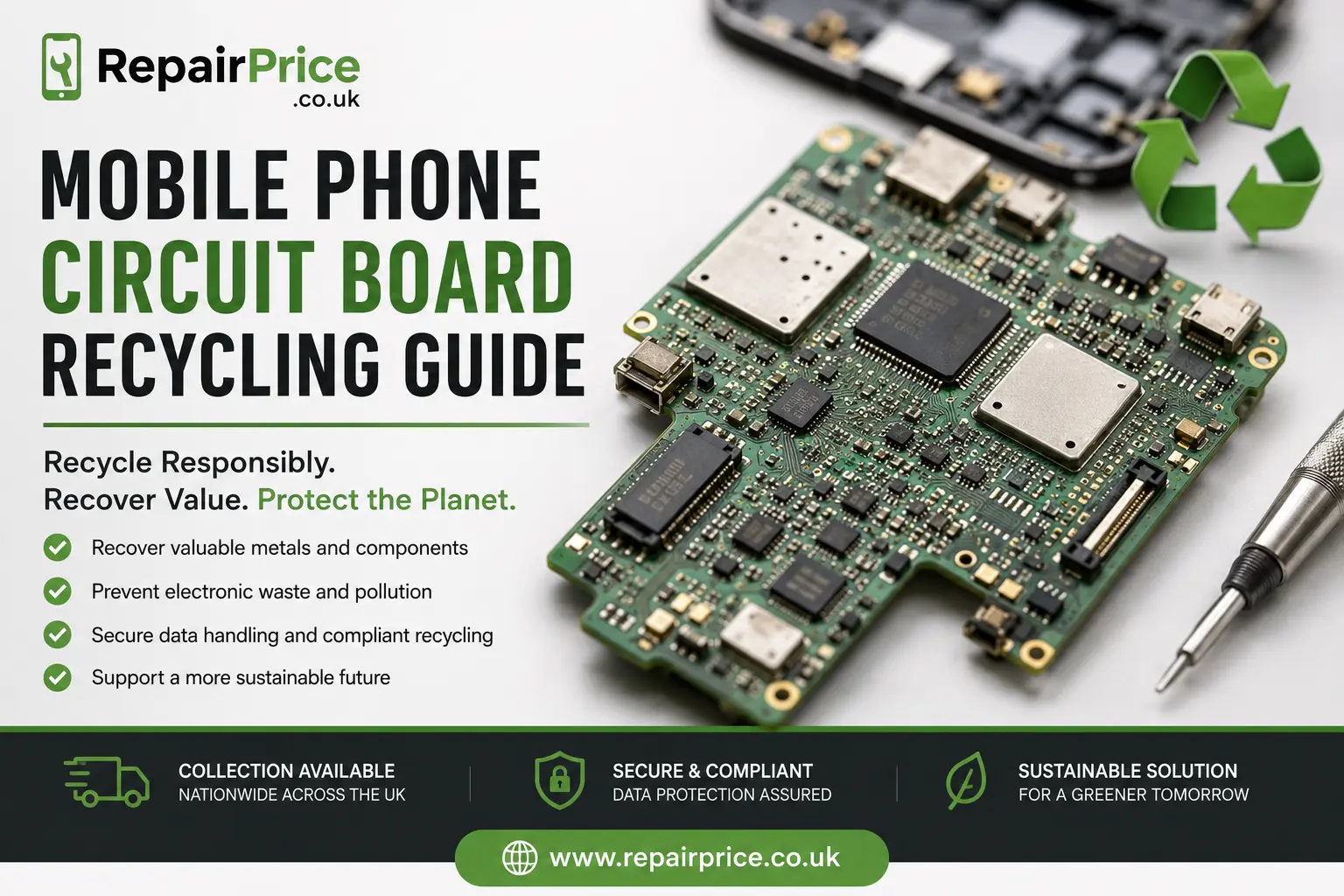
Mobile Phone Circuit Board Recycling Guide: Recover Value from Old and Damaged Phones
Mobile phones contain compact but highly sophisticated circuit boards that control almost every function of the device. From charging and connectivity to storage, cameras, audio and display performance, the main circuit board connects the phone’s most important components. When a handset becomes damaged, outdated or uneconomical to repair, its circuit board may still contain reusable components and recoverable materials. Responsible mobile phone circuit board recycling helps prevent electronic waste from being sent to landfill while creating opportunities to recover valuable metals and working parts.
This guide explains what mobile phone circuit boards contain, how they are graded, why secure handling matters and how households, repair businesses, recyclers and organisations can arrange responsible collection. RepairPrice helps customers compare appropriate recycling and repair options before unwanted devices and circuit boards are discarded.
Book Your Mobile PCB Recycling Collection on WhatsApp
What Is a Mobile Phone Circuit Board?
A mobile phone circuit board, often called a logic board, motherboard or printed circuit board, is the central electronic platform inside a handset. It provides the physical connections that allow processors, memory chips, charging circuits, wireless communication modules and other components to work together. Modern phone boards are densely populated because manufacturers must fit significant computing power into a very small space.
Depending on the handset, a circuit board may include the application processor, storage memory, power-management components, charging controllers, audio chips, radio-frequency modules, connectors and shielding. Some devices use one main board, while others divide components between a primary logic board and one or more smaller daughterboards.
Because these boards contain a mixture of metals, plastics, ceramics and electronic components, they should not be placed in household waste. Our dedicated guide to recycling mobile phone circuit boards provides further information for customers with loose boards, dismantled phones or larger quantities from repair and refurbishment operations.
Why Mobile Phone PCB Recycling Is Important
Millions of mobile phones are replaced because of cracked screens, battery problems, water damage, charging faults or software limitations. Some are repaired and returned to use, but many remain stored in drawers or are disposed of without proper assessment. When unwanted phones enter general waste streams, potentially reusable devices and recoverable materials can be lost.
Mobile phone PCB recycling supports a more circular approach to electronics. Suitable devices can be repaired or refurbished, usable parts can be recovered and damaged circuit boards can be processed through specialist recycling channels. This reduces unnecessary disposal and helps preserve resources that would otherwise need to be extracted and processed from raw materials.
For an overview covering different board types, collection options and responsible processing, visit our main circuit board recycling service. The service is suitable for individuals, phone repair businesses, electronics traders, IT departments and organisations managing redundant equipment.
What Valuable Materials Are Found in Phone Circuit Boards?
Mobile phone circuit boards may contain copper, gold, silver, palladium, tin, nickel and other metals. The exact composition varies according to the manufacturer, model, age and construction of the device. Precious metals are generally present in small concentrations, but the combined material value can become more significant when large quantities of boards are processed together.
Copper is widely used in conductive tracks and internal layers. Gold may be found in contacts, connectors and certain component interfaces because it resists corrosion and provides reliable conductivity. Silver, palladium and tin may also appear in solder, capacitors, contacts and other electronic assemblies.
Recovering these materials safely requires specialist equipment and controlled processes. Burning, crushing or chemically treating circuit boards at home can release harmful substances, damage recoverable materials and create serious health and environmental risks. Our article about valuable metals recovered from circuit boards explains why professional processing is essential.
How Mobile Phone Circuit Boards Are Graded
Circuit boards are often graded according to their component density, metal content, condition and suitability for processing. Mobile phone logic boards are generally compact and component-rich, which can make them more desirable than low-grade boards from simple household appliances. However, value can vary considerably between different phone models and board conditions.
Boards with processors, memory chips, connectors and shielding still attached may be assessed differently from stripped, damaged or heavily contaminated boards. Water damage, corrosion, missing components, fire exposure and excessive adhesive can all affect grading. Mixing phone circuit boards with batteries, screens, plastic housings or unrelated waste may also make sorting more difficult.
Some densely populated mobile and telecommunications boards may share characteristics with higher-grade Class 3 circuit boards. Accurate classification should be completed by a recycler or processor familiar with different electronic board categories rather than being based only on visual appearance.
Mobile Phone Boards Compared with Other PCB Types
Phone circuit boards are smaller than many computer and industrial boards, but they often contain a high concentration of components. Their construction differs from larger boards used in laptops, telecommunications equipment and desktop computers. Understanding these differences helps businesses separate stock correctly before arranging recycling.
Boards removed from routers, network equipment and communication infrastructure may be more suitable for a specialist telecommunications PCB recycling service. These boards can be larger and may include substantial connector arrays, processors and communication modules.
Computer graphics cards, sound cards, network adapters and similar components are covered by our expansion card recovery service. Laptop motherboards can be assessed through the dedicated laptop circuit board recycling page. Keeping these categories separate can make identification, grading and collection more efficient.
Should the Phone Be Repaired Before It Is Recycled?
Recycling should not automatically be the first option for every damaged phone. A handset with a faulty battery, damaged charging port, broken screen or replaceable camera may still have useful life remaining. Extending the life of an existing device can reduce the demand for new manufacturing and may be more economical than immediate replacement.
Before dismantling a phone, consider obtaining a repair assessment. RepairPrice allows customers to compare options through its nationwide mobile phone repair quotation service. Local repair specialists may be able to diagnose the fault and confirm whether repair is practical.
Customers in West Yorkshire can also explore options for phone repairs available around Bradford, compare mobile repair services serving Leeds or request help from phone repair shops near Huddersfield.
When repair costs are too high, parts are unavailable or the board has suffered severe liquid or electrical damage, recycling may be the more responsible route. The aim is to prioritise reuse and repair where practical while ensuring genuinely unusable devices are processed correctly.
How to Prepare a Mobile Phone for Recycling
Before handing over a complete phone, remove any SIM card and external memory card. Back up photographs, contacts, messages and documents that you wish to keep. Sign out of linked accounts and disable activation locks or device-tracking features where possible. A factory reset can then be performed if the phone is still operational.
If the handset does not switch on, explain this when requesting collection or assessment. A non-working display does not necessarily mean the storage is inaccessible, and data may remain on the internal memory. Organisations handling business devices should maintain an asset register and document how each handset is transferred, processed or destroyed.
For more detailed precautions, read our guide to protecting personal data before electronics recycling. Secure handling is particularly important for business phones, employee devices and handsets containing customer or financial information.
What Happens During Mobile Phone Circuit Board Recycling?
The process normally begins with collection, identification and sorting. Complete phones may first be checked to determine whether they can be reused, refurbished or repaired. Devices that cannot be economically restored can be dismantled so that batteries, screens, housings, cameras, speakers and circuit boards are separated.
Batteries require their own controlled recycling route because damaged lithium batteries can create a fire risk. Circuit boards are graded according to their type and condition before being sent to an appropriate processing facility. Depending on the recycler, boards may undergo mechanical separation and specialist metallurgical treatment to recover usable material fractions.
Our article explaining how old mobile phones move through the recycling process provides a broader view of collection, dismantling, component recovery and material processing.
Can Complete Phones Be Recycled Instead of Removing the Board?
Yes. Most individuals should avoid dismantling phones themselves. Modern handsets can be difficult to open and may contain glued batteries, fragile glass, sharp components and tightly packed electronic parts. Puncturing a battery or damaging a charged component can create avoidable safety risks.
Complete unwanted handsets can be submitted through our mobile phone recycling collection service. The device can then be assessed for reuse, repair, parts recovery or material recycling. This is generally more convenient for households and businesses that do not already dismantle electronics professionally.
Customers managing several categories of unwanted equipment can begin with the main electronics recycling hub. Tablets and similar touchscreen devices can be directed to the responsible tablet recycling service.
Recycling Options for Repair Shops and Electronics Businesses
Phone repair shops can accumulate faulty logic boards, charging boards, damaged displays, batteries and stripped handset frames. Keeping these materials indefinitely takes up storage space and can make stock control difficult. A planned collection process helps businesses separate reusable components from items intended for recycling.
Boards should ideally be stored in dry containers and separated from loose batteries, liquids and general rubbish. Different grades can be grouped where practical, but businesses should avoid removing processors, chips or connectors simply to increase apparent value. Incomplete boards may be harder to identify and could receive a different assessment.
Businesses should provide an honest description of the material, including the approximate quantity, whether it is loose or attached to devices and whether any boards are water-damaged, burned or contaminated. Clear photographs may help a collection provider understand the stock before arranging transport.
Repair and Recycling Options for Tablets and Wearable Devices
Mobile phone circuit boards share some characteristics with the compact boards used in tablets and wearable devices. A damaged tablet may still be suitable for repair if the fault involves its battery, charging socket, screen or software. Customers can compare options through our tablet repair comparison service before choosing recycling.
Smartwatches contain smaller boards, batteries, sensors and wireless communication components. Their compact construction can make home dismantling difficult. Owners of faulty wearable devices can explore the smartwatch repair quotation service to determine whether professional repair is worthwhile.
Where repair is no longer practical, these devices should enter a suitable electronics recycling stream rather than being placed in household rubbish. Grouping phones, tablets and wearable devices for an organised collection can be particularly useful for businesses, schools and community organisations.
How Much Are Mobile Phone Circuit Boards Worth?
There is no single fixed value for every mobile phone circuit board. Pricing can depend on board grade, weight, quantity, model mix, attached components, contamination and current processor requirements. A small number of loose boards may be assessed differently from a sorted commercial batch.
Complete phones may sometimes have greater reuse or parts value than their circuit boards alone. For this reason, handsets should be assessed before dismantling. A working device, repairable handset or phone with reusable cameras, screens and housings may offer more recovery potential when kept intact.
Be cautious of unrealistic online estimates based only on the theoretical metal content of a board. Recovering metals involves specialist transport, sorting, processing, compliance and refining costs. A responsible quote should reflect the actual material, quantity and condition rather than an unsupported headline figure.
Why Mobile Phone Boards Should Never Go to Landfill
Sending circuit boards to landfill wastes materials that could potentially be recovered. It also removes devices and components from reuse and refurbishment channels. Although individual phones are small, the environmental effect becomes significant when large numbers are discarded across households and businesses.
Responsible recycling provides a controlled route for batteries, electronic boards, plastics and metal parts. It also encourages users to think carefully about whether an item can be repaired, donated, reused or harvested for components before final processing.
By arranging proper collection, customers can reduce clutter, improve business stock management and support more efficient use of electronic materials. Recycling should form part of a wider device-management plan that includes maintenance, repair, data protection and responsible replacement decisions.
Arrange Mobile Phone Circuit Board Recycling
RepairPrice can help individuals and organisations find an appropriate route for unwanted mobile phone circuit boards, complete handsets and related electronics. When submitting an enquiry, include the approximate number of devices or boards, their condition, your location and whether the items contain batteries or other components.
For business quantities, it is useful to explain whether the equipment comes from repairs, refurbishment, office upgrades, retail returns or IT asset replacement. This information can help determine whether the material should be assessed for reuse, component harvesting, board grading or general electronics recycling.
Do not mix circuit boards with leaking batteries, liquids, food waste or sharp materials. Store the items securely in a dry location until collection arrangements have been confirmed.
Request a Mobile Circuit Board Recycling Quote
Frequently Asked Questions About Mobile Phone PCB Recycling
Can damaged phone motherboards still be recycled?
Yes. Boards affected by electrical faults, broken connectors, impact damage or corrosion may still be suitable for specialist recycling. Their grade and potential recovery value will depend on their condition, attached components and level of contamination.
Should I remove the battery before recycling a phone?
You should only remove the battery when it is designed to be user-removable and can be taken out safely. Many modern phones contain glued internal batteries. These devices should normally be left intact for trained handlers to dismantle.
Can I recycle a phone that still contains personal data?
The device can be accepted for assessment, but users should back up and erase their information whenever possible. Businesses may require documented data-erasure or destruction procedures before devices leave their control.
Are all phone circuit boards high grade?
No. Although many phone boards are component-dense, their grade varies by model, construction, condition and processor criteria. Missing chips, corrosion, contamination and mixed materials can affect classification.
Is it better to recycle a complete phone or only its circuit board?
For most consumers, recycling the complete phone is safer and allows the device to be assessed for reuse, repair and parts recovery before material processing. Repair businesses with trained technicians may already have loose boards available from previous repairs.
Can businesses arrange collections for multiple devices?
Yes. Repair shops, offices, schools, retailers, charities and other organisations can request an assessment for batches of phones, circuit boards and related electronic equipment. Providing accurate quantities and photographs can help with collection planning.
Choose Repair, Reuse or Responsible Recycling
A faulty phone should not automatically become waste. Where practical, repair can extend the device’s useful life and reduce the need for a replacement. When repair is not economical, working components may still be recovered. Only after reuse and parts options have been considered should the remaining circuit board and materials move into specialist recycling.
By choosing an organised recycling route, customers can protect personal information, avoid unsafe disposal and support the recovery of useful electronic materials. Whether you have one damaged handset, a box of loose phone boards or a regular supply from a repair business, responsible assessment is the first step towards a better outcome.