

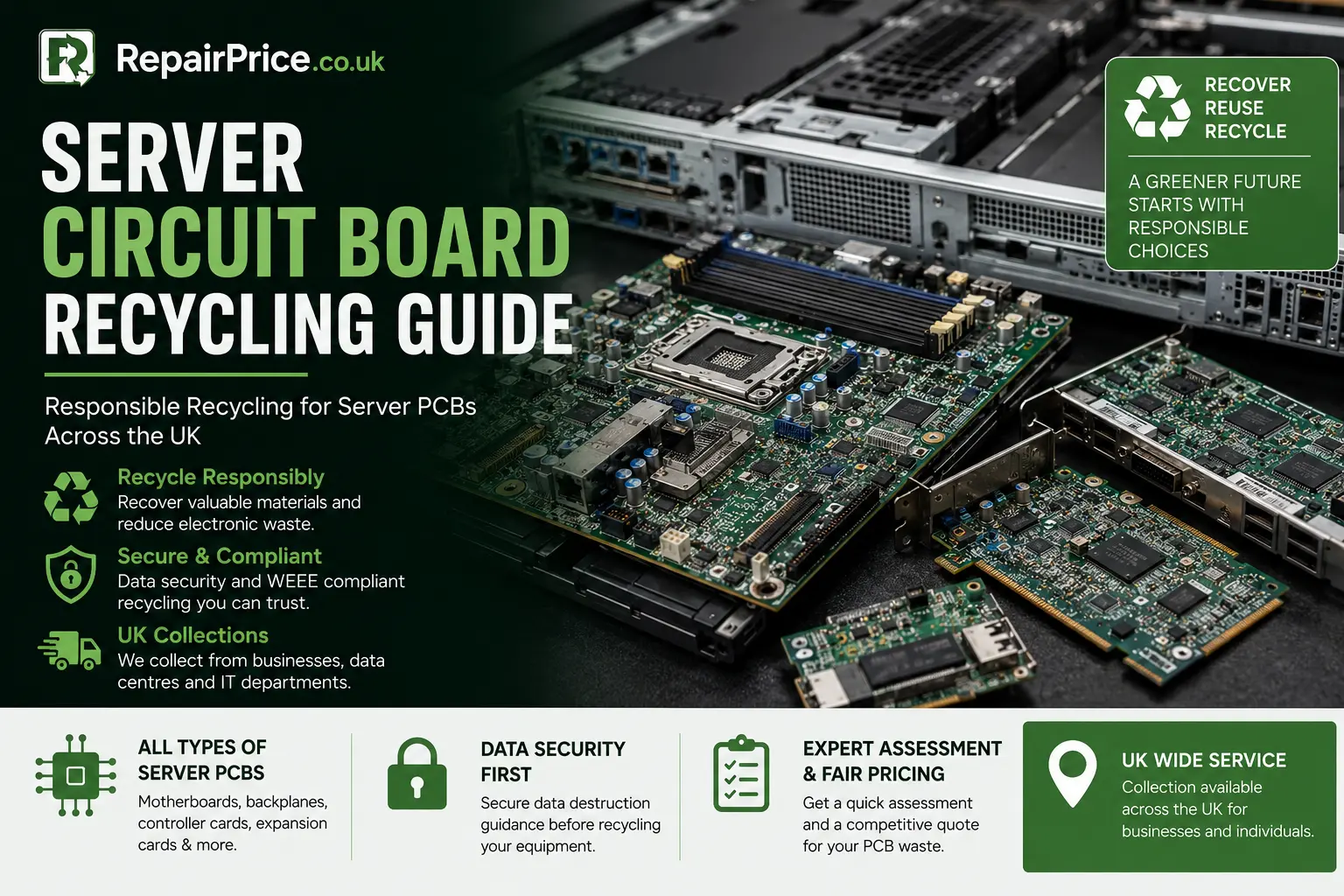
Server Circuit Board Recycling Guide: Responsible UK Recycling for Server PCBs
Servers contain some of the most valuable and technically complex circuit boards found in business IT equipment. Motherboards, processor boards, RAID controllers, network cards, power distribution boards, memory modules and server backplanes can all contain recoverable metals and reusable components. When servers reach the end of their operational life, these parts should be handled through a specialist recycling route rather than placed in general waste or mixed scrap.
This server circuit board recycling guide explains how server PCBs are identified, prepared, graded and processed. It also covers data-security considerations, business collections and the options available when equipment may still be suitable for repair or reuse. RepairPrice helps UK businesses, IT departments, data centres, repair shops and individuals find suitable routes for unwanted server hardware and circuit boards.
Before disposing of complete servers, damaged server boards or accumulated IT components, request guidance on the most appropriate recycling or recovery option. Providing photographs, estimated quantities and information about the equipment can help determine whether the material should be collected as complete servers, separated circuit boards or mixed business IT waste.
Arrange UK Server Circuit Board Recycling on WhatsApp
What Is a Server Circuit Board?
A server circuit board is a printed circuit board designed to operate within enterprise-grade computing equipment. Unlike many ordinary desktop computer boards, server PCBs are built for continuous workloads, high data throughput, redundancy and large quantities of memory or storage. They may contain multiple processor sockets, advanced chipsets, gold-plated contacts, dense component layouts and specialised connectors.
Common examples include server motherboards, storage controller boards, network interface cards, power management boards, blade server boards and rear backplanes. Some systems also contain separate management boards, riser cards, fibre-channel adapters and proprietary expansion modules. Each board type may have a different recycling grade depending on its age, component density, connector quality and recoverable material content.
Server backplanes and rear-wall assemblies deserve particular attention because they can contain numerous connectors and communication pathways. Businesses with these components can learn more through the dedicated server rear-wall and backplane recycling service.
Why Server PCBs Should Be Recycled Separately
Server circuit boards should not be treated as ordinary rubbish. They contain a mixture of metals, plastics, fibreglass, solder and electronic components. Improper disposal can waste recoverable resources and may allow potentially harmful substances to enter unsuitable waste streams.
Specialist processing allows different materials to be separated and directed toward suitable recovery routes. Valuable metals may include copper, gold, silver, palladium and tin, although the precise quantities vary significantly between board types. Recycling does not mean that every board has a high individual value, but properly sorted commercial quantities may be more attractive to specialist processors than unsorted electronic waste.
The broader UK circuit board recycling service provides information for organisations handling server boards alongside other PCB categories. Separating higher-grade server material from low-grade power boards, metal chassis and cables can help recyclers assess loads more accurately.
Types of Server Circuit Boards Accepted for Recycling
Server hardware can contain many different circuit board categories. A recycling enquiry may include complete or partially stripped server motherboards, blade server boards, processor cards, RAID controller cards, SAS or SATA backplanes, network cards, remote-management boards, power distribution PCBs, memory risers and server expansion cards.
Boards removed from data-centre equipment, rack servers, tower servers, storage arrays and network appliances may all be suitable for assessment. Older telecommunications and networking systems may contain boards that overlap with specialist telecommunications PCB recycling. Keeping server boards and telecom boards in clearly labelled containers can make identification easier.
Standard computer motherboards and components should be separated where possible. Businesses recycling mixed office technology can use the computer circuit board recycling route for desktop PC motherboards and related components.
How Server Circuit Boards Are Graded
PCB grading is based on more than the size of a circuit board. Recyclers may consider the board's component density, processor sockets, chips, connector plating, generation, condition and the presence of removable attachments. A densely populated server motherboard may be classified differently from a simple power control board or low-component backplane.
Boards with numerous integrated circuits, high-quality edge connectors and complex processing components may fall into a higher category than sparsely populated boards. However, grading systems differ between recycling companies, and an online photograph cannot always provide a final valuation.
Some premium boards may share characteristics with Class 3 circuit board recycling material. Businesses should avoid assuming that every server PCB automatically qualifies for the highest grade. A specialist assessment is the best way to establish how a batch is likely to be categorised.
Should Components Be Removed Before Recycling?
Do not remove processors, memory, heat sinks, batteries or expansion cards until the recycling company confirms its preferred preparation method. Some recyclers accept complete populated boards, while others may request that particular components are separated. Removing items without guidance can reduce efficiency, damage reusable parts or make the remaining material harder to grade.
Expansion cards such as network adapters, graphics accelerators, RAID controllers and fibre cards can often be grouped separately. More information is available through the specialist expansion card recycling service.
Hard drives should also be removed from servers before the circuit boards are sent for recycling. Drives contain their own control boards and may require secure data erasure or physical destruction. The hard-drive PCB recycling page explains how these smaller control boards can be handled separately.
Protecting Business Data Before Server Recycling
Data security is one of the most important stages of server disposal. Although the server motherboard does not normally store the same volume of user data as a hard drive or solid-state drive, complete systems may still contain storage devices, removable flash modules, management logs, configuration details or embedded memory.
Before equipment leaves the premises, businesses should identify every data-bearing component. Hard drives, SSDs, backup media and removable storage should be erased or destroyed according to the organisation's security policy. Asset tags, customer labels, network information and login credentials should also be removed where appropriate.
Organisations handling confidential records can review the secure data destruction before electronics recycling guide. It explains why deleting files or formatting a drive may not be sufficient for sensitive business equipment.
Repair, Reuse or Recycle a Server?
Recycling should normally be considered after repair and reuse opportunities have been assessed. A server that no longer meets the needs of a large organisation may still be useful for a smaller business, training environment, development lab or parts-recovery operation. Working server memory, processors, power supplies, drive caddies and network cards may also retain reuse potential.
Repair may be appropriate when the server has a replaceable power supply, damaged fan, failed storage controller or another identifiable fault. However, repair may not be economical when the machine is obsolete, energy intensive, unsupported by the manufacturer or affected by extensive board damage.
Some server-related faults can be assessed through a suitable computer and laptop repair comparison service, particularly when the enquiry includes workstations, portable computers or smaller business devices alongside server equipment. Repairing usable technology can extend its life and reduce the immediate demand for replacement hardware.
Businesses clearing mixed mobile technology may also need access to phone repair quotation options and tablet repair specialists. Devices that cannot be repaired can then be moved into an appropriate recycling stream rather than discarded.
The Server PCB Recycling Process
The process usually begins with an inventory or initial description of the material. The owner may provide the approximate number of boards, estimated weight, equipment type, location and photographs. This information allows a recycler to decide whether postal delivery, drop-off or a commercial collection is most suitable.
After arrival, boards are inspected and separated into relevant categories. Reusable components may be identified before non-reusable boards enter material-recovery processing. Depending on the recycling facility, this can involve controlled dismantling, shredding, mechanical separation and specialist metallurgical recovery.
Businesses with varied electronic equipment can use the main electronic device recycling service to enquire about a wider clearance. This may be more practical when a collection contains complete servers, computers, laptops, phones, tablets, cables and other unwanted IT assets.
Preparing Server Boards for Collection
Switch off and disconnect all equipment before dismantling begins. Staff should only remove server boards when they have the necessary technical knowledge and appropriate safety procedures. Heavy rack servers can be difficult to move, and power supplies may retain electrical charge after disconnection.
Keep different material types separate where practical. Place server motherboards, backplanes, expansion cards, storage devices and power boards in labelled containers. Avoid mixing circuit boards with loose batteries, broken glass, liquids or general waste. Anti-static bags or suitable protective packaging can help prevent reusable components from being damaged during transport.
Create a basic asset list for commercial collections. Include equipment descriptions, quantities, serial numbers where required and whether data-bearing media has been removed. Clear records can support internal auditing and make it easier to confirm which assets have left the organisation.
Business and Data-Centre Server Recycling
Data centres, managed service providers, schools, universities, public-sector organisations and corporate IT departments may generate server PCBs during upgrades, migrations and infrastructure decommissioning. These projects can involve a mixture of complete systems, stripped boards, storage equipment and network hardware.
A planned collection is usually more efficient than sending small quantities through separate waste routes. Businesses should provide realistic volume information and disclose whether equipment is palletised, located upstairs, installed in racks or subject to access restrictions. Large collections may require additional handling arrangements.
The business circuit board recycling guide contains additional advice for organisations managing regular PCB waste, bulk clearances and commercial electronic assets.
Recycling Other Devices During a Server Clearance
Server decommissioning often forms part of a broader IT upgrade. Old laptops, company phones, tablets, monitors and accessories may be removed at the same time. Combining related equipment into a documented recycling project can reduce storage pressure and help prevent forgotten devices from accumulating in offices or storerooms.
Portable computers can be directed to the UK laptop recycling service. Laptops should be checked for reusable components and all personal or business data should be dealt with before collection.
Company smartphones can be handled through the mobile phone recycling service. Phones may contain account information, photographs, authentication applications and saved credentials, so they should be reset and removed from company-management platforms where possible.
Server Circuit Board Recycling in West Yorkshire
RepairPrice supports enquiries from businesses and individuals across the UK, including organisations in Bradford, Leeds, Huddersfield and surrounding West Yorkshire areas. Local repair assessment may be useful when equipment could remain operational with replacement parts or component-level attention.
Businesses near Bradford can compare suitable options through Bradford computer and laptop repair services. Organisations in Leeds can use the Leeds laptop repair comparison page, while users near Huddersfield can explore Huddersfield laptop repair specialists.
Where repair is not practical, unwanted boards and devices can be directed into recycling. Providing the collection postcode, equipment type and approximate quantity will help determine the available handling options.
Environmental Benefits of Responsible Server Recycling
Recycling server PCBs helps retain useful materials within the economy and reduces the volume of electronic equipment entering unsuitable disposal routes. Recovering metals from existing products can reduce dependence on newly extracted resources, while reuse can preserve the energy and materials already invested in manufacturing complete components.
Responsible recycling also encourages better equipment management. Businesses that maintain asset registers, assess repairability and separate data-bearing devices are less likely to lose track of old technology. This can improve security, reduce clutter and support wider sustainability objectives.
For a closer look at specialist board categories used in communication infrastructure, read the telecom circuit board recycling guide. It explains how boards from exchanges, routers, switches and communication systems may differ from standard computer hardware.
What Information Is Needed for a Recycling Enquiry?
Provide a clear description of the material, including whether it consists of complete servers, loose motherboards, server backplanes, expansion cards or mixed electronic equipment. Add approximate quantities or total weight where available. Photographs should show the overall batch and several representative boards.
Commercial customers should also provide the collection postcode, access information and whether the equipment is boxed, palletised or still installed. Mention any deadlines associated with an office move, data-centre shutdown or storage clearance. Accurate information makes it easier to recommend an appropriate service.
Do not send equipment without first confirming the delivery or collection arrangements. Different recyclers may have minimum quantities, packaging requirements or restrictions on batteries and complete devices.
Request a Server Circuit Board Recycling Quote
Whether you have several server motherboards or a larger batch of decommissioned IT equipment, start by describing what needs to be collected or assessed. RepairPrice can help direct your enquiry toward relevant repair, reuse and recycling services.
Include photographs, the approximate quantity, your UK location and details of any complete servers or data-bearing devices. Separating server boards from general waste and low-grade scrap can make the assessment more accurate and improve the chances of valuable components being recovered.
Request Quotes for Server PCB Recycling
Frequently Asked Questions About Server PCB Recycling
Can complete servers be collected for recycling?
Complete servers may be accepted depending on the collection size, location and recycling provider. State whether the units are rack-mounted, loose, boxed or palletised when making an enquiry.
Are server circuit boards valuable?
Some server boards contain valuable recoverable metals and densely populated electronic components. Their recycling value depends on grade, condition, age, quantity and current processor requirements. A specialist assessment is needed before any value can be confirmed.
Should CPUs and memory be removed?
Only remove processors, memory or other components after confirming how the recycling company wants the boards prepared. Reusable components may be more valuable when kept intact and protected.
Do server motherboards contain stored data?
Most business data is stored on hard drives, SSDs and other storage media. However, servers may also contain configuration information, embedded storage or management modules. All components should be reviewed before disposal.
Can mixed business electronics be recycled together?
A mixed collection may be possible, but the equipment should still be separated into clear categories where practical. List servers, circuit boards, computers, laptops, phones, drives and batteries separately in the enquiry.
Is server circuit board recycling available throughout the UK?
Availability depends on the type and quantity of equipment, the collection postcode and the selected recycling provider. Supply complete information so that suitable postal, delivery or collection options can be considered.