

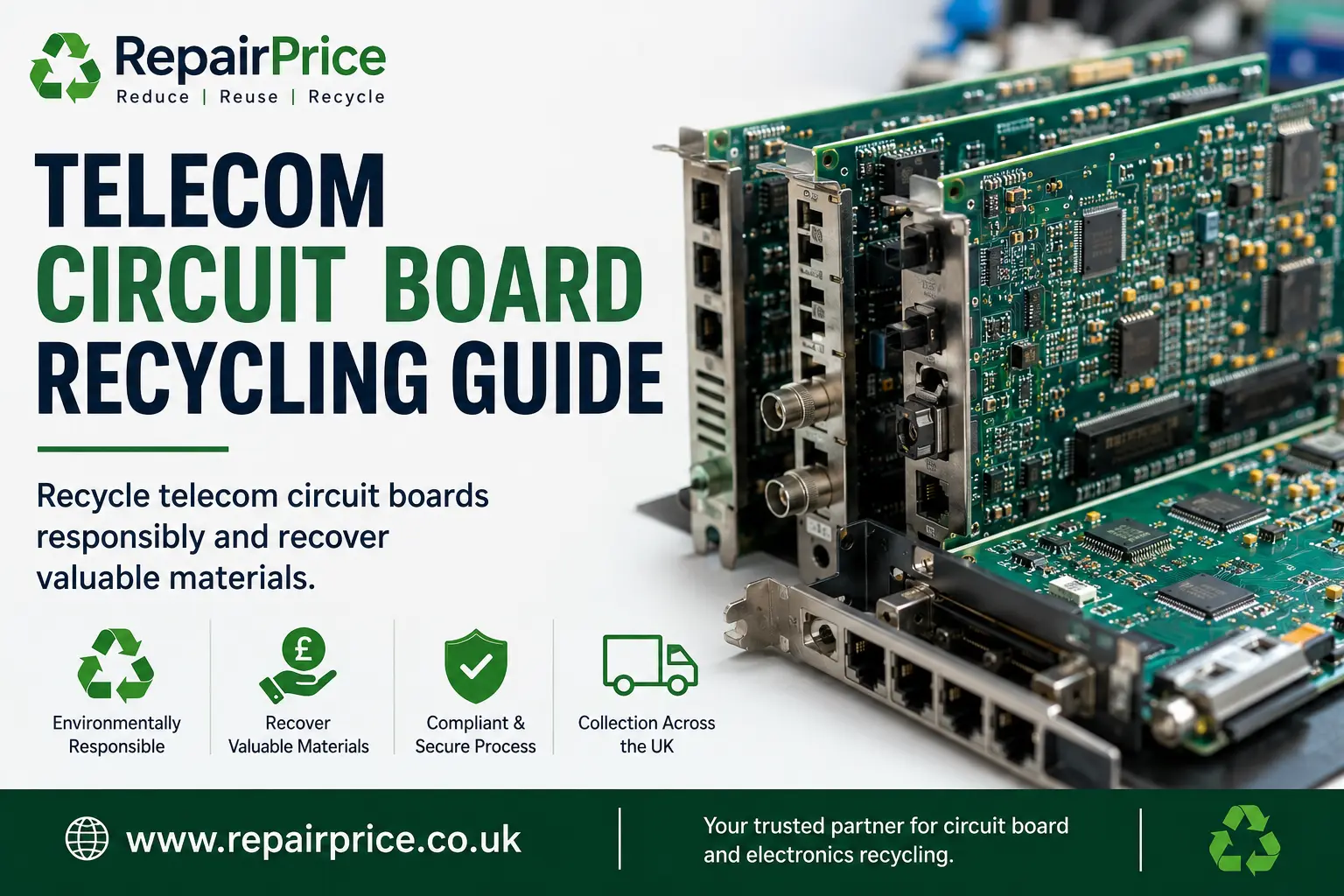
Telecom Circuit Board Recycling Guide for UK Businesses
Telecommunications equipment contains sophisticated circuit boards designed to manage signals, data transmission, network traffic and power distribution. When telephone systems, network cabinets, base-station equipment, routers, switches and communications servers reach the end of their working life, their internal boards should not be placed in general waste. Responsible telecom circuit board recycling can help recover reusable materials, reduce electronic waste and provide businesses with a clearer route for disposing of obsolete equipment.
RepairPrice helps UK businesses, telecommunications contractors, IT departments, recycling coordinators and equipment owners find suitable recycling options for unwanted telecom boards and associated electronic hardware. Whether you have a small quantity of telephone-system cards or a larger commercial collection containing mixed network equipment, you can submit the details of your material and request an appropriate recycling quotation.
Book Your Telecom Board Recycling Collection on WhatsApp
What Are Telecom Circuit Boards?
Telecom circuit boards are printed circuit boards used inside equipment that sends, receives, routes or manages voice and data communications. They can be found in traditional telephone exchanges, private branch exchange systems, network switches, communication servers, broadband equipment, radio systems, fibre-optic infrastructure and mobile communications hardware.
These boards may contain processors, memory modules, connectors, integrated circuits, relays, gold-plated contacts and other electronic components. Their construction varies according to the equipment manufacturer, age and intended function. Some boards are densely populated and may offer greater recycling value, while others contain fewer components or larger quantities of lower-value material.
Businesses replacing communications infrastructure can often accumulate telecom cards, rack-mounted equipment and associated boards over several upgrade cycles. Our dedicated telecommunications PCB recycling service provides a direct route for requesting an assessment of this specialist material.
Why Telecom Boards Should Be Recycled Responsibly
Telecom circuit boards should be handled as electronic waste rather than ordinary rubbish. Throwing communications hardware into general waste can cause potentially reusable metals, components and materials to be lost. It can also make it more difficult for organisations to demonstrate that obsolete electronic equipment has been managed through an appropriate disposal route.
Responsible recycling separates circuit boards and electronic components from unsuitable waste streams. Depending on their condition and composition, materials may be sorted, graded and transferred for specialist processing. Recoverable metals can then be separated from plastics, fibreglass and other board materials through controlled recycling processes.
Organisations with several categories of unwanted boards can begin with our main UK circuit board recycling service. This broader service is suitable when a collection contains telecom cards alongside computer boards, server hardware, mobile-device boards or other printed circuit assemblies.
Which Telecom Equipment Can Contain Recyclable Boards?
A telecom board collection may include circuit cards removed from telephone exchanges, PBX systems, network switches, routers, modems, communication servers, transmission equipment, fibre systems, radio communication devices and rack-mounted network cabinets. It may also contain power-control boards, interface cards, backplanes and expansion modules.
Equipment from data centres and communications rooms can contain large rear-wall or backplane assemblies. These components connect multiple cards within a rack or chassis and may require separate identification. You can learn more about handling these items through our server backplane and rear-wall recycling page.
Older telephone systems may contain multiple removable cards, including processor boards, line cards, trunk cards and interface modules. More recent systems may use compact boards with surface-mounted components. Keeping different board types separated can make the initial assessment easier, particularly when a business has dismantled several systems from different locations.
How Telecom Circuit Boards Are Assessed
The potential recycling value of telecom boards depends on more than their total weight. Recyclers may consider board density, component type, connector content, visible contamination, attached metalwork and whether the material has already been stripped. Clear photographs and an accurate description can therefore help when requesting a quotation.
A useful enquiry should include the approximate quantity, total weight where known, equipment source and condition of the boards. It should also explain whether the collection includes complete telecom units, loose circuit cards, server backplanes, power supplies, cables, batteries or mixed electronic waste.
Boards are commonly separated into grades based on their component density and material composition. Our printed circuit board grading guide explains why two visually similar boards may be placed into different recycling categories.
Do Not Remove Valuable Components Before Assessment
Businesses sometimes remove processors, connectors, chips or metal components before asking for a recycling quotation. This can reduce the identifiable value of the board and make grading more difficult. Unless you have been advised otherwise, it is generally better to leave telecom cards complete and provide photographs of the material in its existing condition.
Large steel brackets, complete chassis sections and obvious non-board attachments may affect the overall weight and classification of a collection. However, dismantling should only be carried out when it can be completed safely by someone familiar with electronic equipment. Power supplies, capacitors and backup batteries may require additional care.
If telecom equipment is still operational or economically repairable, reuse may be preferable to immediate material recovery. Functional units, replacement modules and specialist cards can sometimes continue serving as spare parts. Equipment that is damaged, obsolete or unsupported can then be directed into an appropriate recycling stream.
Telecom Boards Compared with Other PCB Categories
Telecommunications boards often share features with computer, server and networking boards, but they should still be described accurately. A telecom line card, server motherboard and desktop computer board may contain different component layouts and connector types. Correct identification helps the receiving recycler determine how the material should be sorted.
Collections containing server-related hardware can be supported by our server circuit board recycling guide. This resource explains how server boards, rack components and data-centre hardware can form part of a broader commercial recycling project.
Desktop and workstation boards can be directed to our computer motherboard recycling service. Smaller boards removed from handsets and communication devices may be more closely related to the material covered by our mobile phone PCB recycling service.
High-density boards containing numerous integrated circuits and plated connectors may require specialist grading. Our Class 3 circuit board recycling information provides further guidance for businesses that believe they hold higher-grade electronic boards.
Expansion Cards and Network Interface Hardware
Telecom and networking equipment can contain removable expansion cards used for connectivity, signal processing, additional ports or specialised communications functions. These cards may be found in servers, workstations, telephone systems and network appliances.
Keeping removable cards separate from general low-grade electronic waste may improve the clarity of your quotation request. Visit our network and expansion card recycling service for information about recycling interface cards, controller cards and similar plug-in components.
When submitting mixed material, identify whether cards are loose, fitted within complete equipment or packed in antistatic bags. It is also useful to mention whether the collection includes damaged boards, fire-affected equipment, liquid contamination or unusually heavy metal housings.
Business Telecom Equipment Recycling
Commercial telecom recycling projects can involve more than circuit boards. An office upgrade may produce desk phones, laptops, tablets, mobile devices, servers, cables, routers and network accessories. Sending a clear inventory allows the collection to be assessed as a complete project rather than as several unrelated waste streams.
Our business PCB recycling guide explains how organisations can prepare circuit boards from office, industrial and communications equipment. It covers practical considerations such as sorting, storing, documenting and describing commercial quantities of electronic material.
For wider electronic equipment disposal, use the RepairPrice device recycling hub. This service can help direct unwanted devices towards suitable recycling enquiries when your collection includes complete hardware as well as loose circuit boards.
Data Security Before Telecom Equipment Recycling
Some telecom and network devices can store configuration files, contact information, call records, login credentials, network addresses or other operational data. Businesses should review their internal data-security procedures before releasing complete equipment for recycling.
Resetting a device may not always provide the same assurance as verified data erasure or physical destruction of the relevant storage media. Identify hard drives, solid-state drives, memory cards and embedded storage components before collection. Organisations handling confidential information should maintain a documented process showing how data-bearing equipment was prepared.
Loose telecom circuit cards may not contain user data, but this should not be assumed without checking the equipment specification. Network controllers, server modules and management cards may retain system information. Where necessary, consult the manufacturer, an IT professional or a qualified data-destruction provider before disposal.
Repair, Reuse or Recycle Telecom Equipment?
Recycling is not automatically the first option for every communications device. Equipment that remains reliable, supported and suitable for continued use may be repairable or reusable. Extending its working life can reduce the demand for replacement hardware and delay its entry into the waste stream.
RepairPrice also helps users obtain quotations for everyday electronic repairs. Businesses with damaged company handsets can explore mobile phone repair quotations. Faulty notebooks used by field engineers or office staff can be submitted through our laptop repair comparison service.
Tablets used for stock management, customer registration or remote working may also be repairable. Our tablet repair quote service can help users compare repair options before deciding whether recycling is necessary.
When repair is uneconomical, the device can be redirected towards recycling. Unwanted handsets can be submitted through our phone recycling enquiry page, while obsolete portable computers can be assessed through our laptop recycling service.
Preparing Telecom Boards for Collection
Begin by separating circuit boards from ordinary office rubbish, packaging and unrelated waste. Keep the material dry and store it in sturdy containers that can support its weight. Avoid placing heavy boards in weak cardboard boxes, as sharp edges and metal brackets can damage the packaging.
Where possible, group similar cards together and label each container. For example, you might separate telephone-system cards, network boards, server backplanes, expansion cards and mixed low-grade boards. Do not mix loose batteries with circuit boards. Batteries should be identified and handled through a suitable recycling route.
Take several clear photographs in good lighting. Include close-up images showing the components and connectors, as well as wider photographs showing the complete quantity. If boards are stored on pallets, provide the approximate pallet dimensions and weight. These details can help determine whether a collection or alternative delivery arrangement is appropriate.
Telecom PCB Recycling in West Yorkshire
RepairPrice supports enquiries from businesses and equipment owners across the UK, including organisations in Bradford, Leeds, Halifax and surrounding West Yorkshire areas. Local businesses replacing office telephone systems, network cabinets or communications equipment can submit an enquiry describing the boards and devices they need to recycle.
Businesses with damaged handsets can also compare options through our Bradford phone repair service. Companies managing faulty business notebooks can visit our Leeds laptop repair quotation page, while tablet users can request assistance through our Halifax tablet repair service.
These repair routes help businesses check whether equipment can remain in use before it is dismantled. Devices that cannot be repaired can then be separated into complete-device recycling, data-bearing equipment and circuit board categories.
Request a Telecom PCB Recycling Quote
Information to Include in Your Recycling Enquiry
Provide the equipment type, estimated quantity, approximate weight and collection location. State whether the boards have been removed from their original equipment and whether any batteries, storage drives, power supplies or complete telecom units are included.
You should also mention access requirements. For example, explain whether the material is stored at ground level, on pallets, inside a communications room or at a site with restricted vehicle access. Larger commercial collections may require more planning than a small boxed quantity of loose cards.
Accurate details help reduce delays and make it easier to assess the material. Avoid describing every electronic board as a high-grade telecom PCB unless its source and composition are known. Photographs and equipment references provide a more reliable basis for classification.
Frequently Asked Questions About Telecom Circuit Board Recycling
Can old telephone exchange cards be recycled?
Yes. Circuit cards removed from telephone exchanges, PBX systems and similar communications equipment may be suitable for specialist recycling. Their classification and potential value will depend on their construction, condition, quantity and component density.
Do telecom boards have recycling value?
Some telecom boards contain recoverable metals and higher-density electronic components. However, value varies considerably. An assessment may consider the board grade, total weight, attached material, contamination and current processing requirements.
Can complete telecom equipment be collected?
Complete equipment may be considered, but it should be described separately from loose circuit boards. Provide details of racks, cabinets, telephone units, switches, routers, servers, cables, power supplies and batteries so the full collection can be reviewed.
Should I remove chips or connectors first?
Removing components can reduce the value or change the grade of a board. Leave boards complete unless you have received specific preparation instructions from the recycler handling the material.
Can mixed circuit boards be submitted together?
Yes, but separate categories where practical. Telecom cards, computer motherboards, server boards, expansion cards and low-grade power boards may be assessed differently. Labelled containers and clear photographs make sorting and quotation preparation easier.
Is telecom circuit board recycling available outside West Yorkshire?
RepairPrice accepts recycling enquiries from locations across the UK. Collection availability, minimum quantities and transport arrangements can depend on the material type, volume and collection postcode.
Request a Telecom Circuit Board Recycling Quote
Obsolete telecom boards should be treated as a recoverable business resource rather than placed in general waste. Sorting the boards, protecting any data-bearing equipment and providing accurate collection information can make the recycling process more efficient.
Use RepairPrice to describe your telephone-system cards, network boards, server backplanes, communication modules or mixed commercial PCBs. Your enquiry can then be reviewed to determine a suitable route for repair, reuse, complete-device recycling or specialist circuit board recovery.
For the best starting point, photograph the boards, estimate the quantity and note the collection postcode. Submit these details through the enquiry form or contact RepairPrice on WhatsApp to discuss your telecom circuit board recycling requirements.