

TV Power Supply Repair: Symptoms, Causes, Costs and Professional Repair Options
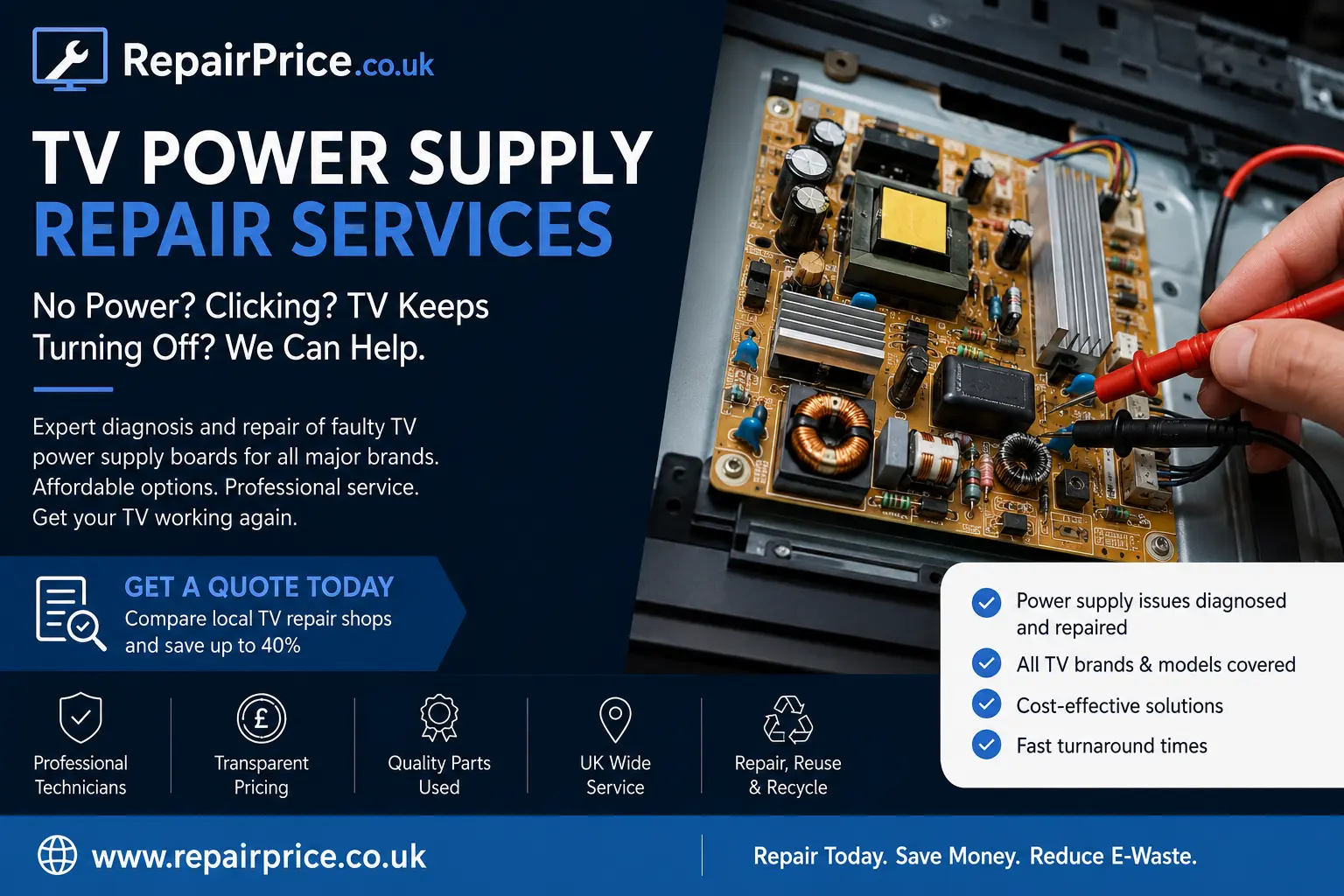
A television that will not switch on, repeatedly turns itself off or produces a clicking sound may have a faulty power supply board. The power supply is one of the most important parts inside a modern television because it converts mains electricity into the regulated voltages required by the main board, backlights, speakers and display panel. When this board develops a fault, the television may appear completely dead even though other internal components remain serviceable.
Before replacing your television, it is worth arranging a professional diagnosis. Many power supply faults can be repaired by replacing damaged capacitors, rectifiers, transformers, fuses, regulators or other board-level components. Repairing the original board can be more affordable and environmentally responsible than purchasing a replacement television.
RepairPrice.co.uk helps customers compare options from suitable television repair businesses. Visit our UK television repair service to submit the details of your faulty television and request an assessment from participating repair shops.
Discuss TV Power Supply Repair or Recycling on WhatsApp
What Does a TV Power Supply Board Do?
The power supply board receives alternating current from the wall socket and converts it into several direct-current outputs. Different parts of the television need different voltages, so the board must deliver stable and carefully controlled power throughout the set.
Standby voltage allows the television to respond when you press the remote-control power button. Additional voltage rails are activated when the television starts. These outputs may supply the main processing board, LED backlight driver, audio circuitry, tuner and other components.
If one voltage is missing, unstable or outside the correct range, the television may fail to start or may behave unpredictably. A qualified technician can test the voltage outputs and determine whether the fault originates from the power board or another connected component.
Common Signs of a Faulty TV Power Supply
Power supply problems do not always make a television completely lifeless. The exact symptoms depend on which part of the board has failed and whether the television’s protection circuits are preventing startup.
The Television Has No Power
A television that shows no standby light and does not react to the remote control may have a blown internal fuse, damaged power input circuit, failed standby supply or serious short circuit. The plug, wall socket and power lead should be checked first, but the television should not be opened by an untrained person because hazardous voltages may remain inside.
The Standby Light Is On but the TV Will Not Start
A working standby light indicates that at least part of the power supply is operating. However, the board may fail when it receives the instruction to activate its main voltage outputs. This can be caused by deteriorated capacitors, a damaged switching component or a fault elsewhere in the television pulling the voltage down.
Repeated Clicking or Startup Attempts
Some faulty televisions repeatedly click, flash the standby light or attempt to start before shutting down. This behaviour can happen when the power supply enters protection mode. It may detect excessive current, unstable voltage, a shorted backlight circuit or a problem on the main board.
The TV Switches Off Without Warning
Intermittent shutdown can be caused by overheating, weak capacitors, cracked solder joints or voltage regulation problems. A television may work when cold and then fail after its internal temperature rises. These faults can become more frequent over time and should be inspected before further damage occurs.
Sound Is Present but the Screen Is Dark
A dark picture with normal sound can sometimes be linked to the power supply, particularly when the LED driver is integrated into the same board. However, failed LED strips are also common. Our guide to diagnosing and repairing faulty TV backlights explains how backlight symptoms differ from display-panel and main-board problems.
Lines, Flickering or Brightness Changes
Unstable power can affect picture brightness and cause flickering, although these symptoms may also relate to the backlight system, timing-control board, display connections or panel. Accurate testing is essential because replacing the wrong board can add unnecessary expense without resolving the fault.
What Causes TV Power Supply Boards to Fail?
Electronic components gradually deteriorate as they are exposed to heat and electrical stress. Televisions with limited ventilation, long daily operating hours or poorly designed cooling may experience accelerated wear.
Electrolytic capacitors are a frequent source of trouble because they can dry out, bulge or lose their ability to filter voltage effectively. Switching transistors, diodes, resistors, integrated circuits and transformers may also fail. In some cases, a cracked solder connection creates an intermittent fault that changes as the board heats and cools.
Electrical surges, lightning, unstable mains power and faulty extension leads can damage the input section of a television. A surge protector may reduce some risks, but it cannot guarantee protection against every electrical event.
Another internal component can also overload the power supply. For example, shorted LED strips may cause the backlight driver to shut down. A defective main board can prevent the power-on command from being sent correctly. This is why professional diagnosis should examine the complete television rather than assuming that every no-power symptom requires a replacement power board.
Power Supply Fault or Main Board Fault?
The power supply and main board work together during startup. The power board provides standby voltage, while the main board receives the remote-control command and signals the power board to activate the television’s remaining outputs.
If standby voltage is present but the main activation signal is missing, the main board may be responsible. If the signal is present but the expected outputs do not appear, the power supply is more likely to be defective. A technician may also disconnect specific loads to determine whether another board is forcing the supply into protection mode.
For further information about processing, HDMI, sound and startup faults, read our detailed guide to TV main board repair and replacement. You can also compare a wider range of symptoms in our article covering common television faults and their possible causes.
Can a TV Power Supply Board Be Repaired?
Many television power boards can be repaired at component level. Instead of replacing the entire board, an experienced electronics technician may identify and replace the individual failed components. This approach can be particularly valuable when a replacement board is expensive, unavailable or no longer manufactured.
A board-level repair may involve replacing capacitors, semiconductor devices, fuses, resistors, regulators, optocouplers or damaged connectors. Burnt areas and cracked solder joints can sometimes be restored, although severe carbonisation or damage to multiple board layers may make repair impractical.
In other cases, fitting a tested replacement board is the more efficient option. The replacement must match the television’s model, version and panel configuration. Two televisions with similar model numbers may use different boards, so ordering solely from the brand name or screen size can result in an incompatible part.
Is It Safe to Repair a TV Power Supply Yourself?
Television power supplies are connected directly to mains electricity and contain high-voltage capacitors. These components may retain a dangerous electrical charge even after the television has been unplugged. Incorrect testing can cause electric shock, damage the television or create a fire risk.
Replacing a visibly damaged fuse without identifying why it failed can also be unsafe. A fuse often blows because another component has short-circuited. Installing another fuse may cause additional damage or expose the user to further risk.
Unless you have suitable electronic repair training, isolation equipment and safe testing procedures, the television should be inspected by a professional. External checks such as testing another wall socket, replacing remote-control batteries and examining the detachable power cable can be performed without opening the set.
How Much Does TV Power Supply Repair Cost?
The cost depends on the television brand, screen size, age, board availability, fault severity and whether the board can be repaired at component level. Labour charges can also vary because some televisions are more difficult to dismantle and reassemble safely.
A straightforward capacitor or fuse-related repair may cost less than fitting a complete replacement board. However, a power supply containing extensive burn damage or several failed components may require more diagnostic and repair time. Large premium televisions can also use expensive or difficult-to-source boards.
A repair shop should ideally confirm the model number, symptoms and any previous repair attempts before providing an estimate. A proper diagnosis is important because a television that appears to have a power fault may instead have failed LED backlights, a defective main board or a shorted display-related component.
Use the enquiry link below to provide your television details and seek a quote from participating repair specialists.
Request a Quote for TV Power Supply Repair
TV Power Supply Repairs by Brand
Power board designs differ considerably between manufacturers and television ranges. Repairers may need model-specific circuit knowledge, compatible replacement parts and the correct firmware or configuration information.
Owners of Bravia televisions can explore specialist Sony TV power and startup repair options. Common symptoms can include repeated standby flashes, clicking, failure to start and intermittent shutdown.
For QLED, LED and other Samsung models, visit our Samsung television repair service page. Depending on the model, power conversion and backlight-driving functions may be located on the same board.
Customers with OLED, NanoCell or LED televisions can view LG TV diagnosis and repair support. OLED sets can have different power requirements from conventional LED televisions, making accurate board identification particularly important.
Local TV Repair Options in West Yorkshire
Transporting a large television can be difficult, especially when the screen is thin or the original packaging is no longer available. Customers should ask whether a repair business offers workshop drop-off, local collection or an inspection service.
Residents seeking a technician in Bradford can visit our Bradford television power supply repair page. Providing the full model number and a clear explanation of the startup symptoms can help a repairer assess the likely fault.
Customers in Leeds can request assistance through our Leeds TV repair shop comparison page. Mention whether the standby light is present, whether the television clicks and whether sound or a faint image can be detected.
For services around Calderdale, explore television repair options in Halifax. An experienced technician can distinguish between a failed power supply, defective backlights and a main-board startup problem.
Households and businesses in Wakefield can use our Wakefield TV fault diagnosis service to seek assistance with televisions that are dead, restarting or switching off unexpectedly.
Customers closer to Kirklees can find TV power board repair support in Huddersfield. Ask the chosen repairer how the television should be packaged or transported to reduce the risk of screen damage.
What Information Should You Give the Repair Shop?
The complete model number is normally printed on a label on the rear of the television. Include this number rather than providing only the manufacturer and screen size. Where possible, also explain when the fault started and whether it followed a power cut, electrical storm or surge.
Describe exactly what happens when the power button is pressed. Useful details include the colour and behaviour of the standby light, the number of clicks, whether the screen flashes, whether sound is produced and how long the television remains on.
You should also disclose previous repair attempts, liquid exposure, impact damage or the use of an unverified replacement board. Accurate information can reduce diagnostic time and help the technician prepare appropriate parts.
Should You Repair or Replace the Television?
Repair is often worthwhile when the display panel is undamaged, the television otherwise meets your needs and the repair cost is reasonable compared with a suitable replacement. A power supply fault does not automatically mean that the entire television has reached the end of its life.
Replacement may make more sense when the screen panel is cracked, several major boards have failed or suitable parts cannot be sourced. The television’s age, energy efficiency, original value and expected remaining lifespan should also be considered.
A professional assessment provides stronger evidence for this decision than purchasing parts based on symptoms alone. Repairing the correct board can extend the television’s usable life, while an inaccurate diagnosis may waste money and leave the original problem unresolved.
Related Electronic Repair Services
RepairPrice.co.uk also helps customers locate support for other electronic devices. A games system that will not power on, overheats or shuts down may require assistance from a console repair specialist.
Computers with charging, display, motherboard or power problems can be submitted through our laptop repair comparison service. Diagnosing the underlying fault before replacing the device may preserve important files and reduce unnecessary electronic waste.
For damaged screens, batteries, charging ports and liquid-related faults, customers can also explore our mobile phone repair service.
Responsible TV and Circuit Board Recycling
When a television cannot be repaired economically, it should not be placed in general household waste. Televisions contain circuit boards, wiring, metals, plastics and electronic components that should be processed through an appropriate recycling route.
Our electrical device recycling service helps users explore more responsible options for unwanted electronics. Reuse and repair should usually be considered first, but recycling can recover useful materials when a device has reached the end of its practical life.
We also provide information about responsible games console recycling for households, repair businesses and organisations clearing multiple types of unwanted equipment.
Removed television boards can contain recoverable metals and reusable electronic components. Visit our dedicated page for recycling unwanted television circuit boards when dealing with faulty power supplies, main boards, timing-control boards and related TV electronics.
Repair centres and commercial organisations may also accumulate mixed high-grade electronic assemblies. Our information about Class 3 circuit board recycling explains another route for suitable categories of populated circuit boards.
Repair First and Recycle Responsibly When Necessary
A television with no power, repeated clicking or intermittent shutdown may still be repairable. Testing the standby circuit, voltage outputs, activation signals and connected loads can reveal whether the power board itself has failed or whether another component is triggering protection mode.
Professional diagnosis can prevent unnecessary board replacement and help you compare the cost of repair with the price of a new television. Where a practical repair is available, restoring the existing set can save money, reduce manufacturing demand and keep a large electronic product in use for longer.
When repair is no longer sensible, choose a responsible recycling route for the television and its circuit boards. This helps prevent recoverable materials from being lost and supports safer handling of electronic waste.
Submit your television’s manufacturer, model number and symptoms through RepairPrice.co.uk to begin comparing suitable repair options.